
By SEOENV Team | Published October 23, 2026
A citation in SEO is any online mention of your business's name, address and phone number (often shortened to NAP), such as a listing on Yelp, a chamber of commerce site or an industry directory. Citations matter mainly for local search, because consistent business details across the web help search engines trust that your information is accurate. A citation may include a link to your site, but it doesn't have to; a backlink is always a link.
This guide explains how citations differ from backlinks, when citation building is worth it and how to keep your citations consistent.
Key takeaways
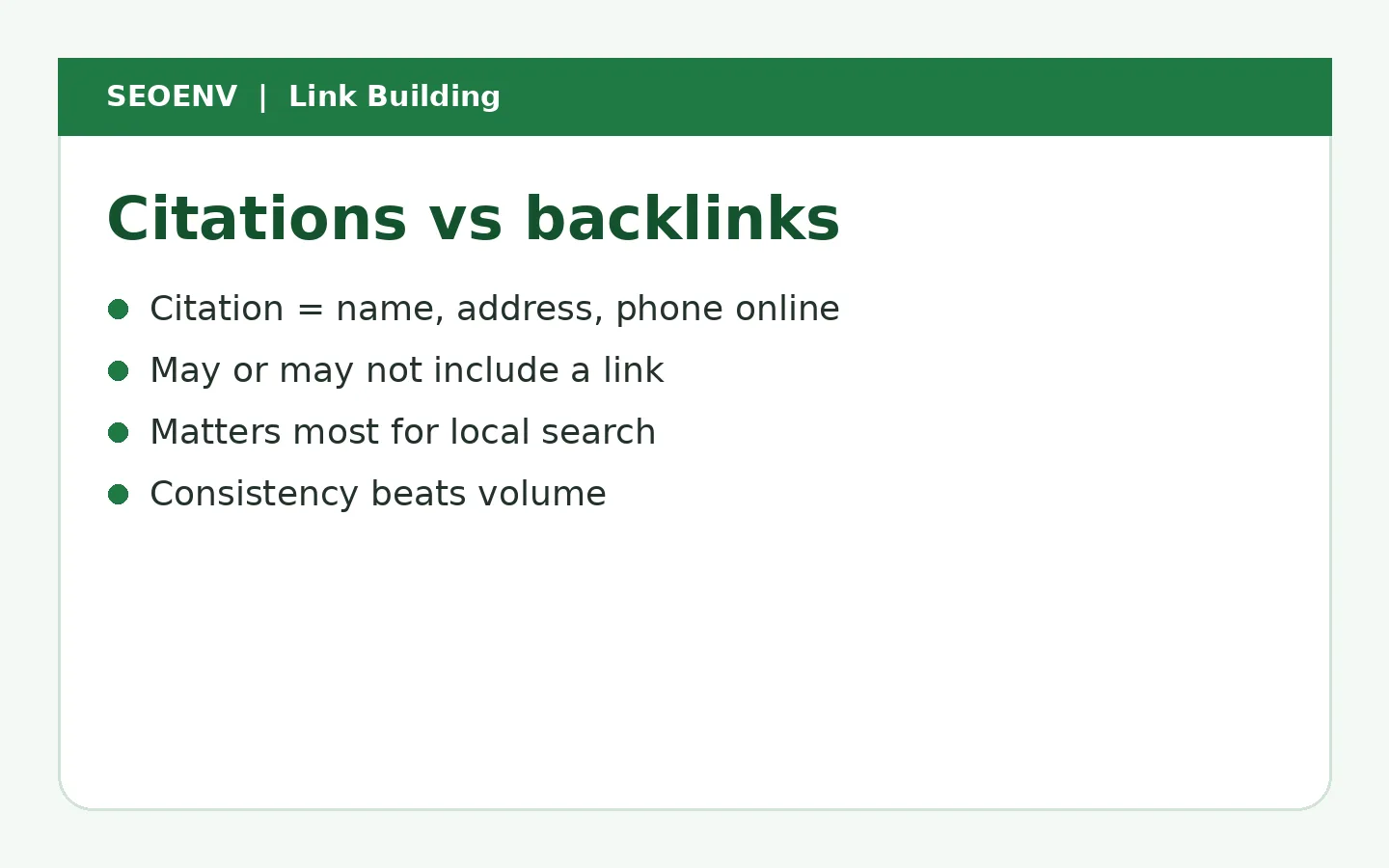
- A citation is an online mention of your business name, address and phone (NAP).
- Citations may or may not include a link.
- They matter most for local search and business data consistency.
- Accuracy and consistency beat sheer numbers.
- Backlinks are links; citations are mentions of your details.
Citations vs backlinks
| Citation | Backlink | |
|---|---|---|
| What it is | Mention of your business details | A link to your site |
| Must include a link? | No | Yes |
| Main role | Local search, business data accuracy | Discovery, authority, traffic |
| Typical sources | Directories, maps, review sites, local press | Any site |
| Key quality signal | Accurate, consistent NAP | Relevance, editorial choice |
What are citations in SEO?
There are two broad kinds:
- Structured citations: business listings on directories and platforms, with fields for name, address, phone, hours and website. Examples: Yelp, Bing Places, Apple Business Connect, industry directories.
- Unstructured citations: mentions of your business in articles, blog posts or news, such as "The Corner Café on High Street, 01234 567890".
Both help confirm your business exists where you say it does.
Why citations matter for local SEO
Google's guidance on improving local ranking says local results are based mainly on relevance, distance and prominence, and that prominence draws on information Google has about a business from across the web, including links, articles and directories. Consistent citations support that picture.
Inconsistent details cause problems. If one directory has your old address and another has a different phone number, search engines and customers can't be sure which is right.
Do citations help non-local businesses?
Less so. An online-only SaaS company doesn't need dozens of map listings. A handful of relevant industry directories, review platforms (G2, Capterra) and business profiles is usually enough, and their value is mostly in referral traffic and credibility.
Citation building for local SEO: step by step
1. Decide your canonical NAP
Write down exactly how your business name, address, phone and website should appear. Use the same format everywhere, including abbreviations like "St" or "Street".
2. Claim the core platforms
Start with Google Business Profile, Bing Places, Apple Business Connect and Facebook. Then the major directories in your country.
3. Add industry and local directories
Trade associations, local chambers, city guides and niche directories relevant to your field. See our guide to directory backlinks for how to judge them.
4. Add structured data to your site
Mark up your business details with LocalBusiness structured data so your own site confirms the same information.
5. Fix inconsistencies
Search for your business name, old addresses and old phone numbers. Update or request changes on listings that are wrong.
6. Keep records
Note every listing, its URL, the login used and when you last checked it. You'll need this when details change.
That last step is usually skipped. Businesses create 30 listings over the years, with different logins, and when they move premises nobody can remember where they're listed.
Keep a record of every listing you create
Log directories, profiles and citations with the account used and their status.
Worked example: a citation clean-up (example data)
The business and numbers are invented example data.
A dental clinic moved premises two years ago. An audit finds:
| Finding | Count | Action |
|---|---|---|
| Listings with current NAP | 14 | Keep |
| Listings with old address | 9 | Update via login or support request |
| Duplicate listings | 3 | Merge or remove |
| Listings with wrong phone format | 4 | Standardise |
| Missing core platforms | 2 | Create |
After the clean-up, 29 listings show identical details. The clinic now tracks each one so the next change takes an afternoon, not a month.
SEO citation checker and local SEO citation tools
Several tools scan for your business details across directories and flag inconsistencies, such as BrightLocal, Whitespark and Moz Local. They're useful for finding listings you forgot about and for bulk updates. For a small business, a manual search plus a spreadsheet can be enough.
Do citations count as backlinks?
Only if they include a link. Many directory links are nofollow, so they pass little ranking value, but they can still send visitors and support your local presence. Don't build citations for link value; build them for accuracy and discoverability.
Common citation mistakes
- Using slightly different business names on different platforms.
- Leaving old addresses live after a move.
- Creating listings on low-quality, spammy directories in bulk.
- Paying for "500 citations" packages with no list of where they were placed.
- Losing track of logins, so you can't update listings later.
How many citations do you need?
There's no magic number. Cover the core platforms, the main directories in your country and the respected directories in your industry. Beyond that, extra citations have diminishing returns. Quality and consistency matter far more than volume.
Citations and reviews
Many citation sources are also review platforms. Reviews influence both customers and local prominence, so encourage genuine reviews on the platforms your customers use and respond to them. Never buy or incentivise fake reviews.
Citations for service-area businesses
Plumbers, electricians and other businesses that travel to customers often hide their address on Google Business Profile. You can still build citations; use the same name, phone and website everywhere, and follow each platform's rules on whether to show the address. Consistency in what you do show is what matters.
How SEOENV handles this
SEOENV's Listing Backlinks module is built for directories, profiles and citations. For each listing you record the platform, the account used, whether it's free or featured and the link, and the app checks its status. When your details change, you have a complete list of where you're listed and which login to use.
Manage citations and listings in one place
Record each listing, the account used and check it's still live.
Citations are the paperwork of local SEO. Get them right once, keep them consistent and keep a record, and they'll quietly support your local visibility.
Related reading
- Local Link Building: How Local Businesses Earn Local Backlinks
- Directory Backlinks: Are They Still Worth It?
- Backlink Examples: 12 Real Types of Links and What Each Is Worth
- What Are Backlinks? How They Work and Why They Matter for SEO
- Off-Page SEO Checklist: 20 Tasks to Run Every Quarter
Sources
- Google Business Profile Help: Tips to improve your local ranking
- Google Search Central: Local business structured data
How we wrote this
The SEOENV Team wrote this guide from our day-to-day work tracking link exchanges, guest posts and paid placements, and checked the guidance against the sources listed above. Any numbers in worked examples are illustrative example data, not results from a real site or study. We review our guides when Google updates its documentation.
Frequently asked questions
What is a citation in SEO?
An online mention of your business name, address and phone number, usually on directories, maps and review sites.
Are citations the same as backlinks?
No. Citations are mentions of your business details and may not include a link. Backlinks are always links.
Do citations still matter for local SEO?
Yes. Consistent business information across the web supports your local prominence and helps customers find accurate details.
How do I check my citations?
Search for your business name, old addresses and phone numbers, or use a citation tool such as BrightLocal, Whitespark or Moz Local.
Should I buy a citation package?
Be careful. Bulk packages often use low-quality directories. A focused list of core and industry platforms is usually better.

Leave A Comment