
By SEOENV Team | Published October 23, 2026
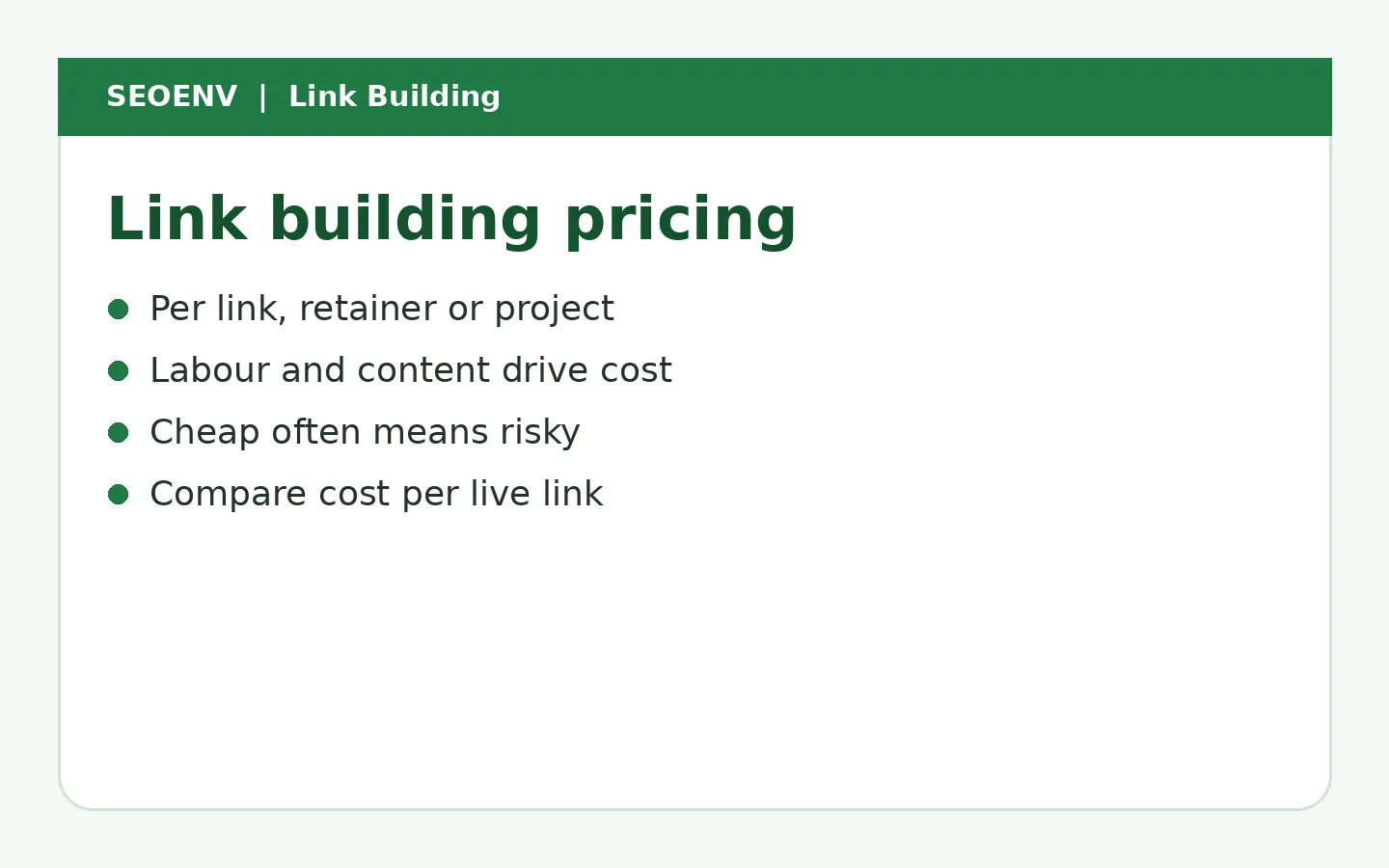
Link building packages are usually priced per link, as a monthly retainer or as a fixed project. Price reflects the labour of prospecting and outreach, the content written and the quality of the sites. Very cheap packages usually mean low-quality, irrelevant or network sites. The fair way to compare is cost per live, relevant link after a few months, not the headline price.
Key takeaways
- Packages are priced per link, per month or per project.
- Cost reflects labour, content and site quality.
- Very cheap links usually mean low-quality or risky sources.
- Compare cost per live, relevant link, not list price.
- Track links so you know what you actually got.
Pricing models
| Model | How it works | Best for |
|---|---|---|
| Per link | Fixed price per link | Clear volume needs |
| Retainer | Monthly fee for activities | Ongoing campaigns |
| Project | Fixed scope and price | Campaigns, PR |
| Marketplace | Price per site listing | High risk if followed |
What drives cost
- Time to prospect and pitch.
- Writing quality content.
- Site quality and relevance.
- Niche difficulty.
- Reporting and replacement guarantees.
Pricing signals that suggest risk
- Hundreds of links for a small fee.
- Pricing by DA tier ("DA 50 = $X").
- "Permanent dofollow" promises.
Google's spam policies cover buying links that pass ranking credit; qualify outbound links explains sponsored marking.
How to compare packages
Calculate cost per live, relevant link after three months:
cost per live relevant link = total cost / links still live and relevant
The total paid only tells you half the story. You need to know how many links you actually kept, which means checking them.
Worked example: comparing packages (example data)
| Package A | Package B | |
|---|---|---|
| Price | $1,000 | $3,000 |
| Links promised | 40 | 10 |
| Relevant | 8 | 9 |
| Live after 3 months | 5 | 9 |
| Cost per live relevant link | $200 | $333 |
| Risky links included | 25 | 0 |
A looks cheaper, but 25 risky links carry costs the price doesn't show (example data).
Questions to ask
- What is included per link?
- Do you pay sites?
- What happens if a link is removed?
See link building ROI.
How to calculate the real cost of a link
Headline price per link hides a lot. Work out the effective cost instead.
Step 1: total the spend
Add the package fee, any content fees, setup charges and your own time managing the provider.
Step 2: count useful links
From the links delivered, count only those that are live, relevant, in body copy and on sites you'd be happy to be associated with.
Step 3: divide
Effective cost per link = total spend ÷ useful links.
Step 4: re-check after 90 days
Subtract links that have disappeared and recalculate.
Example data: effective cost per link
These packages and figures are invented example data, not real market prices.
| Package A | Package B | |
|---|---|---|
| Monthly fee | 1,000 | 2,000 |
| Links delivered | 20 | 8 |
| Useful links (relevant, in body) | 6 | 7 |
| Live after 90 days | 4 | 7 |
| Effective cost per live, useful link | 250 | 286 |
Package A looks four times cheaper per link on paper, but once weak and lost links are removed, the two cost about the same, and Package B's links carry far less risk.
What a fair package should spell out
| Item | Why it matters |
|---|---|
| Number and type of links | So you know what's included |
| How sites are qualified | So quality doesn't slide |
| Who writes content | So you can review it |
| Whether placements are paid | So paid links can be labelled |
| Reporting format | So you can verify |
| Replacement terms | So lost links aren't your loss |
| Notice period | So you can leave if quality drops |
Budgeting for link building
Start from goals, not packages. If three pages need to move from page two to page one, compare how many relevant links the top-ranking pages have with how many yours have. That gap, spread over a realistic timeframe, gives you a sense of scale. Then decide whether to earn those links in-house, hire a provider or combine both. See how many backlinks do I need.
Pitfalls in package pricing
- Paying per link with no quality floor. Vendors chase the cheapest sites.
- Tiered packages based only on DA. Authority scores are third-party estimates, not proof of value.
- Hidden content fees. Ask whether articles are included.
- No replacement policy. Lost links are lost money.
- Annual prepayment. It removes your leverage if quality drops.
Questions to ask before you pay
- Can I see a list of sites used in the last three months?
- Are any placements paid, and are they labelled with rel="sponsored"?
- Who writes the content, and can I approve it?
- How long are links guaranteed to stay live?
- Can I pause or cancel with 30 days' notice?
Package comparison checklist
- Effective cost per useful link calculated.
- Samples inspected by hand.
- Content and placement terms clear.
- Paid placement labelling confirmed.
- Replacement terms in writing.
- Short notice period.
- Internal log ready to track live status.
Common pricing models explained in more detail
Per-link pricing is easy to understand but creates an incentive to deliver the cheapest qualifying links. If you buy this way, set a written quality floor: relevance, in-body placement, real visitors and no visible link price lists.
Monthly retainers pay for ongoing effort. They suit campaigns where links come from outreach and content, which are harder to predict. Ask for an estimated range of links and a clear list of activities each month.
Campaign pricing covers one piece of work, such as a data study plus outreach. Results depend heavily on the asset, so ask to see previous campaigns and how many links they earned.
Hourly or day-rate pricing suits consultants who advise or train your team. You pay for expertise rather than deliverables, so agree outcomes up front.
How to spot pricing that suggests risk
| Signal | Why it's a concern |
|---|---|
| Very low price per "high DA" link | Usually network or link-selling sites |
| Fixed menu of sites with prices | Links are being sold, likely without labels |
| Price tiers by DA only | Ignores relevance and placement |
| "Permanent dofollow guaranteed" | Encourages unlabelled paid links |
| Bulk discounts for hundreds of links | Volume over quality |
Google's spam policies list buying or selling links that pass ranking credit as link spam. Packages built around selling followed links put that risk on you.
How to negotiate a better package
Ask for fewer, better links rather than more links for the same price. Ask to approve sites before placement. Ask for a trial month at the standard rate before committing to a longer term. Providers who are confident in their quality usually agree to at least one of these. If none are acceptable, treat that as useful information about how they expect the work to go.
How SEOENV handles this
SEOENV's Paid Collaborations records vendor, cost and payment status, and you can check the link is live before paying. The ROI Calculator helps estimate value.
Price only means something next to what you keep. Track it.
Related reading
- Link Building Services: How to Evaluate Them Before You Pay
- How to Choose a Link Building Agency: A 12-Point Checklist
- Buying Backlinks: How to Judge the Risk Before You Pay
- How to Measure Link Building ROI
- Paid Backlinks and Google
Sources
How we wrote this
The SEOENV Team wrote this guide from our day-to-day work tracking link exchanges, guest posts and paid placements, and checked the guidance against the sources listed above. Any numbers in worked examples are illustrative example data, not results from a real site or study. We review our guides when Google updates its documentation.
Frequently asked questions
How much do link building packages cost?
It varies widely by model, niche and quality. Compare cost per live, relevant link.
Why are some packages so cheap?
They usually use low-quality, irrelevant or network sites.
Is per-link pricing better than a retainer?
Per-link is clearer for volume; retainers suit ongoing work. Either can be good.
Is it safe to buy link packages?
Buying followed links breaks Google's rules. Paid placements should be marked sponsored.
How do I measure package value?
Track which links stay live and relevant, and their effect on target pages.

Leave A Comment