
By SEOENV Team | Published October 23, 2026
Tiered link building is a technique where you build backlinks to your site (tier 1), then build more links pointing at those backlinks (tier 2), and sometimes another layer pointing at tier 2 (tier 3). The idea is to pump extra authority into your tier 1 links. In practice, tier 2 and 3 links are usually automated, low-quality and built purely to manipulate rankings, which places the whole approach squarely within Google's definition of link spam.
This guide explains how it works, why it's risky and safer ways to strengthen the links you have.
Key takeaways
- Tiered link building points low-quality links at pages that link to you.
- Tier 2 and 3 links are usually automated or spammy.
- It's designed to manipulate rankings, which Google's spam policies prohibit.
- SpamBrain and manual reviews target these patterns.
- Strengthen good links by earning more editorial coverage instead.
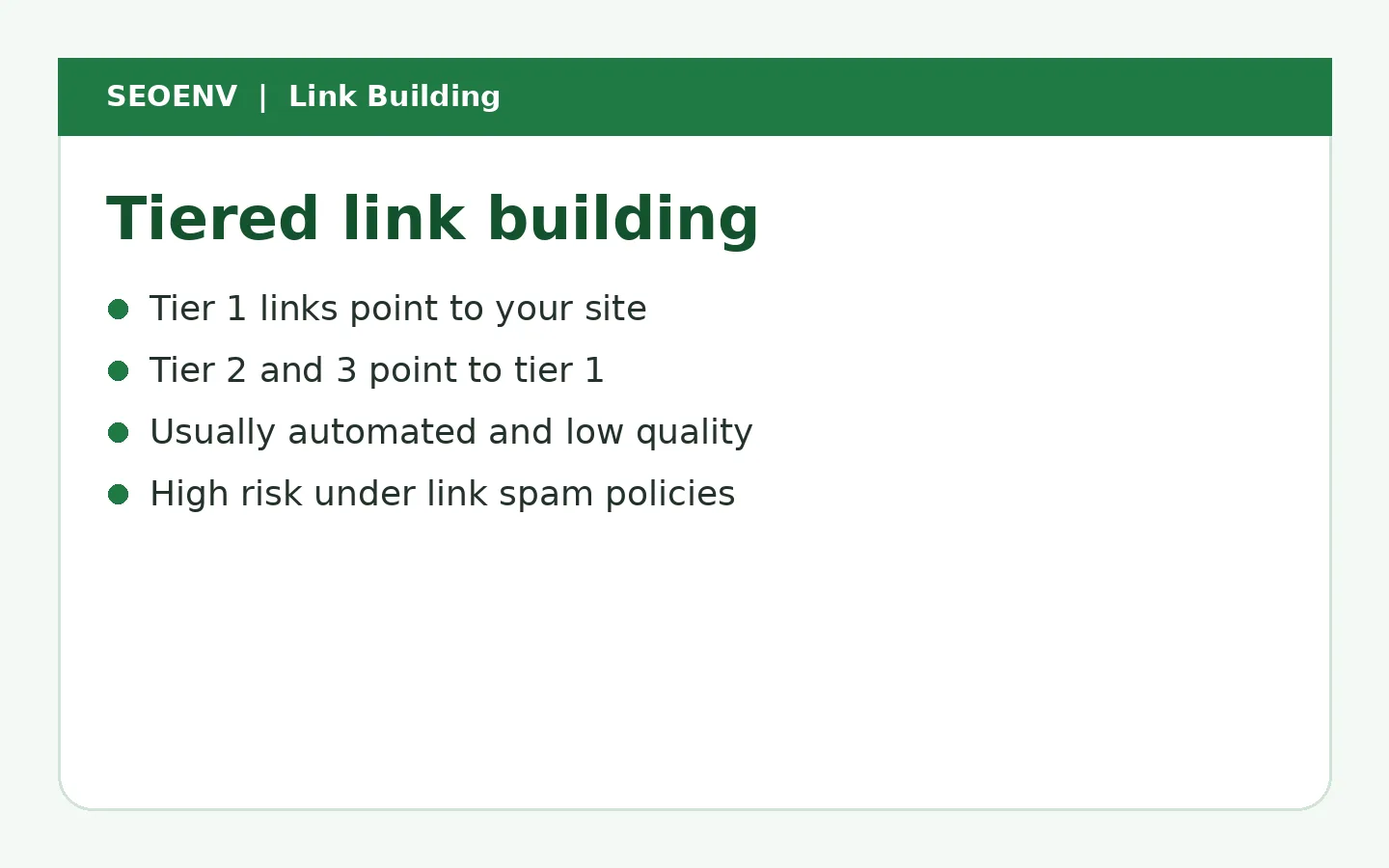
How tiered link building works
| Tier | Points to | Typical sources | Typical quality |
|---|---|---|---|
| Tier 1 | Your site | Guest posts, PBN posts, web 2.0 blogs | Medium to low |
| Tier 2 | Tier 1 pages | Web 2.0s, profiles, comments, articles | Low |
| Tier 3 | Tier 2 pages | Automated comments, forum spam, bookmarks | Very low |
The theory: more links to your tier 1 pages make them stronger, so they pass more value to you, while the spam stays one step removed.
Why it's risky
Google's spam policies define link spam as links intended to manipulate rankings, including automated programs that create links. Tier 2 and 3 links exist only to manipulate. Google's 2021 post on link spam describes using its systems to identify and nullify link spam.
Risks include:
- tier 2 and 3 links being ignored, wasting effort and money;
- the tier 1 links losing value as they look manipulated;
- manual actions if the pattern is clear;
- damage to the sites hosting your tier 1 links.
Tier 1 link building on its own
"Tier 1" just means links directly to your site. Good tier 1 links, such as editorial mentions, guest posts on real sites and partner links, don't need tiers beneath them.
Why people still sell tiered packages
Tier 2 links are cheap to produce in bulk, and short-term movement in rankings can look like success. Sellers rarely show what happens six or twelve months later.
Many sites buy a "link package" without knowing it includes tiers. The provider reports a handful of guest posts, but thousands of spammy links quietly point at those posts, and the client's link profile carries that risk.
Know exactly what your links are
Record every tier 1 link with its source, partner and cost.
Worked example: evaluating a tiered package (example data)
The package below is invented example data.
| Package line | Quantity | What it really is |
|---|---|---|
| Tier 1 guest posts | 5 | Posts on sites selling links openly |
| Tier 2 web 2.0 links | 50 | Thin blogs created for links |
| Tier 3 "power links" | 5,000 | Automated comments and profiles |
Five tier 1 posts might be acceptable on their own, if relevant. The 5,050 links beneath them add risk and little value. The safer choice is to buy nothing from this provider.
Safer ways to strengthen existing links
- Earn more coverage for pages that link to you. Share guest posts with your audience.
- Promote content you've been featured in. Real traffic to those pages is a good thing.
- Build internal links on your own site. Pass value from strong pages to weak ones.
- Earn new editorial links. See white hat link building.
Tiered links and negative SEO
Spammy links pointing at your site, whether from tiered campaigns or attacks, are mostly ignored by Google. If you've bought tiered links in the past, see toxic backlinks and how to disavow backlinks.
Questions to ask any link provider
- Do you build any links to the links you place?
- Do you use automated tools?
- Can I see every link built, at every level?
How SEOENV handles this
SEOENV tracks the tier 1 links you're responsible for: the source, partner, cost and whether each is live and followed. It doesn't build links, tiered or otherwise. Keeping clean records of your direct links makes it obvious what you've paid for and what you haven't.
Keep a clean record of your direct links
Track source, partner, cost and status for every link.
Tiered link building tries to hide spam one step away from your site. Google's systems are designed to see through that. Spend the effort on links that stand on their own.
Build links that don't need propping up
Free for up to 20 links, checks on every plan.
Related reading
- PBN Backlinks: What They Are and Why They're a Bad Bet
- Buying Backlinks: How to Judge the Risk Before You Pay
- White Hat Link Building: Techniques That Stay Within Google's Rules
- Negative SEO: What It Is, How Rare It Is and How to Respond
- Toxic Backlinks: How to Find Them and What to Actually Do
Sources
- Google Search Central: Spam policies (link spam)
- Google Search Central Blog: Link tagging and link spam
How we wrote this
The SEOENV Team wrote this guide from our day-to-day work tracking link exchanges, guest posts and paid placements, and checked the guidance against the sources listed above. Any numbers in worked examples are illustrative example data, not results from a real site or study. We review our guides when Google updates its documentation.
Frequently asked questions
What is tiered link building?
Building links to your backlinks (tier 2) and sometimes to those links (tier 3) to boost their strength.
Is tiered link building safe?
No. Tier 2 and 3 links are usually automated and intended to manipulate rankings, which Google treats as link spam.
What is a tier 1 link?
A link pointing directly to your site. Good tier 1 links don't need tiers below them.
Do tier 2 backlinks work?
They may cause short-term movement, but Google's systems aim to nullify link spam, and the risk outweighs any gain.
What should I do if I bought tiered links?
Stop the campaign, record what was built and consider disavowing clearly manipulative links if you have a manual action.

Leave A Comment