
By SEOENV Team | Published October 23, 2026
PBN backlinks are links from a private blog network: a group of websites, often built on expired domains, that exist mainly to link to a "money site" and boost its rankings. Google treats them as link schemes, and its spam policies also cover expired domain abuse. PBN links are frequently devalued when detected, so you can pay for links that do nothing, and clear patterns can lead to manual actions.
Key takeaways
- A PBN is a network of sites built to link to a money site.
- Google treats PBNs as link schemes.
- Common signs: expired domains, thin content, mixed topics.
- PBN links are often devalued, wasting money.
- Earned links last; PBN links don't.
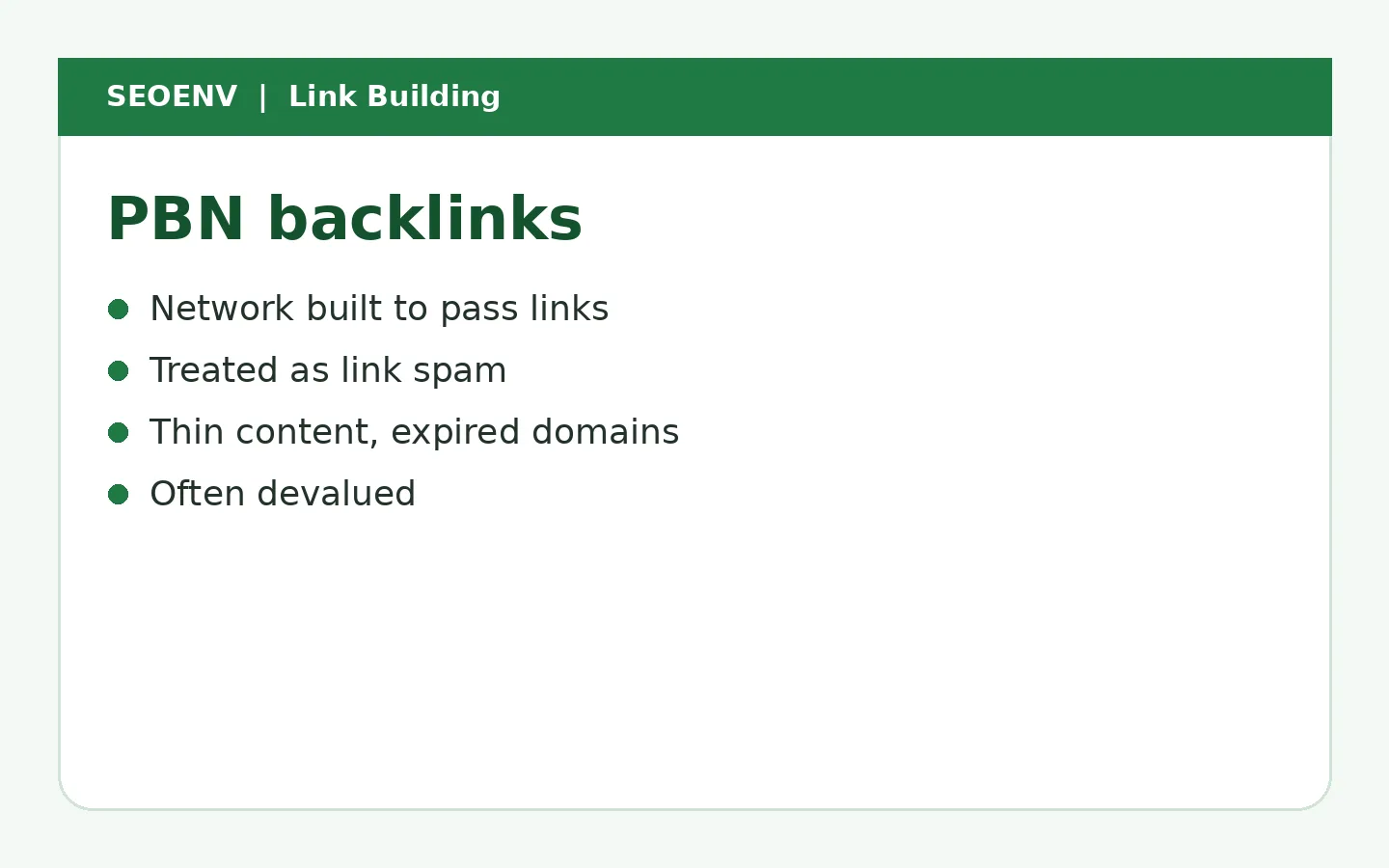
How PBNs work
| Element | Typical setup |
|---|---|
| Domains | Expired domains with old backlinks |
| Content | Thin or AI-spun posts on mixed topics |
| Hosting | Spread across hosts to hide connections |
| Links | Contextual links to money sites |
| Sale | Sold as "high DA" or "powerful" links |
Why Google treats PBNs as spam
Google's spam policies describe link schemes and expired domain abuse, where expired domains are repurposed to manipulate rankings. Google's link spam post describes nullifying link spam.
How to spot a PBN site
- Unrelated topics on one site.
- Thin posts each with an outbound commercial link.
- Old domain history unrelated to current content.
- No real audience, social presence or contact details.
- High DA/DR but little organic traffic.
Why people still use PBNs
Short-term movement and control. The costs: devaluation, manual actions and money wasted.
Many buyers don't know they bought PBN links; they bought "high DA guest posts". Knowing exactly where every link sits is the first defence.
Worked example: checking a "high DA" offer (example data)
| Check | Finding |
|---|---|
| DR | 55 |
| Organic traffic | Near zero |
| Topics | Crypto, pets, travel, loans |
| Domain history | Former dentist site |
| Verdict | Likely PBN; decline |
If you have PBN links
Stop buying, record them and consider disavowing if there's a manual action. See how to disavow.
How private blog networks are built, in more detail
Understanding how PBNs are put together makes them easier to recognise.
Expired domains
Operators buy domains whose registration lapsed, often because the original business closed. These domains may still have links from their past life, which the operator hopes will pass value. Google's spam policies specifically describe "expired domain abuse": buying an expired domain and repurposing it mainly to manipulate rankings with low-value content.
Hiding the footprint
To avoid detection, operators spread sites across hosts, use different themes and registration details and avoid linking the network sites together. The aim is to make each site look independent.
Thin content
Network sites typically publish short, generic posts on many topics. Each post exists to hold one or two outbound links to paying clients or the operator's own money sites.
Selling access
Many PBNs are sold as "high DA guest posts" or "niche edits" through marketplaces and outreach emails. Buyers often don't realise they're buying network links.
How to check a site step by step
Step 1: look at the domain's history
Use a web archive to see what the site used to be. A former dental practice that now publishes posts on crypto, pets and travel is a classic sign.
Step 2: check topical focus
Browse the last 20 posts. Real publications have a focus. Network sites cover everything.
Step 3: check outbound links
Open several posts. If almost every post has one commercial link to an unrelated business, the site exists to sell links.
Step 4: check visibility
Search the site's own name and main topics. Real sites show up for something. Network sites often have authority scores but little or no search visibility.
Step 5: look for real people
Check for named authors with other work, an about page with real details and genuine social profiles.
PBN red flag scorecard
| Signal | Points |
|---|---|
| Domain history unrelated to current content | 2 |
| Posts on many unrelated topics | 2 |
| One commercial link per post | 2 |
| High authority score but little search visibility | 2 |
| No real authors or contact details | 1 |
| Offered through a link marketplace or cold email | 1 |
A score of 6 or more out of 10 strongly suggests a network site.
Example data: reviewing an inherited link profile
These figures are invented example data for a site that took over from a previous agency.
| Group | Domains | Red flag score | Action |
|---|---|---|---|
| Industry sites | 35 | 0-2 | Keep |
| General blogs | 18 | 3-5 | Review individually |
| Suspected PBN | 22 | 6-10 | Request removal; disavow if manual action or no response |
Pitfalls
- Assuming "niche edits" are safe. Many are placed on network sites.
- Trusting metrics. Authority scores can be inflated by expired domain links.
- Keeping it quiet. If an agency built PBN links for you, find out which ones.
- Panic disavowing. Work through the list methodically.
- Building a PBN "carefully". There's no safe version.
PBN checklist
- Domain history checked.
- Topic focus reviewed.
- Outbound link pattern checked.
- Search visibility confirmed.
- Real authors and contact details present.
- Score recorded and decision documented.
- Every link you buy recorded with vendor and site.
What to do instead
Build links that would exist without payment: relevant guest contributions to real publications, data and research others cite, partnerships, and PR. See white hat link building. These take longer, but they don't disappear when a network is detected.
Why PBN links often stop working
Google's 2021 post on link tagging and link spam explains that its systems work to identify and nullify link spam. When a network is detected, the links from it may simply stop counting. Sites that relied on those links can lose rankings without any warning, because the value they were paying for has disappeared. In more blatant cases, Google can apply manual actions to sites that benefit from link schemes.
That's the core problem with PBNs: even when they appear to work, you're renting a benefit that can vanish overnight. Money spent on network links rarely leaves anything lasting behind, whereas money spent on content, research or genuine partnerships keeps producing value.
Talking to an agency about PBN links
If you suspect a current or past agency used network links, ask for a full list of links built, with site URLs. Score them with the checklist above. A reputable agency will share the list. If they refuse, or the list contains many high-scoring sites, plan a clean-up and reconsider the relationship. Keep your own record of every link going forward so you are never in the dark about where your links come from or who placed them again.
How SEOENV handles this
SEOENV tracks the links you build and buy, with vendor and cost in Paid Collaborations, so you know exactly what's in your profile. It doesn't sell or build links.
PBNs promise shortcuts that rarely last. Build links that would survive scrutiny.
Related reading
- Buying Backlinks: How to Judge the Risk Before You Pay
- Tiered Link Building: How It Works and Why It's Risky
- Toxic Backlinks: How to Find Them and What to Actually Do
- White Hat Link Building: Techniques That Stay Within Google's Rules
- How to Disavow Backlinks: When to Do It and Step-by-Step
Sources
- Google Search Central: Spam policies (link spam and expired domain abuse)
- Google Search Central Blog: Link tagging and link spam
How we wrote this
The SEOENV Team wrote this guide from our day-to-day work tracking link exchanges, guest posts and paid placements, and checked the guidance against the sources listed above. Any numbers in worked examples are illustrative example data, not results from a real site or study. We review our guides when Google updates its documentation.
Frequently asked questions
What is a PBN backlink?
A link from a private blog network, a group of sites built to pass links to a money site.
Are PBN links safe?
No. Google treats them as link schemes and often devalues them.
How do I identify a PBN?
Look for mixed topics, thin content, expired domain history and no real traffic.
Do PBNs still work?
They may cause short-term movement but carry high risk of devaluation or manual action.
What should I do with existing PBN links?
Stop buying, record them and disavow if you receive a manual action.

Leave A Comment