A guest post is an article you write for someone else’s site, published under your name or your client’s. Usually, it includes a short bio and sometimes a link back to your site. When done well, it helps the host’s readers first and earns you a relevant link as a side effect.
Guest post: definition and how to track one
Why the term guest post gets misused
One phrase, two very different practices.
In theory, guest posting means writing useful articles for sites your audience reads. However, the same phrase also covers low-effort articles written only to place a link. So editors, clients and builders can mean very different things when they use the same words.
For example, picture a client who hears the term and imagines articles on respected industry blogs. Meanwhile, the agency they nearly hired meant short articles on sites built to sell placements. Indeed, agreeing on a definition early avoids that gap.
Editorial articles
Written for the host’s readers, edited by the host.
Link-first articles
Written mostly to carry a link.
Unclear expectations
Clients and builders picture different things.
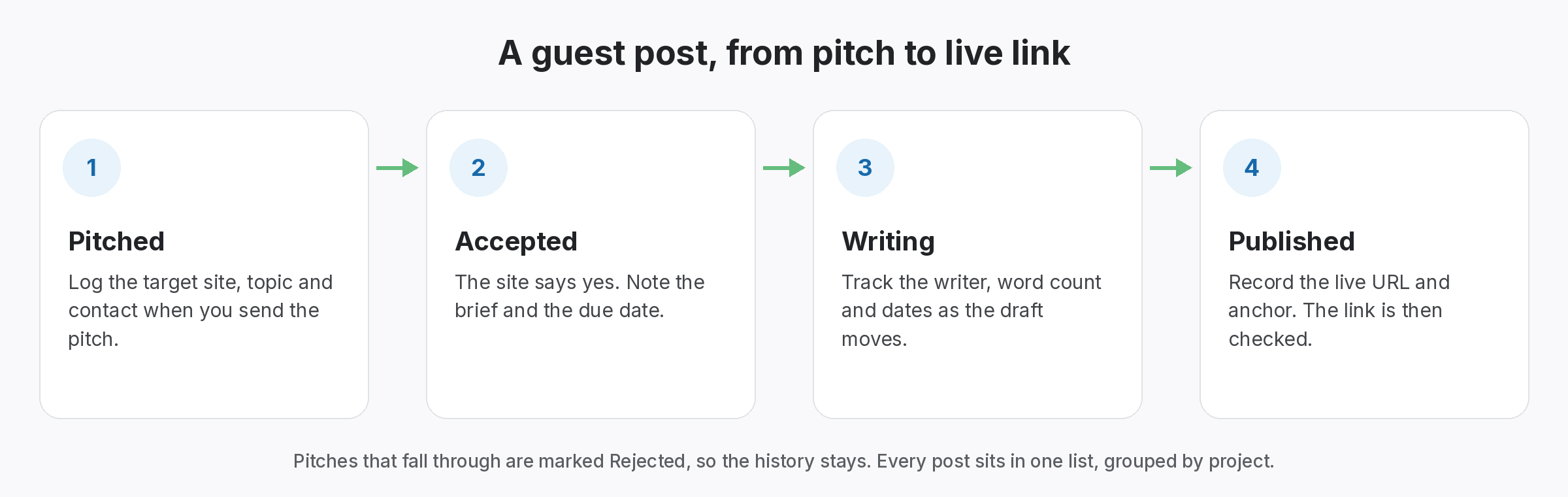
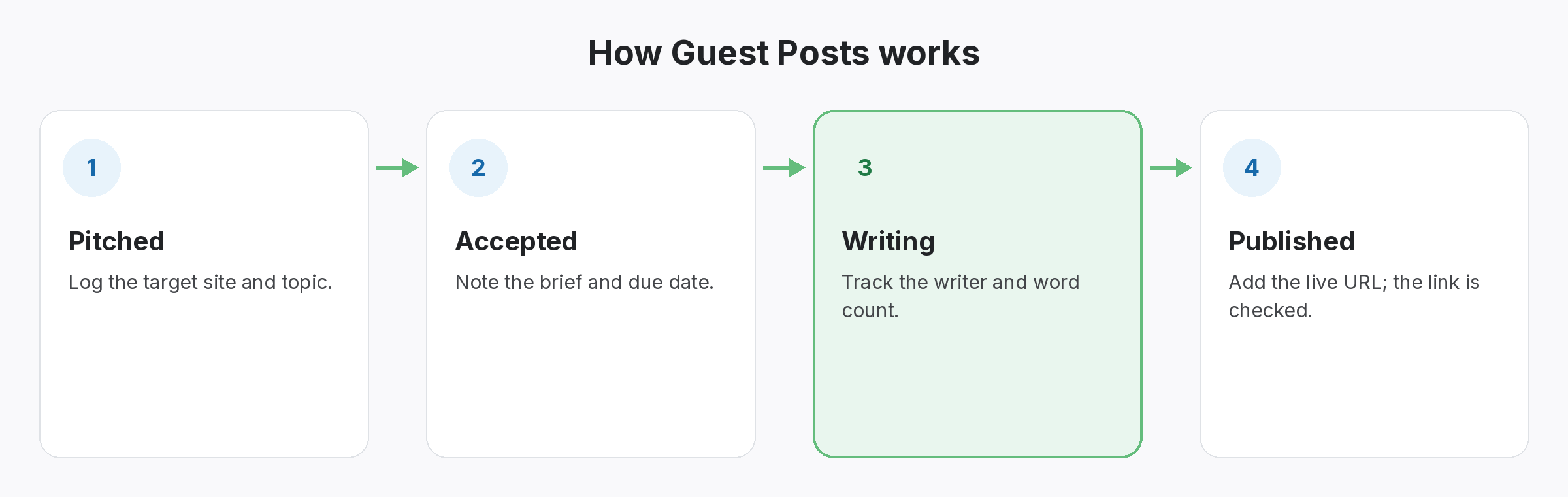
How guest articles move from pitch to live
Most articles follow the same five stages.
- Pitch: you suggest a topic that fits the host’s audience.
- Accepted: the editor agrees and may shape the angle.
- Writing: you draft the article to their guidelines.
- Published: the editor publishes, often after edits, and then sends the link.
- Checked: you confirm the link and keep checking it over time.
What Google says about links in a guest post
Context matters more than the format.
In addition, Google’s link spam policies list large-scale guest posting campaigns with keyword-rich anchor text as a problem. Still, one relevant article with a natural bio link is not the issue. Also, Google’s guide to qualifying outbound links explains when hosts may add nofollow or sponsored.
- Relevant: the topic fits the host site.
- Natural anchors: branded or descriptive, not stuffed.
- Editor decides: hosts control links on their site.
Why a guest post link needs tracking
Live today does not mean live next year.
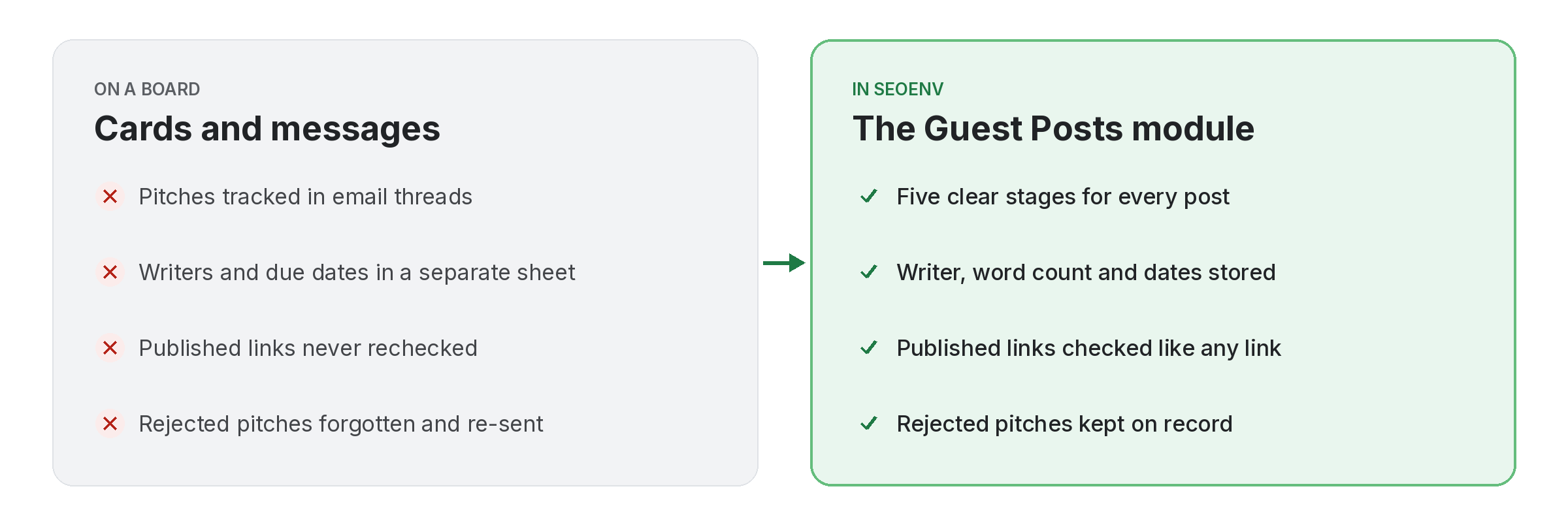
Even once the article is live, editors may update it, remove the link or add nofollow. Sites also redesign or close. So record each article with its live URL, target page and anchor, then check it regularly. Besides, our guide on how long these links stay up covers what to expect.
- Record: live URL, target and anchor.
- Check: status and rel value over time.
- Follow up: when something changes.
Write for readers, then check the link.
Both halves of the job matter.
Keep track of every article you place
Free tools and live SEOENV features.
In short, guest posting means different things to different people. We wrote this definition so clients, editors and builders can start from the same page.
When a guest post is worth writing
Ideally, write one when the host’s readers match your audience and you have something useful to say. Then the link is a bonus, not the point. Also, our guide on how to write a guest post covers the writing, and red flags to watch for covers sites to avoid.
However, skip sites that publish anything for anyone, or that ask for keyword-rich anchors. Those placements rarely last. For anchors, see anchor text in guest articles, and for the full process, see tracking them as a workflow.
Questions about the guest post
What is a guest post?
An article you write for another site, usually with a short bio and sometimes a link back.
Is guest posting bad for SEO?
Not on its own, because large-scale campaigns with keyword-rich anchors are the problem Google describes.
Should those links be nofollow?
Hosts decide, although Google says to qualify links where sponsored or nofollow apply.
How do I track my articles?
First, record each article with live URL, target and anchor, then check the link regularly.
Can SEOENV track them?
Yes, each article gets its own record, and links are checked daily on paid plans (Starter+).
What is a guest post in SEO?
An article you write for someone else’s site, usually with a byline and a link back to your own. In SEO, a guest post is a way to reach a new audience and earn a relevant link.
Who writes a guest post on a blog?
Usually a practitioner in the same field as the blog’s readers, such as a consultant, a founder or a specialist. The host editor decides whether to publish it and how it is edited.
Track every article you place.
From pitch until it is published, with the link checked after it goes live.