
By SEOENV Team | Published October 23, 2026
Keyword backlinks are backlinks whose anchor text contains the keyword you want a page to rank for, such as "SEO report template" linking to your template page. They can help Google understand what the page is about, but they work best as a minority of your links, on relevant pages, alongside branded and descriptive anchors. Built in bulk with exact-match anchors, they become a link spam pattern.
Here's how anchors and target keywords actually interact, and how to plan keyword links that help rather than hurt.
Key takeaways
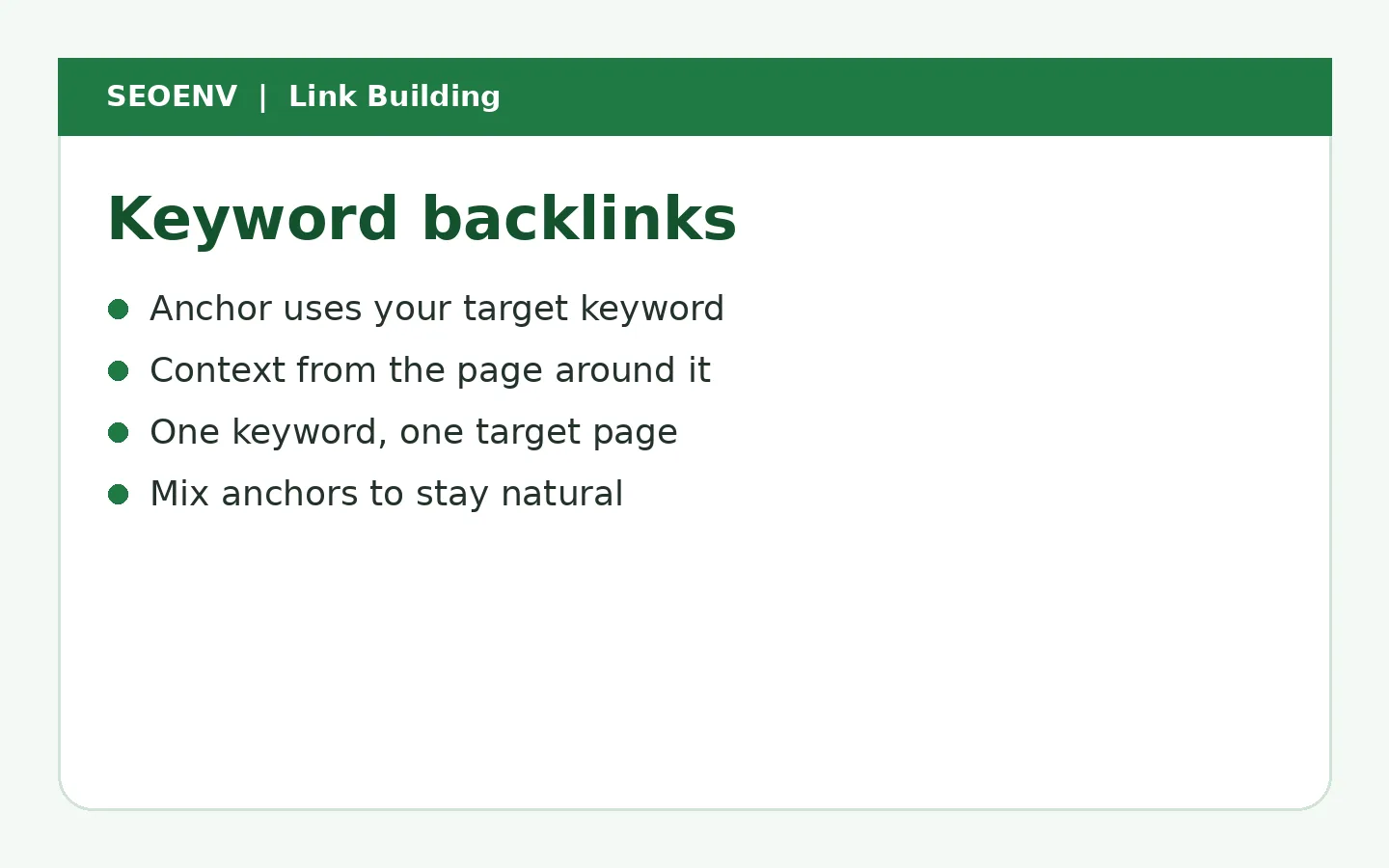
- Keyword backlinks use your target keyword or a close variant as the anchor.
- They add context, but too many look manipulative.
- Relevance of the linking page matters more than the exact anchor.
- Map each target keyword to one page and point links there.
- Mix in branded, descriptive and supporting-page links.
What counts as a keyword backlink?
| Anchor | Target keyword: "seo report template" | Keyword backlink? |
|---|---|---|
| "SEO report template" | Exact match | Yes |
| "free SEO report templates" | Close variant | Yes |
| "a template for monthly SEO reports" | Partial match | Partly |
| "SEOENV's report guide" | Branded + topic | Weakly |
| "this template" | Generic | No |
How anchors and keywords work together
Google uses several kinds of context from a link:
- The anchor text: the most direct description of the target page.
- Surrounding text: sentences around the link that explain why it's there.
- The linking page's topic: a page about SEO reporting linking to your template says more than a page about holidays.
- The target page itself: if the page doesn't cover the keyword well, anchors can't make it relevant.
Google's link best practices recommend anchors that are descriptive and relevant, and note that the words around a link give context too. In practice this means a descriptive partial-match anchor on a relevant page often gives as much context as an exact-match anchor, with less risk.
Why too many keyword backlinks are a problem
Exact-match anchors were once a strong ranking signal, so they were abused. Google's systems now look for unnatural patterns, and its spam policies call out keyword-rich anchor text in large-scale guest posting and link schemes. A profile where most links to a page use one commercial phrase is easy to spot as built.
Natural profiles are dominated by branded, URL and descriptive anchors, because that's how people link when nobody tells them what to write.
Step 1: map keywords to pages
Before you build any keyword links, decide which page targets which keyword. Each important keyword should have one clear target page. If two pages compete, links and anchors get split and neither ranks well.
| Target keyword | Target page | Supporting pages |
|---|---|---|
| seo report template | /seo-report-template/ | /how-to-create-seo-report/, /seo-kpis/ |
| backlink tracker | /features/link-tracker/ | /backlink-tracker-template/ |
| link exchange | /reciprocal-link-exchange/ | /abc-link-exchange-guide/ |
Step 2: plan an anchor mix per page
For each target page, plan the anchors you'll offer in outreach. A sensible plan leans on branded and descriptive anchors and uses exact match occasionally. There's no official ratio; our anchor text ratio guide explains how to judge yours.
Step 3: prioritise relevance over the anchor
A link from a relevant article with a so-so anchor beats a perfect anchor on an unrelated site. When you prospect, judge the site and page first, then let the anchor fit the content.
Step 4: use supporting pages
Point some links to supporting guides that link internally to the target page with a descriptive anchor. Internal anchors are low-risk, and this spreads your external anchors naturally.
Step 5: record and review
Every anchor you agree should be written down next to its target. That's the only way to see the pattern before it becomes a problem.
That last step is where most teams fall down. Anchors live in outreach threads, briefs and partner messages. When a client asks "how many links use our main keyword?", nobody can answer without a day of digging.
Answer "which anchors did we use?" in seconds
Every link you log in SEOENV keeps its anchor, target and status together.
Worked example: planning links for one keyword (example data)
The plan below uses invented example data.
A page targets "white label seo reports" and needs about 15 new referring domains. The team plans:
| Anchor type | Example anchor | Planned links | Target |
|---|---|---|---|
| Branded | "SEOENV" | 4 | Target page |
| Descriptive | "branded reports for agency clients" | 5 | Target page |
| Partial match | "white label reporting" | 3 | Target page |
| Exact match | "white label seo reports" | 1 | Target page |
| Descriptive | "how to build client reports" | 2 | Supporting guide |
Only one of the 15 planned links uses the exact phrase. Two go to a supporting guide, which links internally to the target page with a descriptive anchor.
Keyword backlinks in exchanges and paid links
In link exchanges, both sides often push for exact-match anchors. Agree natural anchors instead, and keep exchanges relevant. Paid links should be marked sponsored; anchor optimisation on a sponsored link is beside the point. See our guide to paid backlinks.
How to tell if you've overdone keyword anchors
- A crawler export shows one commercial phrase as the top anchor to a page, ahead of your brand.
- Most anchors on links you built match your target keywords.
- Rankings for that keyword dropped after a link-building push, while branded searches held.
- Anchors read awkwardly in their sentences.
If you see these, vary future anchors, ask friendly partners to adjust a few existing ones and earn more natural links. Don't rush to disavow links just because of their anchors.
Keyword backlinks vs topical relevance
Search has moved from matching strings to understanding topics. Google can usually tell that "monthly client SEO reports" and "SEO report template" are closely related. That's good news for link builders: you don't need the exact phrase for a link to support a page's relevance. A relevant link with a natural descriptive anchor on a page about the same topic sends a strong, safe signal. Spend your effort finding relevant pages, and let the anchor follow from the sentence.
How to brief writers and partners
Most keyword anchor problems start with a brief. Give writers and partners:
- the target URL and one sentence on what it covers;
- three to five anchor options, mostly branded and descriptive;
- a note that they should choose whatever reads best;
- a request to place the link where it helps the reader, not in the first sentence by default.
Writers produce better content when they aren't forced to wedge a keyword into an awkward spot, and hosts are more likely to accept the piece.
Common questions from clients about keyword links
Clients often ask for "links with our keyword in them". It's worth explaining the trade-off early:
- Why not every link? Because natural links rarely use the same phrase, and a pattern of exact matches is one of the easiest signs of a built profile for Google to detect.
- Will descriptive anchors still help? Yes. A relevant page using a descriptive anchor gives Google clear context about your page.
- What do we report? Report referring domains to target pages, the anchor mix and rankings, not just the number of keyword anchors.
Set expectations in the proposal. A line such as "we use mostly branded and descriptive anchors and keep exact-match anchors to a small share" avoids pressure later. Our link building report template shows how to present anchors in a monthly report without encouraging the wrong goal.
Keyword backlinks and local or niche searches
In small markets the dynamics are a little different. For a local service keyword such as "accountant in Leeds", most natural links come from local directories, chambers, suppliers and local news, and they tend to use the business name. That's fine: the location context comes from the linking sites and from your business details, not from the anchor. Forcing "accountant Leeds" into every local link looks odd to readers and gains little.
How SEOENV handles this
In SEOENV each link has a target URL and anchor, so you can filter by target and see which anchors point there. Links are checked for live status and dofollow or nofollow. On the Growth plan, the Anchor Text Heatmap shows the mix per target and alerts you when exact-match anchors start to dominate.
Plan keyword links without over-optimising
Track anchors per target page and catch patterns early.
Keyword backlinks are a seasoning, not the meal. Relevant pages, natural anchors and a clear keyword-to-page map do more for rankings than repeating the same phrase.
Keep every anchor and target on record
One tracker for every link you build, free for up to 20 links.
Related reading
- Anchor Text in SEO: Types, Ratios and Safe Best Practices
- Anchor Text Ratio
- Contextual Links in SEO: Why Placement Inside Content Matters
- How Many Backlinks Do You Need to Rank? A Practical Way to Estimate
- Link Building Strategies: A Complete Playbook for Beginners
Sources
How we wrote this
The SEOENV Team wrote this guide from our day-to-day work tracking link exchanges, guest posts and paid placements, and checked the guidance against the sources listed above. Any numbers in worked examples are illustrative example data, not results from a real site or study. We review our guides when Google updates its documentation.
Frequently asked questions
What are keyword backlinks?
Backlinks whose anchor text includes the keyword you want the target page to rank for, either exactly or as a close variant.
Do keyword-rich anchors still help rankings?
They add context, but relevance of the linking page matters more, and too many exact-match anchors look manipulative.
How many exact-match anchors are safe?
Google doesn't publish a number. Keep exact match a small share of links you build and lean on branded and descriptive anchors.
Should every backlink point to my homepage?
No. Point links to the page that best matches the topic, and use supporting pages to spread links naturally.
Can I change anchors on existing backlinks?
You can ask partners politely, but don't pressure them. Focus on varying future anchors instead.

Leave A Comment