
By SEOENV Team | Published October 23, 2026
Anchor text is the clickable text of a link, and in SEO it tells both readers and Google what the linked page is about. Good anchor text is descriptive, concise and fits the sentence naturally. For links you build on other sites, vary anchors and avoid repeating the same exact-match keyword, because keyword-heavy anchor patterns are a classic sign of link spam.
This guide is the practical companion to our anchor text ratio guide, which covers how to measure your mix. Here we focus on what anchor text is, how to write it and the best practices for each situation.
Key takeaways
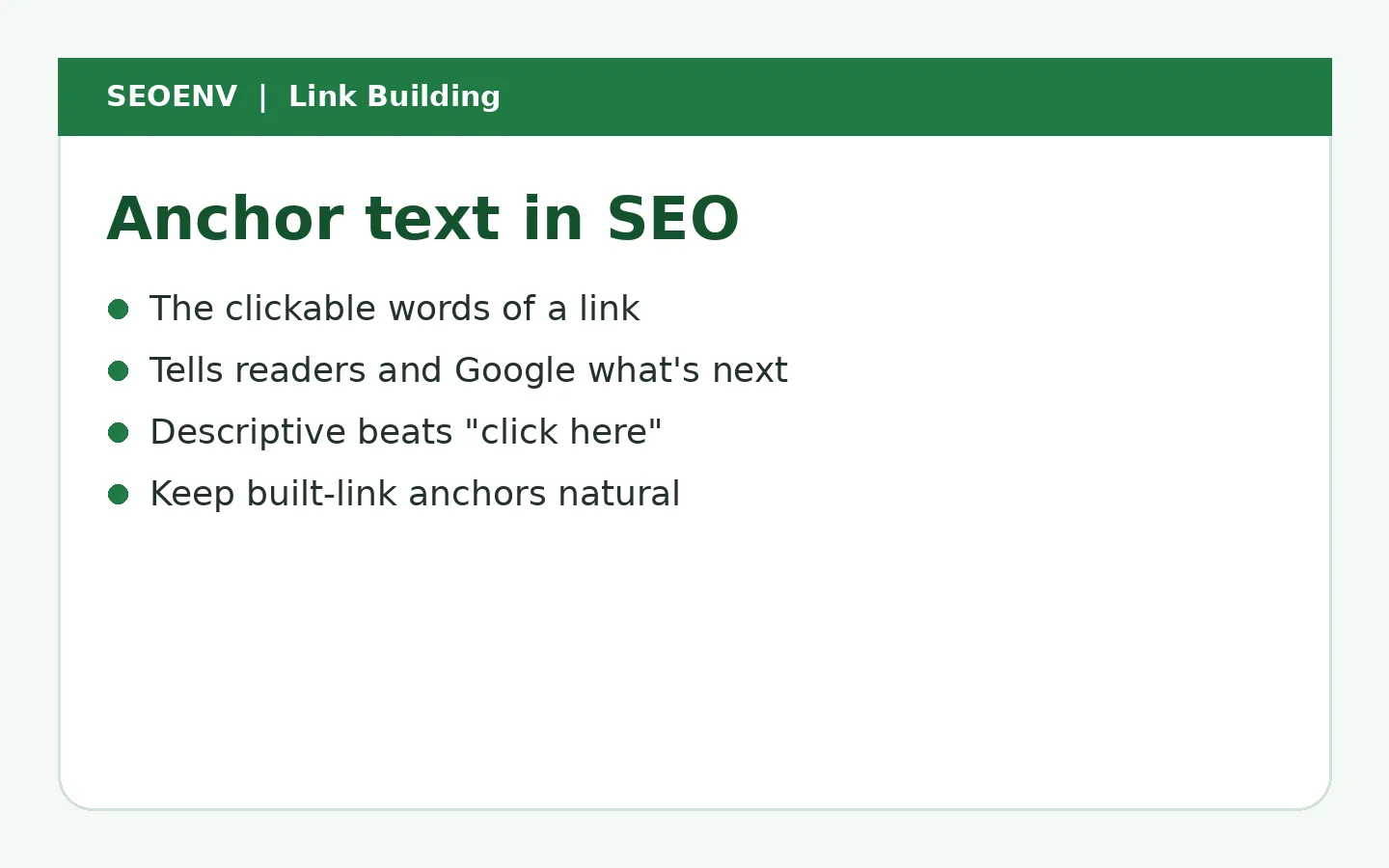
- Anchor text is the clickable text of a link.
- Google uses it to understand the linked page.
- Write anchors that describe the target and read naturally.
- Vary anchors on links you build; don't force exact match.
- Internal anchors can be descriptive and consistent.
Anchor text basics
| Term | Meaning |
|---|---|
| Anchor text | The visible, clickable words of a link |
| Target / href | The URL the link points to |
| Surrounding text | The words around the link, which add context |
| Image anchor | For linked images, the alt text plays a similar role |
Anchor text in HTML
In HTML, a link is an <a> element. The anchor text sits between the opening and closing tags:
<a href="https://www.example.com/guide/">link building guide</a>
Here "link building guide" is the anchor text. You can read the full specification on MDN's anchor element page. In WordPress and most editors, you highlight words and click the link button; the highlighted words become the anchor.
A quick note on terms: "text-anchor" is also an SVG and CSS property that aligns text. It's unrelated to links, so if you searched for it while building a chart, you'll want a design guide instead.
Why anchor text matters for SEO
Google's link best practices say good anchor text is descriptive, reasonably concise and relevant to both the page it's on and the page it links to. Anchors help Google understand what the target page covers and help readers decide whether to click.
Anchors also became a target for manipulation. When exact-match anchors were a strong signal, people built thousands of links with the same commercial phrase. Google's spam policies now mention keyword-rich anchor text links in large-scale guest posting and link schemes.
The main types of anchor text
| Type | Example (target: a backlink tracker) | When it's natural |
|---|---|---|
| Branded | "SEOENV" | Very common in earned links |
| Naked URL | "seoenv.com" | Citations and references |
| Generic | "this guide", "here" | Casual editorial mentions |
| Descriptive / partial match | "a tracker for backlinks you build" | Most helpful in body copy |
| Exact match | "backlink tracker" | Natural occasionally; risky in bulk |
| Image | Alt text of a linked image | Logos, badges, graphics |
How to write good anchor text
- Describe the destination. A reader should know what they'll get before they click.
- Keep it short. A few words to a short phrase. Don't link whole sentences.
- Fit the sentence. The anchor should read naturally, not as a keyword dropped in.
- Avoid "click here" alone. It tells readers and Google nothing. "Download the report template" is better.
- Don't stuff keywords. One clear phrase beats a string of keywords.
- Make it make sense out of context. Screen-reader users often navigate by links alone.
Anchor text for internal links
Internal links are where you have full control and least risk. Use descriptive anchors that match what the target page covers, and be consistent: if you have a page about "SEO report templates", linking to it with "SEO report template" from relevant articles is fine. You don't need to vary internal anchors artificially.
Anchor text for backlinks you build
Links you arrange through guest posts, exchanges and partnerships are where problems start. It's tempting to ask for the money keyword every time. A safer approach:
- offer the host two or three anchor options, mostly branded and descriptive;
- let the host choose what fits their sentence;
- point some links at supporting content, not just the main commercial page;
- record every anchor you agree so you can see your mix.
The trouble is that anchors are agreed in emails and briefs, then forgotten. Six months later you have dozens of built links and no idea how many use the same phrase.
Log the anchor for every link you build
See anchors next to source, target and status, so patterns are easy to spot.
Anchor text best practices by situation
| Situation | Recommended anchor approach |
|---|---|
| Guest post body link | Descriptive or partial match that fits the sentence |
| Guest post author bio | Branded |
| Link exchange | Agree natural anchors in writing; avoid exact match on both sides |
| Paid placement | Any natural anchor, link marked sponsored |
| Directory listing | Business name |
| Internal link | Descriptive, consistent with target page topic |
| Navigation and buttons | Short, clear labels |
Worked example: rewriting anchors in a guest post brief (example data)
The details here are invented example data.
A team's original brief asked writers to use "link building software" as the anchor in every guest post. After 15 posts, 13 used that exact phrase. The new brief gives writers options:
| Option | Anchor | Use |
|---|---|---|
| A | SEOENV | Author bio |
| B | a tool for tracking backlinks you build | Body, when mentioning tools |
| C | our guide to managing backlinks | Body, linking to the guide instead |
| D | link building software | At most occasionally |
Over the next 15 posts, anchors spread across all four options, and five links point to the guide rather than the product page.
Common anchor text mistakes
- Using exact-match anchors on most built links.
- Linking long, keyword-stuffed phrases.
- Generic anchors everywhere, giving no context.
- Mismatched anchors, where the text promises something the page doesn't deliver.
- Changing anchors on existing partner links without asking.
Anchor text and accessibility
Clear anchors help everyone, but they matter most for people using screen readers, who often jump from link to link. A page full of "read more" and "click here" links is hard to use that way. Write anchors that make sense on their own, and if a design needs repeated "Read more" buttons, add the article title so each one is unique.
Does anchor text still matter in 2026?
Yes, but as context, not as a lever to pull. Anchors help Google understand pages, and descriptive anchors improve usability. What's changed is the risk of overdoing it on links you control. Our guide to keyword backlinks explains how anchors and target keywords work together without crossing into manipulation.
Anchor text for images and buttons
Not every link is a text link. When you link an image, such as a logo in a partner directory or a badge on a client site, Google uses the image's alt text in a similar way to anchor text. Write alt text that describes the image and, where it's a link, what it leads to: "SEOENV logo" is clear; "best backlink software tool cheap" is stuffing.
Buttons are links too. A button that says "Start free" is fine as a call to action because the context around it explains what it does. For navigation menus, use the same short labels people would expect, like "Pricing" or "Features". Menus aren't the place to insert keywords; Google understands menu links as navigation.
How to audit your existing anchors
- Export backlinks for your site from a backlink tool, including the anchor column.
- Filter to followed links and group by target URL.
- Classify each anchor as branded, URL, generic, descriptive or exact match.
- Separate links you built from links you earned. Earned anchors are usually varied already.
- Look for any target where one exact-match phrase dominates the built links.
- For those targets, change your briefs and outreach templates first, then decide whether to ask partners to adjust anything.
Do the internal side too. A crawler such as Screaming Frog lists internal anchors per URL. Look for pages linked only with "read more" or "click here", and give them descriptive anchors.
How SEOENV handles this
SEOENV stores the anchor for every link you log, whether it's a guest post, exchange, paid placement or listing. You can search and filter your links to see which anchors you've used for a target page. The Anchor Text Heatmap with alerts, available on the Growth plan, shows the anchor mix at a glance and warns when one phrase starts to dominate.
Keep your anchor mix natural
Record anchors as you build links and spot over-optimisation early.
Write anchors for people first. If an anchor reads naturally and describes the page, it's almost always the right choice.
See every anchor you've agreed in one place
Track anchors, targets and link status for every client.
Related reading
- Anchor Text Ratio
- Keyword Backlinks: How Anchors and Target Keywords Work Together
- Contextual Links in SEO: Why Placement Inside Content Matters
- What Are Backlinks? How They Work and Why They Matter for SEO
- Link Equity (Link Juice) Explained for Site Owners
Sources
- Google Search Central: Link best practices (anchor text)
- Google Search Central: Spam policies
- MDN Web Docs: The anchor element
How we wrote this
The SEOENV Team wrote this guide from our day-to-day work tracking link exchanges, guest posts and paid placements, and checked the guidance against the sources listed above. Any numbers in worked examples are illustrative example data, not results from a real site or study. We review our guides when Google updates its documentation.
Frequently asked questions
What is anchor text in SEO?
It's the clickable text of a link. Search engines use it, along with surrounding text, to understand what the linked page is about.
How do I add anchor text in HTML?
Put the words between the opening and closing a tags, for example a href="URL" followed by the anchor text and the closing tag.
Is exact-match anchor text bad?
Not in itself. It becomes a risk when most links you build use the same exact commercial phrase, which looks manipulative.
Should internal link anchors be varied?
There's no need to vary them artificially. Use descriptive anchors that match the target page.
What is the best anchor text for a guest post?
A descriptive or branded anchor that fits the sentence and helps the reader, chosen with the host's style in mind.

Leave A Comment