
By SEOENV Team | Published October 23, 2026
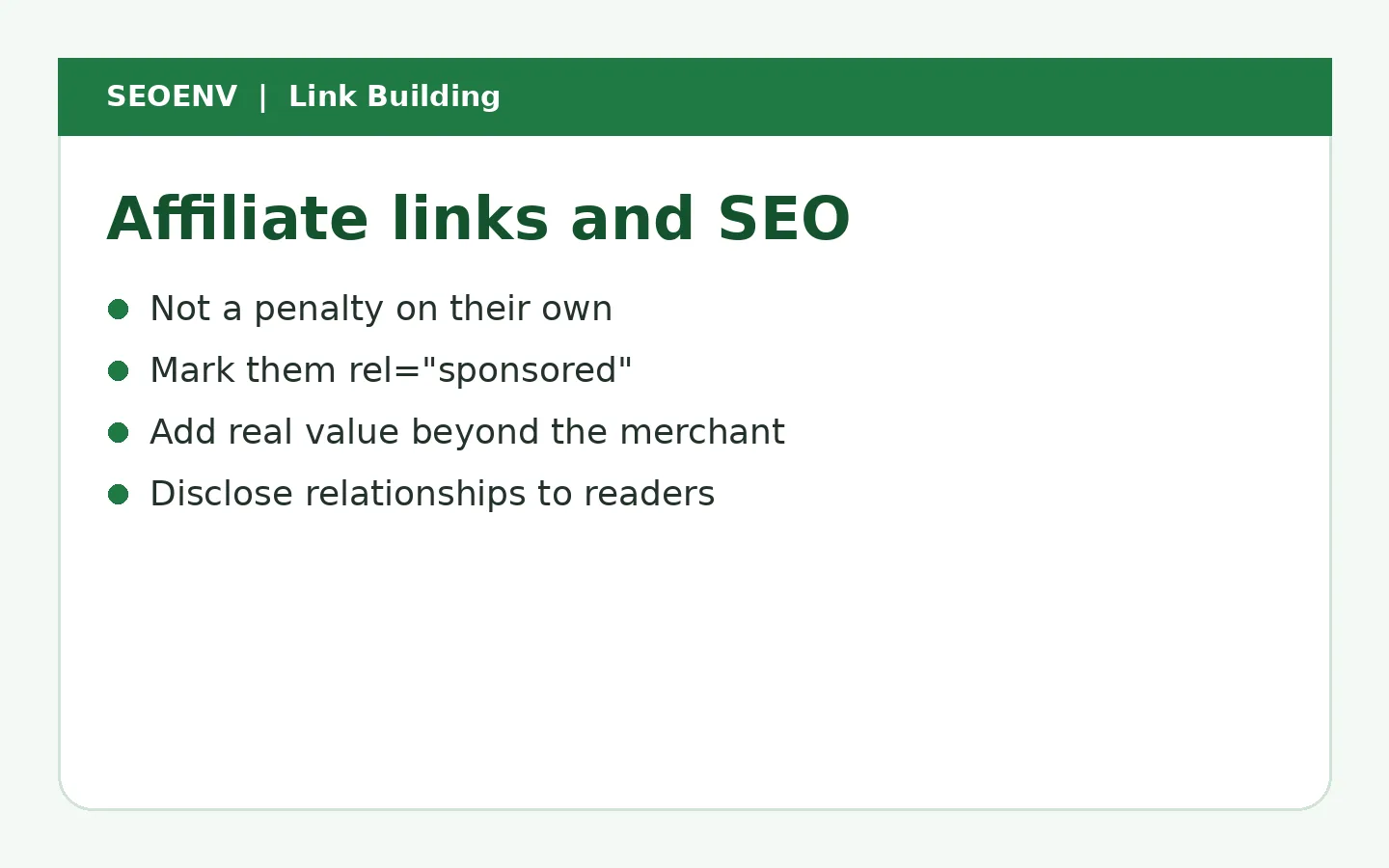
Affiliate links don't hurt SEO on their own. Google is clear that affiliate sites can rank, as long as links are marked with rel="sponsored" (or nofollow) and the page adds real value beyond what the merchant already offers. What hurts is thin affiliate content: pages that copy product descriptions and exist mainly to earn commission.
Here's what Google's rules say, how to set up affiliate links correctly and how to write affiliate content that deserves to rank.
Key takeaways
- Affiliate links don't hurt SEO by themselves.
- Google asks you to mark them rel="sponsored" or nofollow.
- Thin affiliate pages with no added value are the real risk.
- Disclose affiliate relationships clearly to readers.
- Getting affiliates to link to you rarely builds ranking value.
Affiliate links and SEO at a glance
| Question | Answer |
|---|---|
| Do affiliate links cause a penalty? | No, not by themselves |
| Should they be followed links? | No, use rel="sponsored" or nofollow |
| Can affiliate sites rank well? | Yes, if the content is genuinely useful |
| What does Google call a problem? | Thin affiliate pages with no added value |
| Do I need to disclose them? | Yes, for readers and, in many countries, by law |
What Google says about affiliate links
Two Google documents matter here.
The first is Qualify your outbound links, which says links that are advertisements or paid placements, explicitly including affiliate links, should use rel="sponsored". Nofollow is also acceptable.
The second is Google's spam policies, which describe "thin affiliation": pages with product affiliate links where the descriptions and reviews are copied from the merchant with no original content or added value. The policy is about the content, not the existence of the links.
Do affiliate links help SEO?
Not directly. Affiliate links are outbound links to merchants, and qualifying them as sponsored means they pass no endorsement. What can help is the content around them. A thorough comparison, honest testing or original photos can earn rankings and natural backlinks. The affiliate link is how that content makes money, not why it ranks.
There's another angle to "do affiliate links help SEO": merchants sometimes hope their affiliates' links will build their own link profile. They usually won't. Most affiliate links go through tracking redirects and should be marked sponsored, so they pass little or no ranking value to the merchant.
How to add affiliate links correctly
- Add rel="sponsored" to every affiliate link. Most affiliate plugins and link cloakers have a setting for it.
- Keep redirects clean. If you cloak links through /go/ paths, block those paths in robots.txt only if you understand the effect, and keep the sponsored attribute on the visible link.
- Disclose clearly. Put a short disclosure near the top of the page, not only in the footer.
- Don't overload pages. A link for every product mention reads like an ad.
- Check links regularly. Affiliate programmes change URLs and close; broken links frustrate readers.
Disclosure: an SEO issue and a legal one
Disclosure isn't a ranking factor, but it builds trust, and in many countries it's required. In the US, the FTC's endorsement guides FAQ expects clear disclosure of material connections such as commissions. Readers who discover hidden affiliate relationships tend not to come back, which shows up eventually in your traffic.
What makes affiliate content helpful
Google's guidance on reviews asks for evidence of first-hand experience, comparisons and original insight. In practice:
- Use the product. Photos, screenshots and measurements show you've tested it.
- Compare honestly. Explain who each option suits, including when not to buy.
- Show your method. How did you test? What did you measure?
- Update. Prices and products change. Date your updates.
- Cover the downsides. A review with no cons isn't believable.
Affiliate sites and link builders share a problem: dozens of partner links, each with its own terms, spread across pages and spreadsheets. When a programme changes URLs or a partner page disappears, it can take months to notice.
Keep partner and sponsored links organised
Log every sponsored placement with its partner, terms and live status.
Thin affiliate pages: warning signs
- product descriptions copied from the merchant;
- "best X" lists of products you never used;
- pages that are mostly affiliate buttons with a few lines of text;
- dozens of near-identical pages for different product variants;
- no author, no method, no date.
If your site has many of these, improving or consolidating them usually does more than any link building.
Worked example: fixing an affiliate review page (example data)
The details below are invented example data.
A page reviewing five project-management tools gets few visitors. An audit finds:
| Issue | Before | After |
|---|---|---|
| Affiliate links attribute | Followed | rel="sponsored" |
| Disclosure | Footer only | One line under the intro |
| Original content | Merchant descriptions | Notes from testing each tool for a week |
| Screenshots | Stock images | 12 original screenshots |
| Comparison | None | Table of pricing tiers and limits |
| Downsides | None | One "watch out for" per tool |
| Last updated | 2 years ago | Current, with change notes |
Nothing about the links changed except the attribute. The page became worth reading, which is what earns rankings and the occasional natural backlink.
Affiliate links vs paid links vs sponsored content
| Type | Who pays whom | Attribute |
|---|---|---|
| Affiliate link | Merchant pays you per sale | sponsored |
| Paid link | You pay a site to link to you | sponsored |
| Sponsored post | Brand pays for content on your site | sponsored on its links |
| Editorial link | No payment | none needed |
All three paid types should be qualified. Our post on paid backlinks covers the "you pay for a link" side in detail.
Can I use affiliate links on a business site?
Yes. Many software review sites, blogs and newsletters mix editorial content with affiliate links. Keep the same rules: qualify the links, disclose them and make sure the page would be useful without them. If affiliate pages dominate your site, ask whether your main content still reflects what visitors expect from your brand.
Do affiliate links slow pages down?
Affiliate widgets and scripts can. Plain text links don't. If you use product boxes, carousels or comparison widgets from a network, check their impact on page speed and Core Web Vitals. Simple HTML tables usually load faster and are easier for readers to scan.
Affiliate programmes as a link-building channel
Some businesses run affiliate programmes partly to get links. Treat that as a traffic and sales channel. Affiliates who write genuine reviews may also mention you in other articles with normal editorial links, which is a nice side effect, but the programme links themselves should be sponsored.
How SEOENV handles this
SEOENV is built for link builders rather than affiliate managers, but the same discipline applies. In Paid Collaborations you can record each sponsored placement with the vendor, cost, payment status and reference, and check the link is live before you pay. Every link is checked for status and whether it's dofollow or nofollow, so you can confirm sponsored placements are set up the way you agreed.
Check sponsored links before you pay
Log paid placements and confirm they're live before marking the invoice paid.
Affiliate links are a business model, not an SEO trick. Mark them, disclose them and make the page worth reading, and they won't hold your site back.
Keep every paid and partner link on record
One tracker for exchanges, guest posts, paid placements and listings.
Related reading
- Dofollow vs Nofollow Links: Do Nofollow Links Help SEO?
- Are External Links Good for SEO? How Outbound Linking Affects Rankings
- Paid Backlinks and Google
- Nofollow vs Dofollow Links
- Buying Backlinks: How to Judge the Risk Before You Pay
Sources
- Google Search Central: Qualify your outbound links
- Google Search Central: Spam policies (thin affiliate pages)
- US FTC: Endorsement guides FAQs
How we wrote this
The SEOENV Team wrote this guide from our day-to-day work tracking link exchanges, guest posts and paid placements, and checked the guidance against the sources listed above. Any numbers in worked examples are illustrative example data, not results from a real site or study. We review our guides when Google updates its documentation.
Frequently asked questions
Do affiliate links hurt SEO?
No, not on their own. Google asks you to mark them as sponsored and to add real value; thin affiliate pages are what cause problems.
Should affiliate links be nofollow or sponsored?
Google prefers rel="sponsored" for affiliate links, and also accepts nofollow.
Can an affiliate website rank on Google?
Yes. Affiliate sites with original, first-hand, helpful content rank for competitive searches.
Do affiliate links pass link juice to the merchant?
Generally not. They usually pass through redirects and should be marked sponsored, so they pass little or no ranking value.
Do I have to disclose affiliate links?
In many countries, yes. In the US, the FTC expects clear disclosure of material connections such as commissions.

Leave A Comment