
By SEOENV Team | Published October 23, 2026
Nofollow links can help SEO indirectly, but usually far less than dofollow (followed) links. Since 2019 Google has treated nofollow as a hint rather than a strict instruction, so it may use some nofollow links for crawling or ranking, but you can't count on it. Their reliable value is traffic, brand exposure and a natural-looking link profile.
This post focuses on the practical question people ask: should you bother with nofollow links, and how do you tell which of your backlinks are followed? For the full technical background, read our guide to nofollow vs dofollow links.
Key takeaways
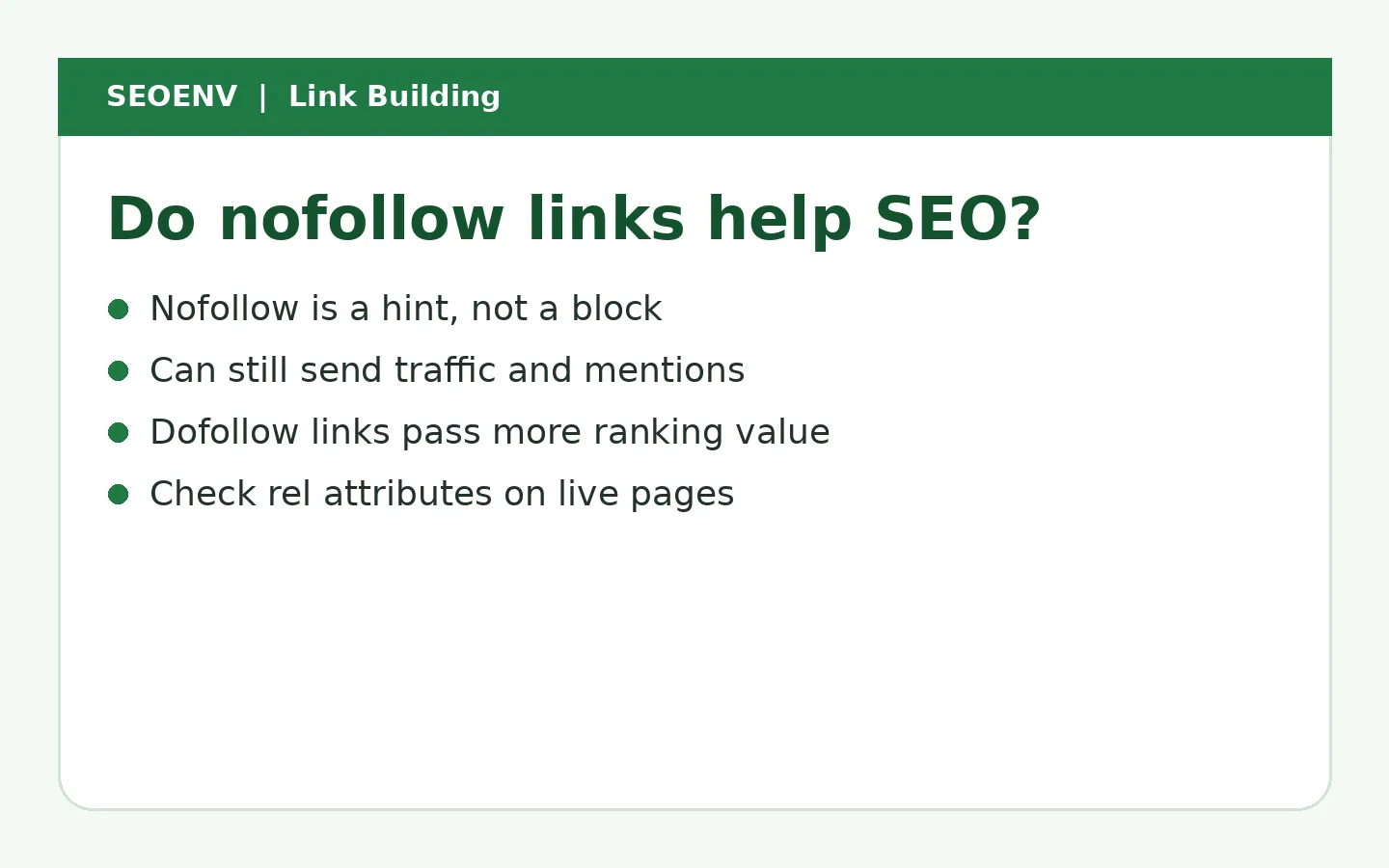
- Nofollow is a hint to Google, not a strict block.
- Nofollow links can still send traffic and mentions.
- Dofollow (normal) links usually pass more ranking value.
- Paid links should use rel="sponsored", not dofollow.
- Recheck built links; attributes can change after go-live.
The short answer
| Question | Answer |
|---|---|
| Do dofollow backlinks pass ranking value? | Yes, they are normal links Google can use fully |
| Do nofollow links pass ranking value? | Sometimes; Google treats nofollow as a hint |
| Can nofollow links send traffic? | Yes, exactly like any other link |
| Should paid links be dofollow? | No, mark them sponsored or nofollow |
| Is a 100% dofollow profile natural? | No, real profiles include nofollow links |
What "dofollow" actually means
There's no rel="dofollow" attribute. A "dofollow" link is just a normal link with no qualifying rel value. A nofollow link adds rel="nofollow". Google also supports rel="sponsored" for paid links and rel="ugc" for user-generated content such as comments and forum posts.
What Google says about nofollow
In its 2019 announcement, Evolving "nofollow", Google said all three attributes (nofollow, sponsored, ugc) are treated as hints about which links to consider or exclude within Search. Before that change, nofollow links were generally ignored for ranking.
What that means in practice:
- Google may still choose to crawl or credit some nofollow links.
- You have no way to know which ones.
- It isn't a loophole for paid links. Paid links still need to be qualified.
Do nofollow links help SEO, then?
Yes, in three indirect ways, and possibly a direct one.
Referral traffic
A nofollow link in a popular article, Reddit thread or news story can send a lot of visitors. Some of them may later link to you with a followed link from their own site.
Discovery and mentions
Journalists and bloggers find sources by searching and reading. A nofollow citation on a big publication puts your name in front of the people who give followed links.
A natural profile
Real sites collect links from social profiles, forums, comments, Wikipedia and news sites, many of them nofollow. A profile with only followed links built through outreach looks unusual.
Possible direct value
Because nofollow is now a hint, some nofollow links may count. Treat that as a bonus, not a strategy.
When dofollow backlinks matter more
If your goal is ranking a specific page, followed links from relevant sites usually do the most. Prioritise dofollow backlinks when:
- you're competing for a commercial search where rival pages have many followed links;
- the link is editorial (the site chose to link) so there's no reason to qualify it;
- the linking page is relevant and itself gets traffic.
Don't ask for dofollow on paid placements. Google's qualifying outbound links guide says paid links should use sponsored. Our post on paid backlinks explains the rules.
Here's the problem most link builders run into. A partner agrees to a followed link, and a few weeks later a plugin or a new editor adds nofollow to every outbound link on the site. The link still looks live, so nobody checks.
Know which of your links are still dofollow
SEOENV reads the rel attribute on each live page and labels every link Dofollow, Nofollow or Unknown.
How to find dofollow backlinks
On a single page
- Open the page, right-click the link and choose Inspect.
- Look at the
<a>element. If it has norelvalue, or one without nofollow, sponsored or ugc, it's followed. - Check the page
<head>for a meta robots tag with nofollow, which applies to every link on the page.
Across your profile
Backlink tools such as Ahrefs and Semrush let you filter backlinks by dofollow or nofollow. Google Search Console's Links report shows linking sites but not the attribute, so you'll need a tool or manual checks.
For links you built
Keep a list of every link you arranged with its expected attribute, and recheck it on a schedule. That's the only way to catch a link that was changed after you confirmed it.
Worked example: a mixed profile (example data)
The figures below are invented example data.
A software blog has 120 referring domains:
| Link source | Domains | Nofollow share |
|---|---|---|
| Editorial mentions | 45 | Low |
| Guest posts | 25 | Low |
| Social profiles and forums | 30 | Almost all |
| News and big publishers | 10 | High |
| Directories | 10 | Mixed |
The site owner worries that 45 domains, more than a third, send only nofollow links. In reality the mix is normal. The big publishers' nofollow citations brought a surge of visits and two of those visitors later linked with followed links. The useful action is to monitor the 25 guest posts, where the team agreed followed links, and confirm they stay that way.
Nofollow and internal links
Don't nofollow your own internal links to "sculpt" PageRank. It doesn't save link value; it just wastes it, and it can stop Google crawling pages you want found. Use noindex or robots rules if you don't want a page in search, and keep internal links followed.
Common nofollow mistakes
- Refusing good nofollow opportunities on big sites.
- Asking for dofollow on paid placements.
- Assuming a link is still followed months after it went live.
- Adding nofollow to all outbound links on your own site by default, which can make your content look less helpful. See are external links good for SEO.
Sponsored and UGC: the other two hints
Many people treat nofollow as the only alternative to a followed link, but Google gives you two more specific options.
- rel="sponsored" marks links that are ads, paid placements, sponsorships or affiliate links. It is the preferred value for anything you were paid or compensated for.
- rel="ugc" marks links in user-generated content such as comments and forum posts.
You can combine values, for example rel="nofollow sponsored", and Google says nofollow alone is still acceptable for paid links. For link builders, the practical point is that a sponsored link is not a failure. It's the correct way to run a paid placement, and it still delivers the traffic and exposure you paid for.
Should you ever ask a site to change nofollow to dofollow?
Only when the link was editorial, unpaid and the site's nofollow was applied by accident, for example a plugin that adds nofollow to every external link. In that case a polite note explaining that the link is an editorial citation is reasonable. If the site has a policy of nofollowing outbound links, respect it. If you paid for the link, don't ask at all. Pushing for followed paid links is how a normal partnership becomes a link scheme.
Nofollow links in link exchanges
In a reciprocal link exchange, both sides usually expect followed links. If one side switches theirs to nofollow later, the deal is no longer what was agreed. Record the expected attribute for both legs when you set up the exchange, and check both regularly so neither side is surprised.
How SEOENV handles this
Every link you add to SEOENV gets a type, Dofollow, Nofollow or Unknown, read from the rel attribute on the live page. Run "Check all" on any plan, and paid plans also check daily. When a partner changes a link to nofollow, you'll see the type change in the link table and can follow up with them.
Catch dofollow-to-nofollow switches
Log your built links and recheck their attributes whenever you need to.
Nofollow links aren't worthless and dofollow links aren't magic. Build a natural mix, and keep an eye on the links you agreed should be followed.
Track link attributes for every client
See dofollow and nofollow status by client and project in one table.
Related reading
- Nofollow vs Dofollow Links
- What Are Backlinks? How They Work and Why They Matter for SEO
- What Makes a High-Quality Backlink? A Checklist for Judging Links
- Paid Backlinks and Google
- Do Affiliate Links Help or Hurt SEO?
Sources
How we wrote this
The SEOENV Team wrote this guide from our day-to-day work tracking link exchanges, guest posts and paid placements, and checked the guidance against the sources listed above. Any numbers in worked examples are illustrative example data, not results from a real site or study. We review our guides when Google updates its documentation.
Frequently asked questions
Do nofollow links help SEO at all?
They can help indirectly through traffic, mentions and a natural profile. Since 2019 Google treats nofollow as a hint, so some may count directly, but you can't rely on it.
Is there a dofollow attribute?
No. A dofollow link is simply a normal link without nofollow, sponsored or ugc in its rel attribute.
Should I ask for dofollow links in guest posts?
For editorial guest posts on relevant sites, a normal followed link is common. If you paid for the placement, it should be marked sponsored.
How do I check if a backlink is dofollow?
Inspect the link in your browser and look for a rel attribute, and check the page's meta robots tag. For many links, use a backlink tool or a tracker that reads attributes.
What percentage of my backlinks should be dofollow?
There's no official ratio. Natural profiles include a share of nofollow links from social, forums and publishers. Focus on relevance rather than a target percentage.
Leave A Comment