
By SEOENV Team | Published October 23, 2026
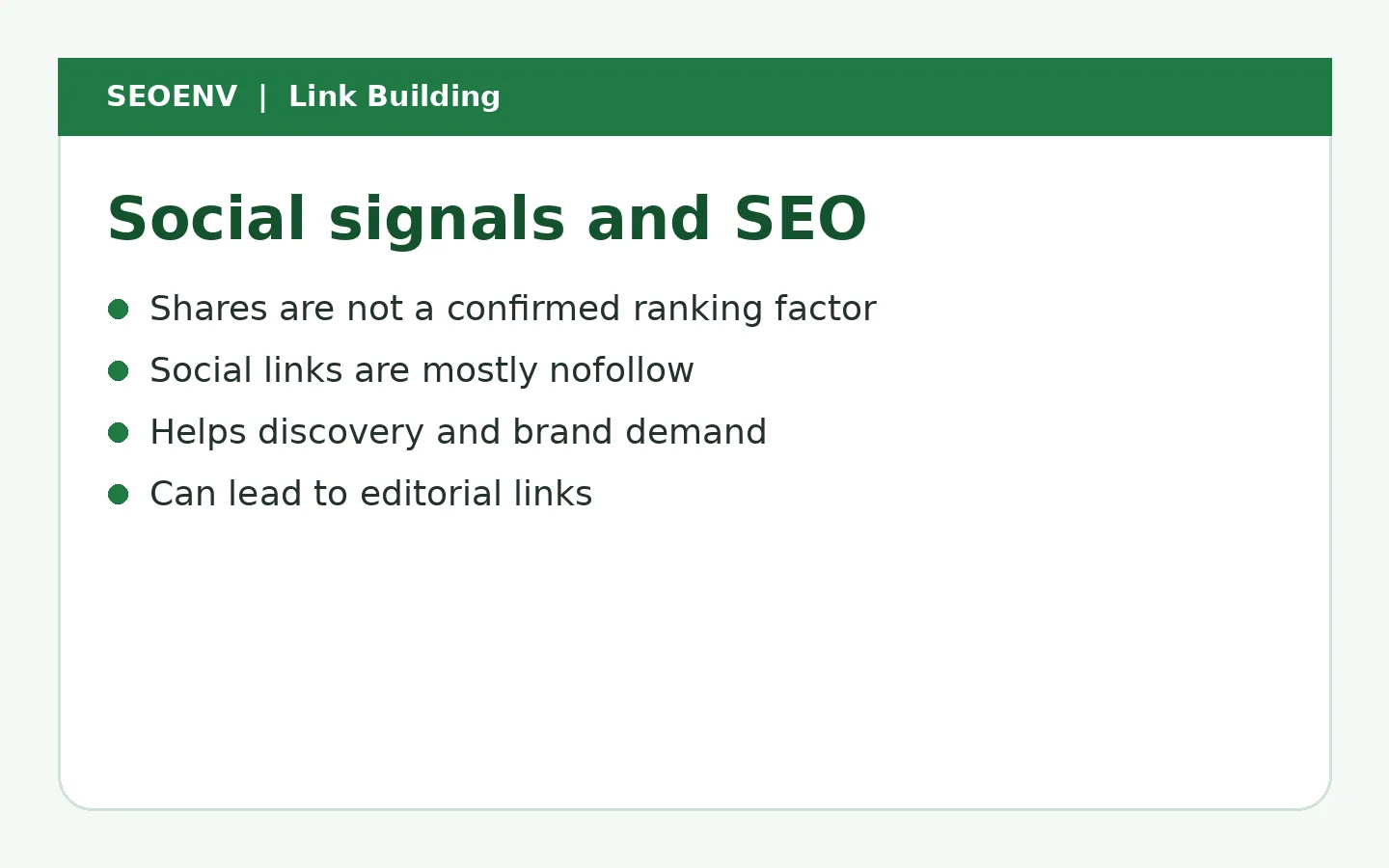
Social signals such as likes, shares and follower counts are not a ranking factor Google has confirmed, and most links on social platforms are nofollow, so they pass little or no ranking value. Social media still helps SEO indirectly: it puts your content in front of writers who might link to it, builds brand searches and helps new pages get discovered. Treat social as a distribution channel for link-worthy content, not as a source of backlinks.
Here's what social links do and don't do, and how to use social media in a way that supports SEO.
Key takeaways
- Likes and shares aren't a direct ranking factor Google has confirmed.
- Most social links are nofollow.
- Social helps indirectly: discovery, brand searches and earned links.
- Social bookmarking for links is outdated and spam-prone.
- Use social to get content in front of people who might link.
What social signals are
| Signal | Direct ranking factor? | Indirect value |
|---|---|---|
| Likes and reactions | Not confirmed | Reach |
| Shares and reposts | Not confirmed | Reach, discovery |
| Links in posts | Mostly nofollow | Traffic, discovery |
| Profile links | Mostly nofollow | Brand, trust |
| Follower count | Not confirmed | Audience for future content |
What Google has said
Google's public documentation on how Search works describes crawling, indexing and ranking based on many signals, and Google representatives have repeatedly said social shares aren't used directly in ranking. Social platforms typically mark user links with nofollow or ugc, which Google's qualify outbound links guide describes as hints.
Correlation studies that show top-ranking pages have more shares don't prove cause. Good content tends to get shared and linked for the same reasons.
How social helps SEO indirectly
- Discovery by linkers. Journalists and bloggers find sources on social platforms.
- Brand searches. People who see you on social later search for you by name.
- Faster discovery of new pages. Traffic and attention can help pages get found.
- Feedback. Social reactions show which topics resonate, guiding future content.
- Relationships. Engaging with writers in your niche makes outreach warmer.
Social bookmarking: still worth it?
Social bookmarking sites were once used for quick links. Today most are nofollow, many are spam-filled, and mass submission is the kind of automated link building Google's spam policies warn about. A few genuine communities in your niche, where you participate properly, are worth far more.
Social media backlinks: profiles and posts
Create complete profiles on the platforms your audience uses, with a link to your site. They help people verify your business. Don't expect them to move rankings.
Social media generates mentions you might never see: someone shares your template, a writer quotes your thread, a newsletter features your post. Some of those turn into real backlinks later, and unless you record them you can't tell which social efforts led to links.
Record the links that come from your social efforts
Add earned links as they appear and check they stay live.
Worked example: social distribution leading to links (example data)
The figures are invented example data.
A B2B team shares a new free template on LinkedIn and in two industry communities:
| Channel | Views (example) | Direct backlinks | Later editorial links traced back |
|---|---|---|---|
| LinkedIn post | 8,000 | 0 (nofollow) | 3 bloggers mentioned finding it there |
| Industry Slack community | 1,200 | 0 | 2 |
| Niche forum thread | 900 | 1 (ugc) | 1 |
| Newsletter feature | 15,000 | 1 | 2 |
The social links themselves passed little value, but they led to eight editorial links over the next two months.
How to use social for SEO
- Share genuinely useful content, not just links.
- Tag or mention people you cite, which often leads to them sharing or linking.
- Join niche communities and contribute before promoting.
- Turn popular posts into full articles on your site.
- Watch for writers who engage and add them to outreach lists.
Common myths
- "More shares means higher rankings." Not directly.
- "Social bookmarking builds authority." Not anymore.
- "Nofollow social links are pointless." They bring people, and people bring links.
Should you report social metrics as SEO results?
Report them as distribution results, not ranking results. In SEO reports, focus on links, rankings and organic traffic, and note where social helped content reach linkers.
Social profiles and brand trust
Complete, active profiles help people check you're real before they link to you or buy from you. Use consistent names, logos and descriptions, and link back to your site. It's a small trust signal, not a ranking lever.
How SEOENV handles this
SEOENV tracks the backlinks you care about, wherever they came from. Add editorial links that resulted from social distribution, tag them by project, and SEOENV checks status and dofollow or nofollow, so your reports show real links, not vanity metrics.
Use social to get great content in front of people who write about your topic. The links come from them, not from the share buttons.
Related reading
- What Are Backlinks? How They Work and Why They Matter for SEO
- Dofollow vs Nofollow Links: Do Nofollow Links Help SEO?
- Digital PR for SEO: How to Earn Links from News Sites
- Free Backlinks: 12 Legit Ways to Get Backlinks Without Paying
- Off-Page SEO Checklist: 20 Tasks to Run Every Quarter
Sources
How we wrote this
The SEOENV Team wrote this guide from our day-to-day work tracking link exchanges, guest posts and paid placements, and checked the guidance against the sources listed above. Any numbers in worked examples are illustrative example data, not results from a real site or study. We review our guides when Google updates its documentation.
Frequently asked questions
Do social signals affect SEO?
Not directly, according to Google. Social helps indirectly by getting content seen by people who may link to it.
Are social media links dofollow?
Most are nofollow or ugc, so they pass little ranking value.
Is social bookmarking still useful for SEO?
Rarely. Most bookmarking links are nofollow and mass submission is treated as spam.
Should I share every blog post on social?
Share posts that are genuinely useful to your audience, with context, rather than posting every link.
Do social profiles help SEO?
They help brand trust and discovery but don't directly improve rankings.

Leave A Comment