
By SEOENV Team | Published October 23, 2026
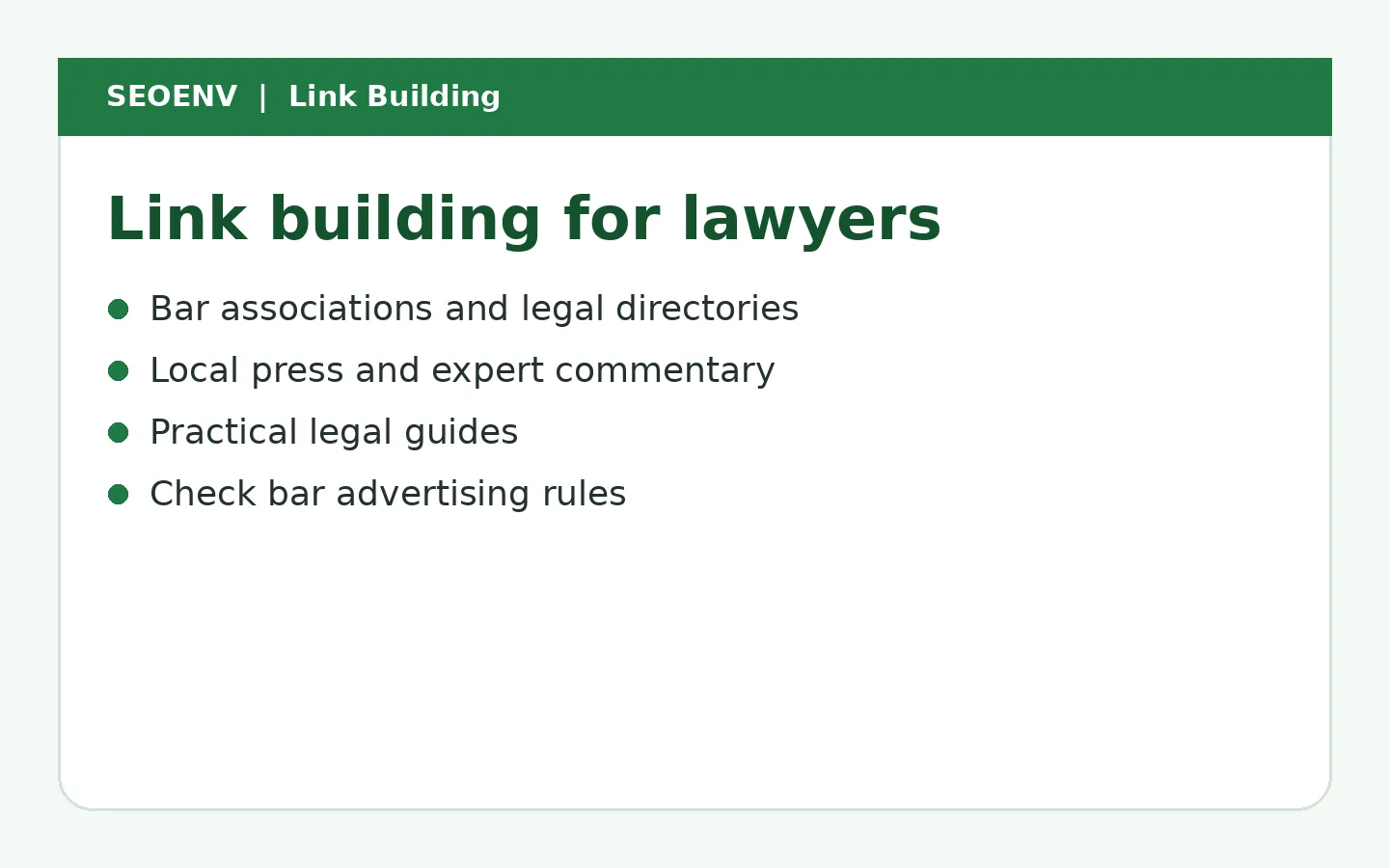
Law firms earn the best backlinks from bar associations, respected legal directories, local news, university and community organisations and expert commentary on legal developments, supported by practical guides that answer clients' questions. Because legal marketing is regulated, check your jurisdiction's advertising and referral rules before paying for any placement, and avoid generic paid links, which also break Google's spam policies.
This guide covers legal link sources, a practical plan and the compliance points to check.
Key takeaways
- Law firms have strong local and professional link sources.
- Bar associations, legal directories and local press are reliable.
- Expert commentary on legal news earns editorial links.
- Check your bar's advertising and referral rules before paying for anything.
- Track links by practice area and office.
Legal link sources
| Source | Effort | Notes |
|---|---|---|
| State and local bar associations | Low | Member directories, committee pages |
| Legal directories | Low-medium | Choose respected, relevant ones |
| Local press | Medium | Commentary on local legal issues |
| Legal and business publications | Medium-high | Expert articles |
| Law schools and universities | Medium | Alumni, guest lectures, clinics |
| Community organisations | Medium | Pro bono, sponsorships |
| Courts and public bodies | Rare | Usually not available |
| Podcasts and webinars | Medium | Legal and industry shows |
Compliance first
Lawyers' advertising is regulated. The ABA's Model Rule 7.2 restricts giving anything of value for recommending a lawyer's services, with some exceptions such as reasonable costs of advertising. States adopt their own versions. Before paying for directory listings, sponsored content or referral-style links, check your state bar's rules or ask your ethics counsel. This article isn't legal advice.
Google's spam policies add a second reason to avoid buying followed links.
How law firms earn backlinks
Professional memberships
Bar sections, specialist associations and local business groups list members.
Legal directories
Choose directories that clients and lawyers actually use. Paid tiers may be advertising; check bar rules.
Expert commentary
Journalists covering court decisions, new laws or local disputes need lawyers who can explain them clearly and quickly.
Practical guides
"What to do after a car accident in [city]" or "how probate works in [state]" earn links from community sites, forums and journalists.
Community involvement
Pro bono work, legal clinics, scholarships and sponsorships, where genuine, earn local links.
Speaking and teaching
CLE presentations, university lectures and webinars often come with speaker pages.
Law firms collect links from many directions: partners speak at events, associates write articles, marketing pays for directories, and nobody has a full list. When a partner leaves or the firm rebrands, links point to dead bio pages.
Keep every firm link in one record
Track directories, articles and speaker pages by practice area.
Worked example: a six-month plan (example data)
The firm and figures are invented example data for a two-office family law practice.
| Activity | Volume | Links (example) |
|---|---|---|
| Bar and section memberships | 4 | 4 |
| Legal directories (reviewed with ethics rules) | 5 | 5 |
| Local press commentary | 6 pitches | 3 |
| Guide: "divorce timeline in [state]" outreach | 40 | 6 |
| University family law clinic talk | 1 | 1 |
| Local charity partnership | 1 | 1 |
Twenty links over six months, each from a source that makes sense for a family law firm.
Practice-area and location pages
Build links to the practice-area and office pages that bring clients. Track by office so each location's local links are visible.
Choosing a legal link building agency
Ask for legal examples, how they handle bar advertising rules, whether they pay for placements and who owns the records. Avoid agencies selling "high DA" links on unrelated sites.
Common mistakes
- Paying for links without checking bar rules.
- Generic guest posts on unrelated sites.
- Losing links when lawyers leave and bio pages are deleted.
- Inconsistent firm details across directories.
Protecting links when lawyers move
Redirect departing lawyers' bio pages to the practice area page rather than deleting them, so links to those bios keep passing value.
How SEOENV handles this
SEOENV organises links by project (office or practice area) and records partners, directories and paid listings in their own modules. Each link is checked for status and dofollow or nofollow. Paid Collaborations records costs, so you have a clear record if anyone asks what was paid for.
Organise firm links by office and practice
Projects, partners and listings, all with status checks.
Legal link building rewards expertise and community involvement. Keep it ethical, keep it relevant and keep a record.
Related reading
- Local Link Building: How Local Businesses Earn Local Backlinks
- Citation Link Building: Citations vs Backlinks Explained
- Digital PR for SEO: How to Earn Links from News Sites
- Editorial Backlinks: What They Are and How to Earn Them
- White Hat Link Building: Techniques That Stay Within Google's Rules
Sources
- Google Search Central: Spam policies (link spam)
- American Bar Association: Model Rule 7.2 (Advertising)
How we wrote this
The SEOENV Team wrote this guide from our day-to-day work tracking link exchanges, guest posts and paid placements, and checked the guidance against the sources listed above. Any numbers in worked examples are illustrative example data, not results from a real site or study. We review our guides when Google updates its documentation.
Frequently asked questions
How do law firms get backlinks?
Through bar associations, legal directories, local press commentary, practical guides and community involvement.
Can lawyers pay for backlinks?
Paid followed links break Google's rules, and paying for recommendations may breach bar rules. Check your jurisdiction.
Are legal directories worth it?
Respected directories that clients use are worth it. Check whether paid tiers count as advertising under your bar's rules.
What pages should law firm links point to?
Practice-area, location and guide pages that bring potential clients.
Is this legal advice?
No. Check your state bar's rules or ethics counsel for compliance questions.

Leave A Comment