
By SEOENV Team | Published October 23, 2026
An editorial backlink is a link that another site chooses to give you because your content helps its readers, without payment, exchange or any requirement from you. A journalist citing your data or a blogger linking to your guide as the best explanation are both editorial links. They're the most valuable kind of backlink because they're exactly what search engines treat links as: independent recommendations.
This guide covers what counts as an editorial link, why it matters and practical ways to earn more of them.
Key takeaways
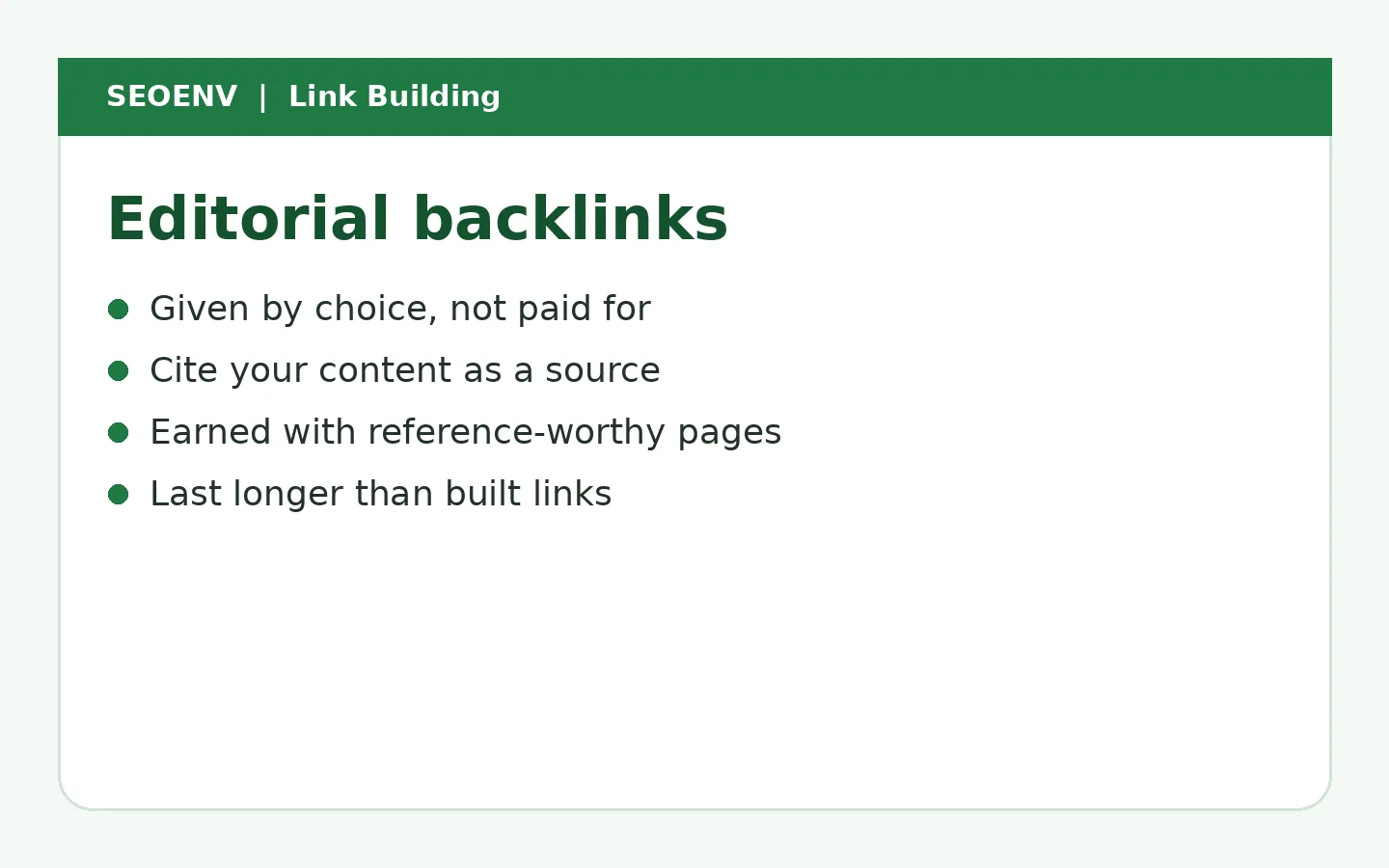
- Editorial backlinks are links a site gives by choice, without payment.
- They're the kind of link Google's systems are built to reward.
- You earn them with content worth citing, not by asking for links.
- Outreach helps people find your content; it doesn't buy the link.
- They take longer to get but rarely disappear.
Editorial vs non-editorial links
| Link | Editorial? | Why |
|---|---|---|
| A blogger cites your study unprompted | Yes | Chosen by the writer |
| A journalist links after you sent a data story | Yes | You pitched, they chose |
| A guest post you wrote with a link to yourself | Partly | You placed it, the editor approved |
| A link exchange | No | Agreed in return for a link |
| A paid placement | No | Payment involved, should be sponsored |
| A directory listing you submitted | No | Self-created |
The test is simple: did someone with no obligation decide your page was worth linking to?
Why editorial backlinks matter
Google's spam policies describe link spam as links intended to manipulate rankings: paid links, excessive exchanges, automated programs. Editorial links are the opposite. They're what links were supposed to mean all along, so they carry the most weight and the least risk.
They also last. Writers rarely remove a citation they chose, whereas paid and exchanged links often disappear when deals end or sites change hands. And they come with context: a writer who cites you explains why, which sends readers who are already interested.
What makes content earn editorial links
Writers link when your page makes their article better. That usually means one of these:
- Original data. Surveys, studies and analyses that others can quote.
- The clearest explanation. A guide that defines a concept better than anything else.
- Useful tools and templates. Calculators, generators, checklists.
- Strong opinions with evidence. A well-argued position people want to reference or rebut.
- Visuals. Diagrams and charts that explain something quickly.
Google's helpful content guidance asks whether content offers original information or insightful analysis beyond the obvious. The same qualities earn links.
Six ways to earn editorial backlinks
1. Publish something only you can
Use your own data, experience or process. A link-building agency could publish anonymised averages on response rates from its own campaigns, clearly explained. Generic "10 tips" posts rarely earn citations.
2. Make it easy to cite
Put the key fact or definition near the top in a quotable sentence. Add a clear title, date and author. Offer embed code for charts.
3. Help people find it
Editorial doesn't mean passive. Share your piece with writers who cover the topic, in communities where it's useful, and in your newsletter. You're making it discoverable, not asking for a link in return.
4. Answer journalists' requests
Services that connect journalists with sources (such as Qwoted or Featured) let you contribute expertise. Quotes often come with a link.
5. Reclaim unlinked mentions
When someone mentions your brand or data without linking, a polite note asking them to add the source link usually works.
6. Update and maintain
Pages that stay accurate keep earning links. Refresh data yearly and note what changed.
Editorial links arrive unpredictably. Someone links to you in March, another in June, and nobody on the team notices either one, so nobody thanks the writer or builds a relationship.
Record the links you earn as well as the ones you build
Keep earned and built links in one tracker and check they stay live.
Worked example: a data piece that earned links (example data)
This scenario and its figures are invented example data.
A small SaaS team surveyed its users about how they track backlinks and published the results with three charts.
| Month | Outreach emails sent | Editorial links earned | Source of links |
|---|---|---|---|
| 1 | 40 | 6 | Bloggers who covered the topic |
| 2 | 10 | 5 | Writers who found it via search and social |
| 3 | 0 | 4 | Organic citations |
| 4-6 | 0 | 7 | Organic citations |
Most links arrived after outreach stopped, because the page ranked for its topic and writers found it when researching. That compounding effect is why editorial assets are worth the investment.
Editorial links vs guest posts
Guest posts sit in a grey zone. An editor approves your article, so there's some editorial judgement, but you chose the link. Guest posting on real sites is fine; large-scale guest posting with keyword anchors is link spam. Treat guest posts as a way to reach audiences, and let editorial links be the goal. See guest blogging for SEO.
How long editorial link building takes
Longer than buying or swapping links. Expect a data piece or definitive guide to earn links over months, not days. The upside is that the links keep coming and rarely vanish.
Common mistakes
- Asking for links before giving people a reason to link.
- Publishing "ultimate guides" that repeat what already ranks.
- Gating the useful part behind a form, so writers can't cite it.
- Mass-emailing the same pitch to hundreds of sites.
- Calling paid placements "editorial" in client reports.
How to measure editorial links
Count new referring domains that you didn't build directly, and note which content earned them. Over time you'll see which formats (data, templates, tools) earn the most. That tells you what to publish next. Our link building KPIs guide explains which metrics to report.
Editorial links from your own industry relationships
Some of the best editorial links come from people who already know you: partners, customers, conference organisers and podcast hosts. They write about the industry and need examples and sources. Staying in touch, sharing useful work and contributing genuinely to industry conversations makes you the obvious source to cite. It isn't fast, but it's how many established sites built their profiles.
How SEOENV handles this
SEOENV tracks the links you're responsible for, and you can add earned links alongside the ones you build. Each link is checked for live status and dofollow or nofollow, and organised by client and project. That gives you one place to see your full picture, earned and built, rather than only the links you paid or traded for.
See earned and built links side by side
Add every link to one tracker and filter by type and client.
Editorial links can't be bought, which is exactly why they're valuable. Build content worth citing and make sure the right people see it.
Keep your link profile organised as it grows
One table for every backlink, free for up to 20 links.
Related reading
- What Are Backlinks? How They Work and Why They Matter for SEO
- What Makes a High-Quality Backlink? A Checklist for Judging Links
- Digital PR for SEO: How to Earn Links from News Sites
- Backlink Examples: 12 Real Types of Links and What Each Is Worth
- White Hat Link Building: Techniques That Stay Within Google's Rules
Sources
How we wrote this
The SEOENV Team wrote this guide from our day-to-day work tracking link exchanges, guest posts and paid placements, and checked the guidance against the sources listed above. Any numbers in worked examples are illustrative example data, not results from a real site or study. We review our guides when Google updates its documentation.
Frequently asked questions
What is an editorial backlink?
A link another site chooses to give because your content helps its readers, with no payment or exchange involved.
Are editorial links better than guest post links?
Usually, yes. Editorial links are fully independent; guest post links are placed by you and approved by an editor.
How do I get editorial backlinks?
Publish original data, clear guides or useful tools, make them easy to cite and share them with people who write about the topic.
Can I pay for editorial links?
No. A paid link is by definition not editorial and should be marked rel="sponsored".
How long does it take to earn editorial links?
Typically months. Strong assets keep earning links long after you publish them.

Leave A Comment