
By SEOENV Team | Published October 23, 2026
Off-page SEO is everything you do outside your own website to improve how search engines and people see it, mainly earning backlinks, but also brand mentions, reviews, citations and digital PR. On-page SEO is what you control on your pages; off-page SEO is about what others say and link to. Both matter, and off-page work is most effective when your on-page content is already worth recommending.
Key takeaways
- Off-page SEO covers actions outside your site that influence rankings.
- Backlinks are the largest part, but not the only one.
- Brand mentions, reviews and citations also matter.
- You can influence off-page signals but not control them.
- Combine with on-page and technical SEO.
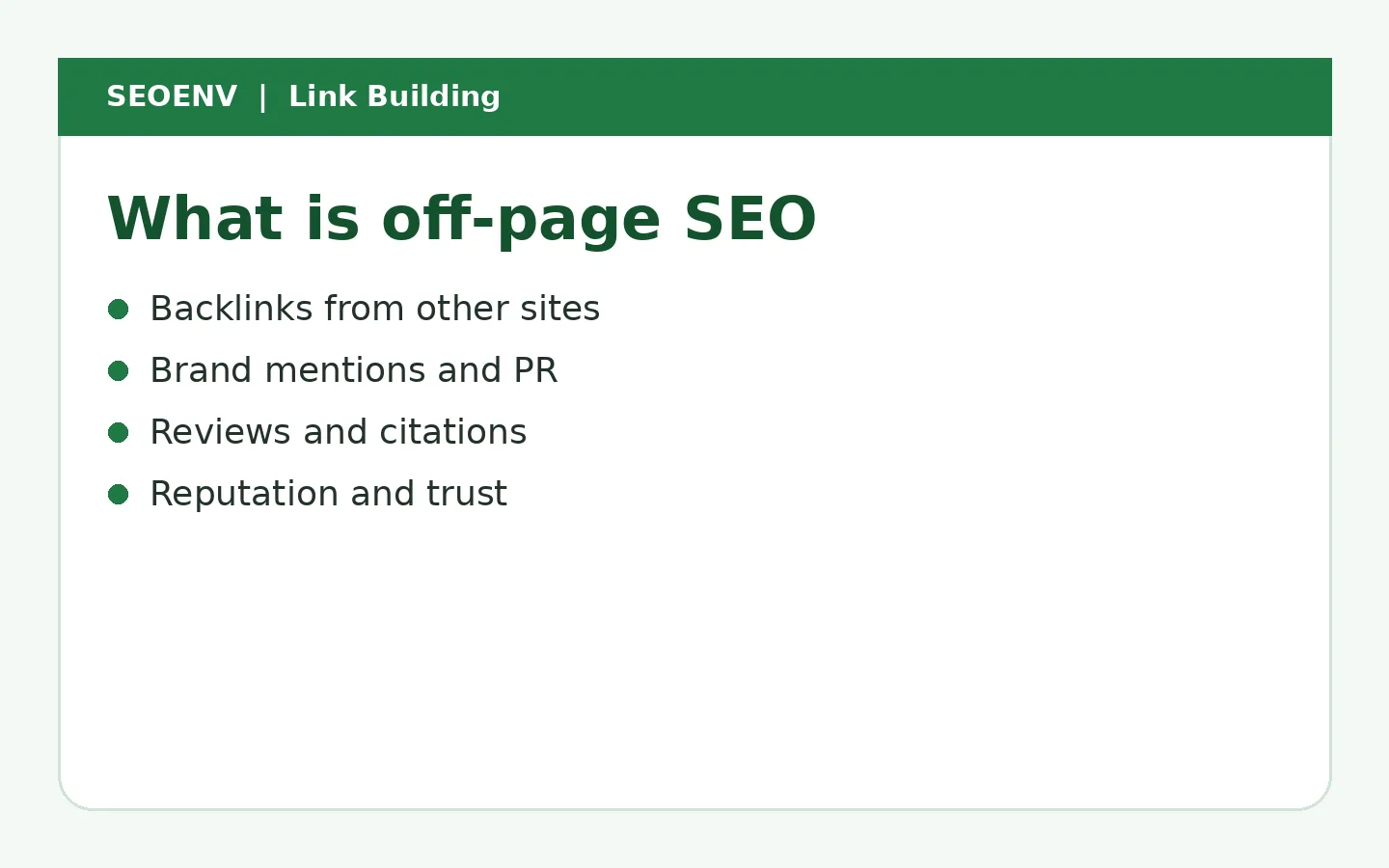
Off-page SEO factors
| Factor | What it is | Influence |
|---|---|---|
| Backlinks | Links from other sites | High |
| Brand mentions | Your name cited, linked or not | Medium |
| Reviews | Customer reviews on platforms | Medium, especially local |
| Citations | Business details on directories | Local |
| Digital PR | News and industry coverage | High (via links and brand) |
| Social | Distribution, not a direct factor | Indirect |
Why off-page SEO matters
Google's How Search works explains that links help Google discover pages. Links and mentions from others are also how search engines and people judge whether a page is trusted. You can say anything about yourself on your own site; off-page signals are what others say.
Off-page SEO techniques
- Link building through outreach, guest posts and partners. See link building strategies.
- Digital PR. See digital PR for SEO.
- Local citations and reviews. See citation SEO.
- Unlinked mention reclamation.
- Community participation.
What off-page SEO is not
Buying followed links, link networks and automated link creation are covered by Google's spam policies. They're off-page activities, but not ones that help long term.
Off-page vs on-page vs technical
| Type | Examples |
|---|---|
| On-page | Content, titles, headings, internal links |
| Technical | Crawling, indexing, speed, structured data |
| Off-page | Backlinks, mentions, reviews, PR |
Off-page work happens on other people's sites, which means you have no control over whether it stays. Links built last quarter can disappear without notice.
Worked example: an off-page audit (example data)
The site and figures are invented example data.
| Area | Finding | Action |
|---|---|---|
| Backlinks | 120 referring domains, 8 to key pages | Build links to key pages |
| Lost links | 14 lost in 6 months | Recover where possible |
| Mentions | 11 unlinked | Reclaim |
| Reviews | 23, avg 4.2 | Ask happy customers |
| Citations | 3 inconsistent addresses | Fix |
How to measure off-page SEO
Referring domains, links to key pages, branded search, reviews and lost links. See link building KPIs.
Common mistakes
- Treating off-page as only link counts.
- Ignoring reviews and citations for local businesses.
- Building links to weak pages.
- Not tracking what you've built.
Off-page SEO activities explained in more depth
Link building
Earning links from relevant sites remains the core of off-page SEO. Google's own documentation explains that it finds pages partly by following links, and links from relevant pages help it understand what a page is about. The approaches that hold up are content worth citing, outreach to relevant editors, guest contributions to real publications and partnerships. See how to get backlinks.
Brand mentions
Unlinked mentions of your brand in articles, forums and reviews signal that people talk about you. They also make good outreach targets: an editor who already mentions you may add a link if asked politely.
Digital PR
Data studies, expert commentary and newsworthy announcements can earn coverage on news and industry sites. See digital PR for SEO.
Local signals
For local businesses, a complete Google Business Profile, consistent name, address and phone number across directories, and genuine reviews matter. See local link building.
Community and social presence
Social shares aren't a direct ranking factor, but being visible where your audience gathers leads to mentions and links. See social signals and SEO.
A 30-day off-page SEO starter plan
| Week | Focus | Tasks |
|---|---|---|
| Week 1 | Audit | List current backlinks, find lost links, note brand mentions without links |
| Week 2 | Foundations | Claim and complete profiles and listings; fix inconsistent business details |
| Week 3 | Outreach | Pitch 20 relevant pages with a specific resource; ask unlinked mentions for a link |
| Week 4 | Review | Verify new links, record them, plan next month's asset |
Example data: one month of off-page work for a small agency
These figures are invented example data.
| Activity | Effort | Outcome |
|---|---|---|
| Unlinked mention requests | 12 emails | 4 links added |
| Resource page outreach | 25 pitches | 3 links |
| Guest post on industry blog | 1 article | 1 in-body link |
| Directory clean-up | 2 hours | 9 listings corrected |
| Lost link recovery | 6 emails | 2 links restored |
The cheapest wins were the unlinked mentions and lost link recovery, because the relationship already existed.
Common off-page SEO pitfalls
- Treating off-page SEO as link buying. Paid links that pass ranking credit break Google's spam policies.
- Ignoring on-page basics. Links to a weak page rarely help. Fix the page first.
- Chasing every metric. Social follower counts and domain scores aren't goals.
- No record-keeping. Without a log you can't tell which tactics work or notice when links vanish.
- Inconsistent local details. Mismatched addresses across listings confuse customers and search engines.
Off-page SEO checklist
- Backlink profile reviewed this quarter.
- Lost links identified and recovery emails sent.
- Unlinked brand mentions tracked and contacted.
- At least one linkable asset published each quarter.
- Business profiles complete and consistent.
- Every new link verified and logged.
- Paid placements qualified with rel="sponsored".
For a fuller list, see our off-page SEO checklist.
Tracking off-page SEO results
Off-page work is easy to do and hard to measure. Track a small set of numbers consistently rather than everything at once.
| Metric | Where to find it | Why it matters |
|---|---|---|
| Referring domains to target pages | Backlink tool, Search Console Links report | Shows whether links are reaching the pages that need them |
| Live vs lost links | Your link log | Shows whether earned links are holding |
| Rankings for target queries | Rank tracker or Search Console | Shows whether pages are moving |
| Organic clicks to target pages | Search Console | Shows business impact |
| Referral visits from links | Analytics | Shows whether links send real people |
Review monthly, but judge results quarterly. Links take time to be found and counted, and month-to-month swings are often noise. If target pages gain referring domains but don't move after a quarter, look at on-page factors such as search intent, content depth and internal links before building more links.
Who should handle off-page SEO
Small sites can do most off-page work in-house with a few hours a week: one person researching prospects, writing pitches and keeping the link log. As volume grows, many teams bring in an agency for outreach while keeping strategy and verification in-house. Whichever route you take, keep ownership of the record of every link, so nothing is lost if people or providers change.
How SEOENV handles this
SEOENV handles the link side of off-page SEO: exchanges, guest posts, paid collaborations, listings and partners, all in one tracker with status and dofollow or nofollow checks. It isn't a crawler or a backlink index, so use it alongside Search Console or a backlink tool for discovery.
Off-page SEO is your reputation online. Earn it, then keep an eye on it.
Related reading
- On-Page vs Off-Page SEO: Differences, Examples and Priorities
- Off-Page SEO Checklist: 20 Tasks to Run Every Quarter
- Off-Page SEO Sites List: Where Legitimate Links Actually Come From
- What Are Backlinks? How They Work and Why They Matter for SEO
- Link Building Strategies: A Complete Playbook for Beginners
Sources
How we wrote this
The SEOENV Team wrote this guide from our day-to-day work tracking link exchanges, guest posts and paid placements, and checked the guidance against the sources listed above. Any numbers in worked examples are illustrative example data, not results from a real site or study. We review our guides when Google updates its documentation.
Frequently asked questions
What is off-page SEO?
Actions outside your website that influence rankings, mainly backlinks, plus mentions, reviews, citations and PR.
Is off-page SEO only link building?
No. Links are the largest part, but mentions, reviews and citations also count.
What is an example of off-page SEO?
Earning a link from an industry publication through a guest post or a journalist citing your data.
Is social media off-page SEO?
It's often grouped with off-page, but social signals aren't a confirmed direct ranking factor.
Which matters more, on-page or off-page?
Both. Strong on-page content makes off-page efforts more effective.

Leave A Comment