
By SEOENV Team | Published October 23, 2026
The most reliable way to get backlinks is to publish a page that's genuinely worth citing, then put it in front of people who write about that topic: through outreach, guest posts, digital PR, partners and fixing broken links. Quick wins come from reclaiming unlinked mentions and asking partners; bigger wins come from original data and tools. Avoid buying followed links or mass exchanges, which break Google's rules.
Below are 15 methods, ordered roughly from easiest to most involved, with what each takes and what it's worth.
Key takeaways
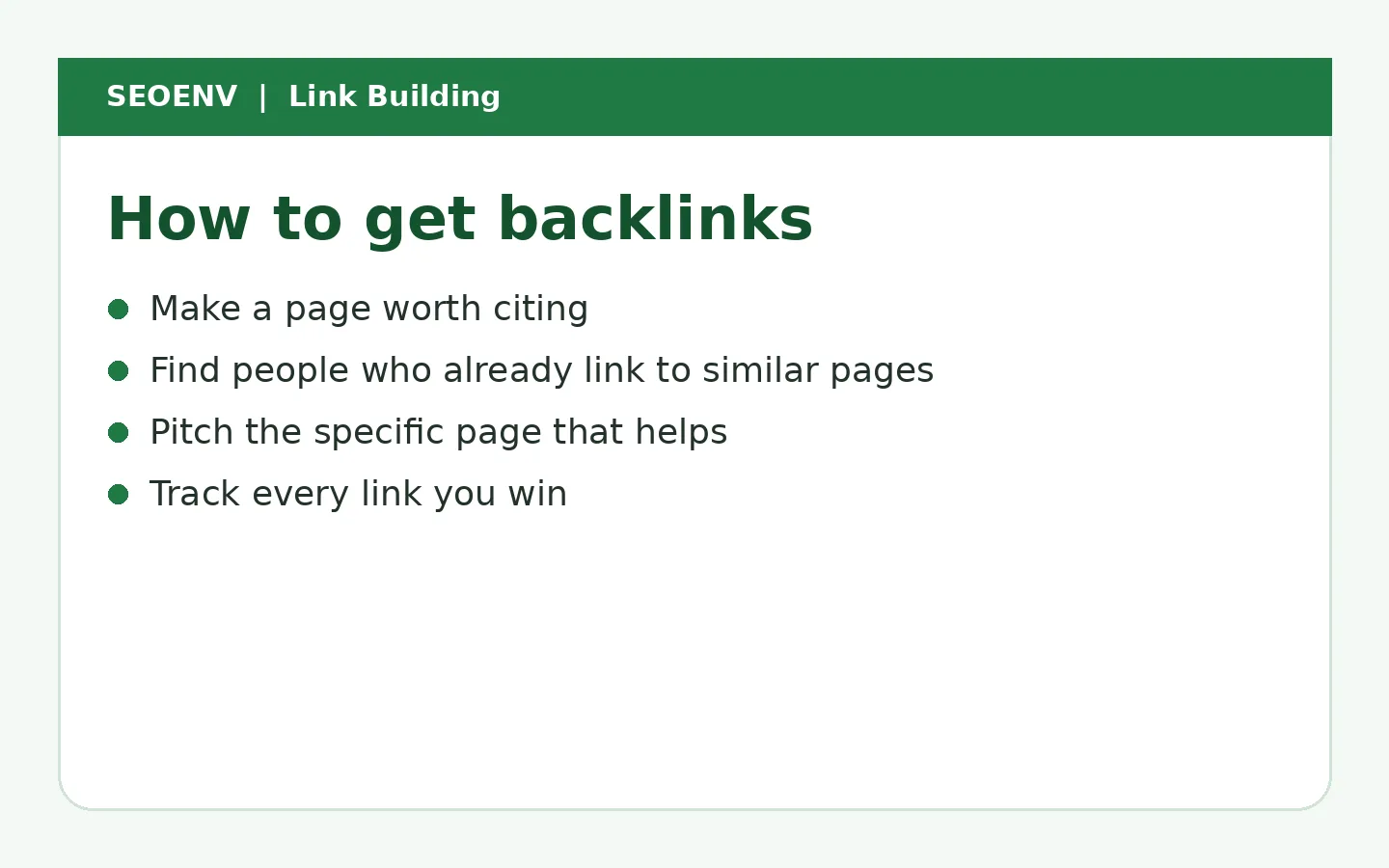
- Start with a page that deserves links.
- Low-effort wins: unlinked mentions, partners and broken links.
- High-value plays: original data, digital PR and tools.
- Guest posts and exchanges work when kept relevant and occasional.
- Track every link you win so none go missing.
The 15 methods at a glance
| # | Method | Effort | Typical value |
|---|---|---|---|
| 1 | Reclaim unlinked brand mentions | Low | High |
| 2 | Ask partners, suppliers and customers | Low | Medium-high |
| 3 | Fix links to your broken pages | Low | High |
| 4 | Get listed in relevant directories | Low | Low-medium |
| 5 | Answer journalist requests | Medium | Medium-high |
| 6 | Resource page outreach | Medium | Medium |
| 7 | Broken link building | Medium | Medium |
| 8 | Guest posting on relevant sites | Medium-high | Medium |
| 9 | Podcast and interview appearances | Medium | Medium |
| 10 | Competitor backlink gap | Medium | Medium-high |
| 11 | Create templates and checklists | Medium | Medium-high |
| 12 | Build a free tool | High | High |
| 13 | Publish original data | High | High |
| 14 | Digital PR campaigns | High | High |
| 15 | Relevant, occasional link exchanges | Medium | Varies |
Start here: a page worth linking to
Every method below works better with a page that earns its link. Before outreach, ask: would someone writing about this topic be better off linking to us? If the honest answer is "not really", improve the page first. Google's SEO starter guide puts it simply: promote content that's useful, and links tend to follow.
Quick wins
1. Reclaim unlinked brand mentions
Search for your brand name, product names and founder-free company terms in Google or a mentions tool. Where someone mentions you without linking, send a short thank-you and ask whether they'd add a link for readers.
2. Ask partners, suppliers and customers
Integration partners, agencies you work with, suppliers and happy customers often have "partners" or "tools we use" pages. A friendly request is usually enough.
3. Fix links pointing to your broken pages
In a backlink tool, filter for links to your pages that return 404. Redirect those URLs to the closest live page. You recover links you already earned.
4. Get listed in relevant directories
Industry associations, chambers of commerce and niche directories. Skip bulk directory packages. See directory backlinks.
Outreach methods
5. Answer journalist requests
Platforms connecting journalists with sources let you contribute expert comments. Respond quickly, answer the question directly and include a short credential.
6. Resource page outreach
Search for pages like "[topic] + resources" or "useful links". Suggest your page where it genuinely adds something the list lacks.
7. Broken link building
Find dead links on relevant pages (a crawler or a browser extension helps), then let the site owner know and suggest your page as a replacement if it fits.
8. Guest posting on relevant sites
Pitch useful articles to real publications in your niche, with a link where it helps readers. Keep anchors natural. Our guest posting process and outreach email template walk through it.
9. Podcasts and interviews
Hosts need guests. Show notes usually link to guests' sites, and you reach a real audience.
10. Competitor backlink gap
Use a backlink tool to find sites linking to two or more competitors but not you. They already cover your topic and may link to a better resource.
Outreach-based methods share one problem: they generate a lot of moving parts. Dozens of pitches, a handful of yeses, some links that go live weeks later and some that never do. Without a record, links quietly fall through the cracks.
Keep track of every link you're working on
Log pitches, guest posts and placements, then check which links went live.
Linkable assets
11. Templates and checklists
Practical templates (reports, trackers, briefs) are easy for writers to recommend. Make them free and ungated.
12. Free tools
Calculators, generators and checkers earn links for years. They take more work to build and maintain.
13. Original data
Surveys, analyses of public data or anonymised insights from your own work give journalists and bloggers something quotable.
14. Digital PR
Package data or a strong story for journalists. One successful campaign can earn dozens of links. See digital PR for SEO.
Exchanges, used carefully
15. Relevant, occasional link exchanges
Two related sites linking to each other's genuinely useful pages is normal. Google's spam policies name "excessive link exchanges" as link spam, so keep them relevant and infrequent. Our reciprocal link exchange guide covers how.
Worked example: a three-month plan (example data)
This plan and its figures are invented example data for a small B2B site.
| Month | Activities | Links won (example) |
|---|---|---|
| 1 | Unlinked mentions (15 found), partner requests (6), broken page fixes (4 URLs) | 11 |
| 2 | Publish a free template; resource page outreach (40); 3 guest post pitches accepted | 9 |
| 3 | Competitor gap outreach (50); journalist requests (10 answered) | 8 |
Month one is almost entirely quick wins, which fund the time to create an asset in month two. By month three the asset is earning links on its own.
Methods to avoid
- Buying followed links, or "guaranteed DA" packages.
- Private blog networks (PBNs). See PBN backlinks.
- Automated comment, forum and profile links.
- Large-scale guest posting with keyword-rich anchors.
- Excessive or unrelated link swaps.
How long until backlinks help?
New links need to be crawled and processed, and their effect builds over time. Many teams see movement within a few months for less competitive pages. For competitive terms, plan for a longer, steady effort.
How to increase backlinks without increasing risk
Focus on relevance, vary anchors, spread links across several pages and keep a record of what you arranged. If a tactic only works when nobody looks closely, skip it.
How SEOENV handles this
SEOENV gives each method a home. Guest posts move through five stages from Pitched to Published. Exchanges and ABC swaps sit in their own modules with both legs checked. Paid placements and listings have their own records. Every link lands in one Link Tracker, where it's checked for status and dofollow or nofollow.
Run your link building from one tracker
Every method, every link, every status in one place.
Pick three or four methods that suit your resources, do them consistently and keep track of the results. That beats trying all fifteen at once.
Start tracking the links you win
Free for up to 20 links, with checks on every plan.
Related reading
- What Are Backlinks? How They Work and Why They Matter for SEO
- Link Building Strategies: A Complete Playbook for Beginners
- Editorial Backlinks: What They Are and How to Earn Them
- Guest Blogging for SEO: How to Do It Without Risk in 2026
- Free Backlinks: 12 Legit Ways to Get Backlinks Without Paying
Sources
- Google Search Central: Spam policies (link spam)
- Google Search Central: SEO starter guide (promote your site)
How we wrote this
The SEOENV Team wrote this guide from our day-to-day work tracking link exchanges, guest posts and paid placements, and checked the guidance against the sources listed above. Any numbers in worked examples are illustrative example data, not results from a real site or study. We review our guides when Google updates its documentation.
Frequently asked questions
What is the easiest way to get backlinks?
Reclaiming unlinked brand mentions and asking partners, suppliers and customers for links are usually the easiest wins.
How do I get backlinks for a new website?
Start with partner and directory links, publish one strong reference page or template and do targeted outreach to sites covering your topic.
Can I get backlinks for free?
Yes. Most legitimate methods, such as outreach, guest posts and broken link building, cost time rather than money.
Is buying backlinks a good idea?
Buying followed links breaks Google's spam policies. Paid placements should be marked rel="sponsored".
How many backlinks should I build per month?
There's no safe number. Focus on a steady pace of relevant links rather than a target count.

Leave A Comment