
By SEOENV Team | Published October 23, 2026
An off-page SEO checklist keeps the work outside your site on schedule: check that existing links are still live, reclaim mentions, fix citations, respond to reviews, plan new links for target pages and report results. Running these 20 tasks each quarter catches problems early and keeps link building focused on the pages that matter.
Key takeaways
- Run off-page checks quarterly.
- Start with link health: lost, broken and nofollowed links.
- Then mentions, citations and reviews.
- Plan new links for target pages.
- Report on target pages, not totals.
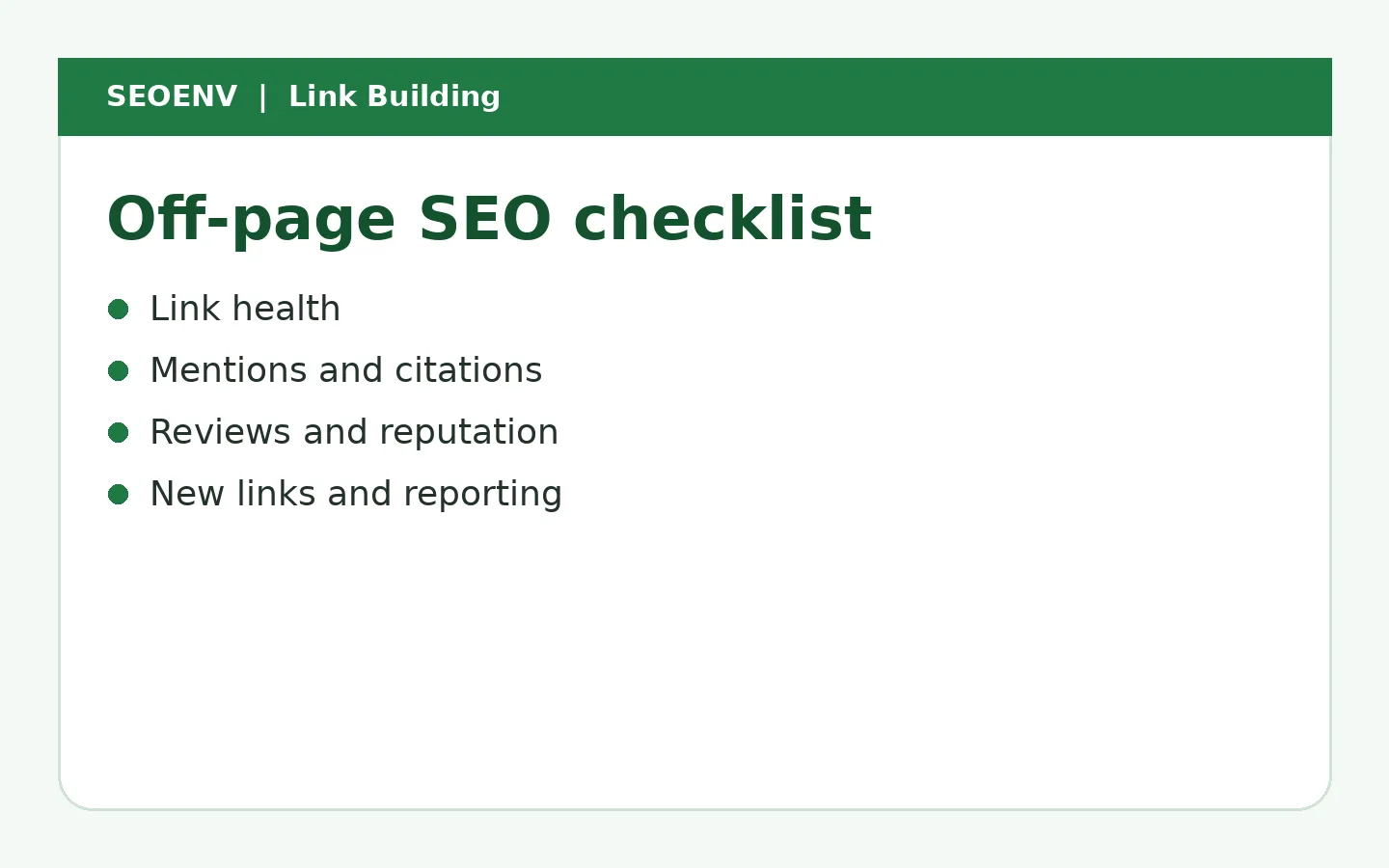
The checklist at a glance
| # | Task | Area |
|---|---|---|
| 1 | Check built links for Lost or Broken | Link health |
| 2 | Check for links switched to nofollow | Link health |
| 3 | Review links to 404 pages on your site | Link health |
| 4 | Review Search Console Links report | Link health |
| 5 | Check anchor text distribution | Link health |
| 6 | Look for unnatural spikes | Link health |
| 7 | Search for unlinked brand mentions | Mentions |
| 8 | Ask for links on mentions | Mentions |
| 9 | Verify NAP consistency | Citations |
| 10 | Update listings after changes | Citations |
| 11 | Respond to new reviews | Reviews |
| 12 | Ask happy customers for reviews | Reviews |
| 13 | Pick target pages for next quarter | Planning |
| 14 | Gap analysis vs competitors | Planning |
| 15 | Plan one linkable asset | Planning |
| 16 | Refresh prospect list | Outreach |
| 17 | Follow up with partners | Outreach |
| 18 | Review paid placements and renewals | Partners |
| 19 | Report referring domains to target pages | Reporting |
| 20 | Record lessons learned | Reporting |
Link health (tasks 1-6)
Use Search Console's Links report and a backlink tool to review top linking sites and pages. For links you built, check each one directly. See backlink audit guide and anchor text in SEO.
Mentions (7-8)
Search your brand in quotes, excluding your site. Ask for links politely.
Citations (9-10)
Check your business details match across listings. See citation SEO.
Reviews (11-12)
Respond to every review and ask satisfied customers. Never buy reviews.
Planning and outreach (13-18)
Choose target pages, size the gap and plan an asset. Review paid placements for renewals and make sure they're marked sponsored, in line with Google's spam policies.
Tasks 1 and 2 take the longest by hand: opening every page you've built a link on and inspecting the code.
Worked example: a quarterly review (example data)
| Task | Finding (example) | Action |
|---|---|---|
| Lost links | 9 of 140 | 4 recovered |
| Nofollow changes | 3 | 2 restored |
| 404 targets | 6 URLs | Redirected |
| Unlinked mentions | 7 | 3 linked |
| NAP issues | 2 | Fixed |
| Target pages next quarter | 3 | Gap plan |
Reporting (19-20)
Report on target pages. See link building report template.
How to work through the checklist in practice
The checklist is easier to sustain when each task has a rhythm and an owner. Here's how to turn it into a routine.
Monthly tasks (about two hours)
- Check link status. Open your link log and confirm every link built in the last six months is still live, still points to the right URL and still has the rel attribute you agreed.
- Recover lost links. For anything missing, email the contact who placed it. Be polite: pages get redesigned and links get dropped by accident.
- Fix broken targets. If a link points to a page you've moved or deleted, either redirect the old URL with a 301 or ask the site to update the link.
- Scan for new mentions. Search your brand name and product names. Note any mention without a link.
Quarterly tasks (about half a day)
- Review the whole backlink profile. Look for unusual spikes, large numbers of links from unrelated sites or sudden exact-match anchors.
- Audit citations. Check that your business name, address and phone number match across your main listings.
- Review reviews. Respond to recent reviews and look for patterns in complaints.
- Plan the next asset. Decide what you'll publish next quarter that deserves links.
Yearly tasks
- Revisit target pages. Are links still pointed at the pages that matter most?
- Review partners and suppliers. Partnerships change. Check old partner listings and update them.
- Reset goals. Compare the year's links, rankings and clicks against your plan.
Example data: an annual off-page calendar
These assignments are invented example data for a three-person marketing team.
| Month | Main focus | Owner |
|---|---|---|
| January | Full backlink review, goal setting | SEO lead |
| February | Data study outreach | Content writer |
| March | Citation clean-up | Marketing assistant |
| April | Quarterly review, lost link recovery | SEO lead |
| May | Guest contributions | Content writer |
| June | Partner listing updates | Marketing assistant |
| July | Quarterly review | SEO lead |
| August | New linkable asset | Content writer |
| September | Unlinked mention outreach | Marketing assistant |
| October | Quarterly review | SEO lead |
| November | Seasonal PR pitches | Content writer |
| December | Year-end report | SEO lead |
Pitfalls that make checklists fail
- No owner. A task everyone is responsible for is one nobody does.
- Too many tasks at once. Start with link health and mentions, then add the rest.
- No record. If you don't log what you checked and found, next quarter starts from zero.
- Treating every lost link as an emergency. Some removals are normal. Prioritise links from relevant, high-traffic pages.
- Ignoring on-page work. Off-page effort can't rescue a page that doesn't match search intent.
How to prioritise when time is short
If you have one hour a month, spend it on two tasks: checking that your most valuable links are still live and turning one unlinked mention into a link. Both protect or add value without building anything new. If you have a day a month, add one outreach campaign around a single strong asset.
Tools you need for the checklist
You don't need a large stack. A backlink tool or Google Search Console's Links report shows who links to you. A spreadsheet or link tracker holds your record of links you've built, with dates, contacts and status. Search alerts catch new mentions. Your business profile dashboards cover citations and reviews. The key is that one place holds the full list of links you've earned or paid for, because backlink tools show what they've found, not what you agreed.
Printable summary
- Monthly: link status, lost links, broken targets, new mentions.
- Quarterly: profile review, citations, reviews, next asset.
- Yearly: target pages, partners, goals.
- Always: log every check and outcome.
Reporting the checklist to stakeholders
A one-page monthly summary keeps the work visible: links gained, links lost and recovered, mentions converted, citations fixed and the next month's focus. Add a short note on anything unusual, such as a spike in links from unrelated sites. Over a year, these summaries show which tasks actually produced results, so you can drop the ones that don't.
Adapting the checklist for agencies
Agencies running off-page work for several clients can use the same checklist per client, with one shared calendar. Give each client its own link log so reports stay separate, and schedule quarterly reviews in different weeks so the team isn't overloaded at quarter end.
How SEOENV handles this
SEOENV covers the link side: status and type checks, anchor tracking (heatmap and alerts on Growth), listing records with account details, paid collaborations with renewal dates and shareable reports.
Twenty tasks, once a quarter. It's the difference between a link profile you understand and one you hope is fine.
Related reading
- What Is Off-Page SEO? Definition, Factors and Examples
- Backlink Audit Guide
- Citation Link Building: Citations vs Backlinks Explained
- Link Building KPIs
- Link Building Report Template
Sources
How we wrote this
The SEOENV Team wrote this guide from our day-to-day work tracking link exchanges, guest posts and paid placements, and checked the guidance against the sources listed above. Any numbers in worked examples are illustrative example data, not results from a real site or study. We review our guides when Google updates its documentation.
Frequently asked questions
What is an off-page SEO checklist?
A list of recurring tasks for link health, mentions, citations, reviews, planning and reporting.
How often should I run off-page SEO checks?
Quarterly works for most sites; check high-value links more often.
What is the most important off-page task?
Checking that existing links are still live, then building links to target pages.
Should I disavow links during audits?
Only for clear manipulative links, especially with a manual action. Most spammy links are ignored.
Do reviews count as off-page SEO?
Yes, especially for local businesses.

Leave A Comment