
By SEOENV Team | Published October 23, 2026
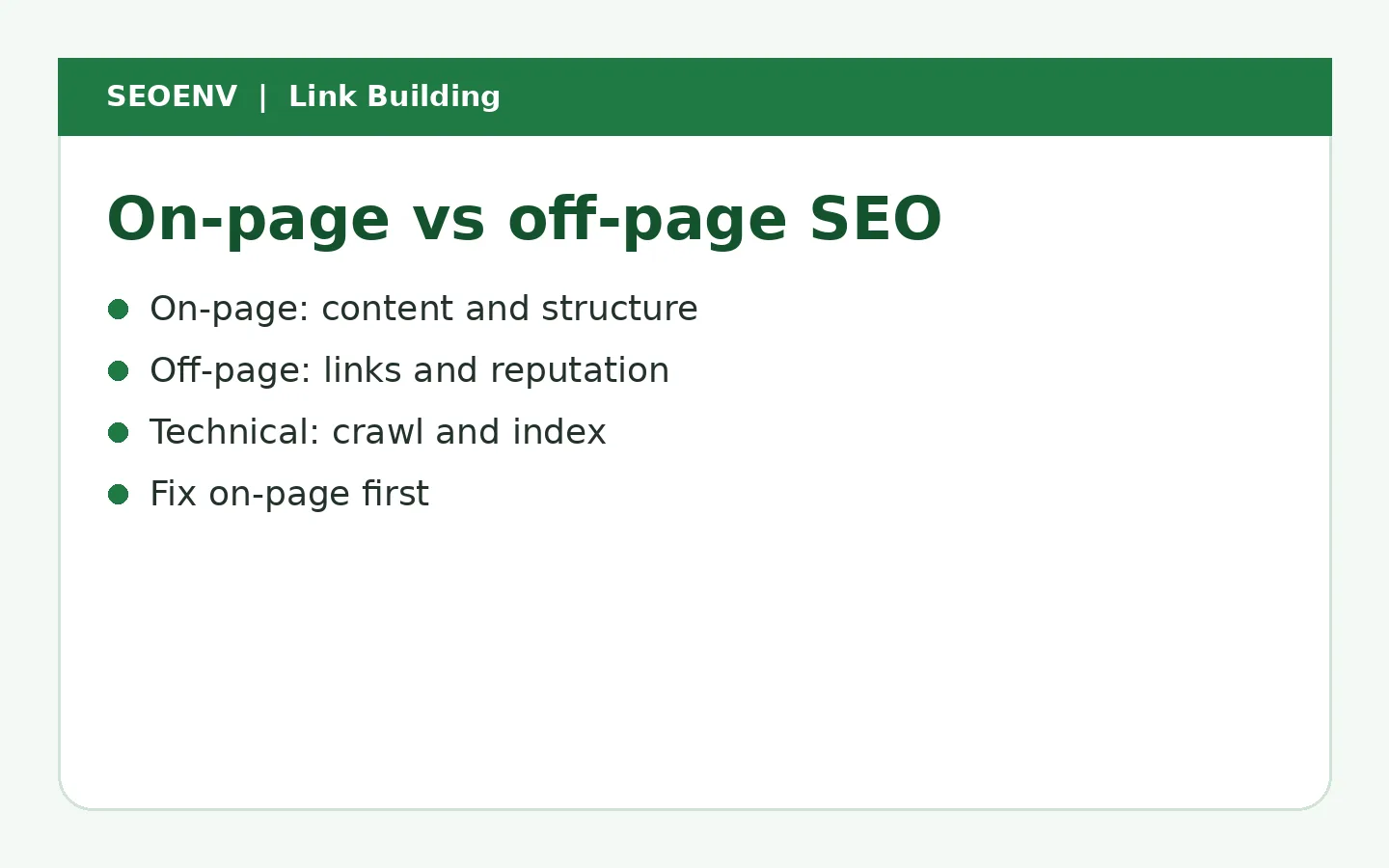
On-page SEO covers everything you control on your own pages: content, titles, headings, internal links and structured data. Off-page SEO covers signals from outside your site, mainly backlinks, plus mentions, reviews and PR. On-page makes a page worth ranking; off-page shows others agree. Fix on-page basics first, because links pointed at weak pages are wasted.
Key takeaways
- On-page: content, titles, headings, internal links.
- Off-page: backlinks, mentions, reviews, PR.
- Technical SEO underpins both.
- Fix on-page first so off-page effort pays off.
- Most competitive pages need both.
The difference at a glance
| On-page SEO | Off-page SEO | |
|---|---|---|
| Where | Your pages | Other sites |
| Control | Full | Partial |
| Examples | Content, titles, headings, internal links | Backlinks, mentions, reviews, PR |
| Speed of change | Fast | Slow |
| Main question | Is this the best answer? | Do others trust it? |
Technical SEO (crawling, indexing, speed) supports both.
On-page SEO examples
- Content that fully answers the query.
- Clear title tags and meta descriptions.
- Logical headings.
- Internal links to related pages.
- Images with alt text.
- Structured data.
Google's SEO starter guide covers these basics.
Off-page SEO examples
- Editorial backlinks.
- Guest posts on industry sites.
- Digital PR coverage.
- Local citations and reviews.
See what is off-page SEO.
How they work together
Google's How Search works describes discovery through links and ranking by relevance and quality. On-page makes your page relevant; off-page helps it get discovered and trusted. Internal links connect the two by passing value from linked pages. See link equity explained.
Which to prioritise
| Situation | Priority |
|---|---|
| New site, thin content | On-page |
| Good content, few links | Off-page |
| Ranking on page 2 | Both, start with on-page gaps |
| Strong links, poor rankings | On-page and technical |
Off-page work is harder to keep track of because it lives on other people's sites, and it can change without you knowing.
Worked example: prioritising a page (example data)
| Check | Finding | Fix |
|---|---|---|
| Content | Missing pricing section | On-page |
| Title | Doesn't include main term | On-page |
| Internal links | 1 | On-page |
| Referring domains | 3 vs competitor median 14 | Off-page |
The team fixed on-page issues in a week, then built links over three months.
Common mistakes
- Building links to thin pages.
- Ignoring internal links.
- Over-optimised anchors. See anchor text.
A step-by-step audit that covers both
Running on-page and off-page checks together stops you building links to pages that can't rank, or polishing pages nobody links to.
Step 1: pick the page and the query
Choose one page and the main query it should rank for. Search that query and open the top five results.
Step 2: check search intent
Are the top results guides, product pages, comparison tables or tools? If your page is a different type, fix that first. No number of links will make a sales page rank for a query where Google shows how-to guides.
Step 3: check on-page basics
- Title and H1 include the topic naturally.
- The first paragraph answers the query.
- Content covers the subtopics the top results cover.
- Images have descriptive alt text.
- The page loads quickly and works well on mobile.
- Other pages on your site link to it with descriptive anchors.
Google's SEO starter guide covers these fundamentals.
Step 4: check off-page signals
- How many relevant sites link to this page?
- How does that compare with the pages ranking above you?
- Are there unlinked mentions you could convert?
- Are any existing links lost or broken?
Step 5: decide the next action
If on-page gaps are large, fix them first. If the page is strong but has far fewer relevant links than competitors, plan outreach.
Decision table
| On-page | Off-page | Next action |
|---|---|---|
| Weak | Weak | Fix the page first, then build links |
| Weak | Strong | Fix the page; links are being wasted |
| Strong | Weak | Build relevant links to this page |
| Strong | Strong | Maintain, refresh and monitor |
Example data: auditing five pages
These pages and figures are invented example data.
| Page | Intent match | On-page score | Referring domains | Competitor median | Action |
|---|---|---|---|---|---|
| /pricing/ | Yes | Good | 4 | 12 | Outreach |
| /blog/guide-a/ | Yes | Good | 15 | 10 | Maintain |
| /features/ | No | Fair | 8 | 6 | Rework page type |
| /blog/guide-b/ | Yes | Poor | 2 | 9 | Fix content, then links |
| /templates/ | Yes | Good | 1 | 3 | Light outreach |
Only two of five pages needed link building as the main next step. That's typical: audits often show that on-page fixes are the faster win.
Internal links: the bridge between the two
Internal links are on-page, but they spread the value of external links around your site. If a blog post earns ten links, linking from it to your pricing page passes some of that benefit along. After any link campaign, check that the page receiving links links on to the pages you most want to rank.
Pitfalls
- Building links to the homepage only. Deep pages need links too.
- Rewriting pages that already rank well. Change carefully and measure.
- Treating technical SEO as optional. Pages that can't be crawled or indexed can't benefit from either.
- Ignoring the competitor gap. Compare with what actually ranks, not with an ideal.
Quick checklist
- Intent matches top results.
- Title, H1 and intro are clear.
- Content covers key subtopics.
- Internal links point to the page.
- Relevant external links compared with competitors.
- Lost links recovered.
- Next action recorded.
Examples of each in a real workflow
Imagine a small software company that wants its "project budget template" page to rank.
On-page work it might do:
- Rewrite the title to match how people search, such as "Project Budget Template (Free Download)".
- Add a short intro explaining what the template includes.
- Add a worked example showing the template filled in.
- Compress images and add alt text.
- Link to the page from three related blog posts.
Off-page work it might do:
- Pitch the template to project management blogs that list free resources.
- Ask a software partner to include it in their resource hub.
- Contact sites that mention "project budget template" but link to outdated versions.
- Record each link and re-check it monthly.
The on-page work makes the page worth linking to. The off-page work brings links that help it rank and send visitors. Neither alone would be as effective.
How long each takes to show results
On-page changes can show up as soon as Google recrawls the page, often within days or weeks. Off-page results usually take longer because links must be found, crawled and weighed. Plan for a quarter before judging a link campaign, and measure on-page changes separately so you know which work moved the needle.
Which one should a new site start with?
A new site should start with on-page work: clear pages that match search intent, sensible internal links and a site Google can crawl. Once a few pages are genuinely useful, start earning links to them through partners, suppliers, communities and outreach. Building links to a site with thin pages wastes effort, while great pages with no links struggle to compete in crowded results.
How SEOENV handles this
SEOENV focuses on the off-page link work: tracking every link you build with status and dofollow or nofollow checks, organised by client and project. Pair it with your on-page tools.
Make each page worth linking to, then earn the links. That's on-page and off-page working together.
Related reading
- What Is Off-Page SEO? Definition, Factors and Examples
- Off-Page SEO Checklist: 20 Tasks to Run Every Quarter
- Link Equity (Link Juice) Explained for Site Owners
- Anchor Text in SEO: Types, Ratios and Safe Best Practices
- Link Building Strategies: A Complete Playbook for Beginners
Sources
How we wrote this
The SEOENV Team wrote this guide from our day-to-day work tracking link exchanges, guest posts and paid placements, and checked the guidance against the sources listed above. Any numbers in worked examples are illustrative example data, not results from a real site or study. We review our guides when Google updates its documentation.
Frequently asked questions
What is the difference between on-page and off-page SEO?
On-page is what you control on your pages; off-page is signals from other sites, mainly backlinks.
Which is more important?
Both. On-page makes a page relevant; off-page shows others trust it.
Is internal linking on-page or off-page?
On-page. It's on your own site.
Is technical SEO part of on-page?
It's usually treated separately but supports both.
Should I do on-page or off-page first?
Usually on-page, so links point at pages worth ranking.

Leave A Comment