
By SEOENV Team | Published October 23, 2026
A backlink exchange is safe when it's occasional, between genuinely related sites, with links placed where they help readers. It becomes risky when it's done at scale, between unrelated sites, through swap networks or with exact-match anchors, which is what Google's spam policies mean by "excessive link exchanges". Before agreeing to any swap, ask whether the link would make sense without the exchange.
This guide focuses on judging risk. For how reciprocal exchanges work step by step, see our reciprocal link exchange guide, and for the basics, what is link exchange in SEO.
Key takeaways
- Occasional, relevant exchanges happen naturally.
- Google flags excessive exchanges, not every mutual link.
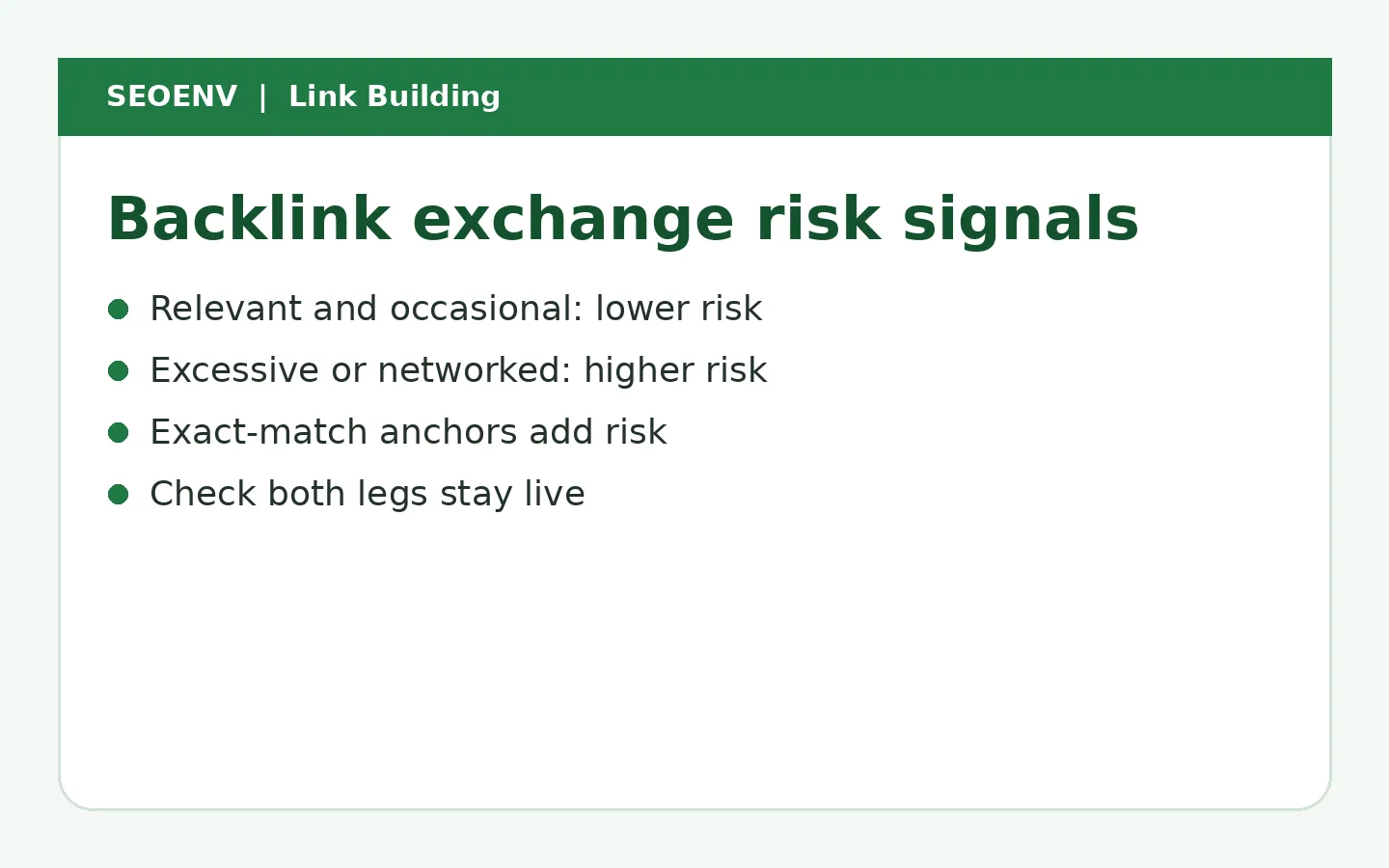
- Risk signals: scale, irrelevance, exact anchors, networks.
- Use a simple five-question test before agreeing.
- Record every exchange and check both legs stay live.
What Google actually says
Google's spam policies list "excessive link exchanges ('Link to me and I'll link to you') or partner pages exclusively for the sake of cross-linking" as link spam. The word "excessive" matters: related sites linking to each other is normal on the web.
Risk signals
| Signal | Lower risk | Higher risk |
|---|---|---|
| Relevance | Same topic or audience | Unrelated |
| Frequency | A few a year | Dozens a month |
| Source | Natural relationship | Swap groups, networks |
| Anchor | Brand or natural | Exact-match keyword |
| Placement | In useful content | Links pages, footers |
| Pattern | One-off | A↔B, B↔C, C↔A across a network |
| Payment | None | Swap plus fee |
A five-question test for any swap offer
- Would I link to their page if they weren't linking back?
- Is their site relevant to my readers?
- Does the site have real traffic and editorial standards?
- Are anchors natural?
- Is this one of many swaps this month?
If you answer "no" to any of 1-4, or "yes" to 5, decline.
ABC and three-way exchanges
Three-way swaps hide reciprocity but are still exchanges. Treat them with the same test. See ABC link exchange.
Marking exchanged links
If an exchange feels more transactional than editorial, Google's qualify outbound links guidance lets you use nofollow.
Exchanges have two legs. If your partner removes their link but yours stays, the deal is broken and you won't know unless you check both.
Worked example: scoring three offers (example data)
| Offer | Relevant | Traffic | Anchor | Volume | Decision |
|---|---|---|---|---|---|
| Industry blog | Yes | Yes | Brand | One-off | Accept |
| Swap group member | No | Low | Exact match | 5 a month | Decline |
| Supplier | Yes | Moderate | Natural | One-off | Accept |
Cleaning up past exchanges
If you've swapped heavily before, list every exchange, remove or nofollow irrelevant ones and keep only those that pass the test.
How to evaluate a link exchange offer step by step
Step 1: read the offer carefully
Note what's being asked: a one-to-one swap, a three-way (ABC) arrangement, a "partner page" listing or a guest post swap. Note whether money or services are also involved.
Step 2: check the other site
Open the site. Is it relevant to your audience? Does it have real visitors and edited content? Look at its outbound links: if it links to hundreds of unrelated sites, it's likely part of a swap network.
Step 3: check the proposed page
Where would your link go? A relevant article where readers benefit is very different from a "links" or "partners" page with dozens of unrelated entries.
Step 4: check where their link would go
Would you place their link somewhere it genuinely helps your readers? If you'd only add it because of the swap, that's a sign it's an exchange for ranking purposes.
Step 5: decide and record
If you go ahead, record both links: where each sits, the date, the contact and the agreed terms. Re-check both periodically.
Example data: a link exchange scorecard
These offers are invented example data.
| Question | Offer 1 | Offer 2 | Offer 3 |
|---|---|---|---|
| Relevant to my readers? | Yes | No | Partly |
| Real site with visitors? | Yes | No | Yes |
| In-body placement on a relevant page? | Yes | Links page | Yes |
| Would I link to them anyway? | Yes | No | Maybe |
| Money or "network" involved? | No | Yes | No |
| Decision | Proceed, natural partner | Decline | Proceed only if content fits |
What "excessive" looks like
Google's spam policies mention "excessive link exchanges" as link spam. There's no published number, but patterns that look excessive include:
- Many links to and from the same group of sites.
- Swaps across unrelated topics.
- Dedicated "link partners" pages.
- Exchange agreements arranged at scale through networks or marketplaces.
- Three-way schemes designed to hide reciprocity.
A few natural cross-links between genuine partners, such as a software integration and its partner, are a normal part of the web.
Pitfalls
- Joining swap networks. They create exactly the pattern Google describes.
- Ignoring relevance. A swap with an unrelated site helps neither audience.
- Forgetting your side. You're also placing a link, and you're responsible for where you link.
- Not tracking. Partners remove links; without a record, you won't know.
- Mixing money in. Payment makes the link a paid link that should be qualified.
Link exchange checklist
- Offer type understood.
- Partner site relevant and genuine.
- Placement in relevant body content.
- You'd link to them without the swap.
- No money or network involved, or links qualified appropriately.
- Both links recorded with dates and contacts.
- Status re-checked monthly.
Healthier alternatives to swaps
Instead of trading links, look for ways to collaborate that create value for both audiences: co-authored guides, joint webinars, integration pages, expert quotes for each other's articles or shared research. Links that come from collaboration are earned by the content, not traded, and they usually send more engaged visitors.
Talking to partners about exchanged links
If you already have exchanges with genuine partners, there's no need to panic. Review them with the tests above. Keep links that serve readers, and politely agree to remove or qualify ones that don't. Most partners appreciate a clear, friendly approach, and it's an opportunity to replace a weak swap with a more useful collaboration.
How exchanges show up in a backlink profile
Search engines see links, not agreements. When many of your links come from sites you also link to, especially across unrelated topics or from pages full of reciprocal links, the pattern is easy to spot. Reviewing your own profile through that lens helps: export the sites linking to you, export the sites you link out to, and look at the overlap. A handful of overlapping, relevant partners is normal. A large overlap with unrelated sites suggests an exchange pattern worth cleaning up. Our guides to reciprocal link exchange and what link exchange means in SEO go deeper on this, including how to clean up older swaps and replace them with real, useful collaborations.
How SEOENV handles this
SEOENV's Master Link Exchange records both sides of each swap: the link you gave, the link you received, the partner and anchors. Both are checked for status and dofollow or nofollow. ABC Link Exchange handles three-way swaps. The Anchor Text Heatmap on Growth flags over-optimised anchors.
Exchange rarely, relevantly and openly, and check both sides stay in place.
Related reading
- Reciprocal Link Exchange
- What Is Link Exchange in SEO?
- Three-Way Link Exchange (ABC)
- How to Build a Site Inventory for Link Swaps
- Anchor Text in SEO: Types, Ratios and Safe Best Practices
Sources
How we wrote this
The SEOENV Team wrote this guide from our day-to-day work tracking link exchanges, guest posts and paid placements, and checked the guidance against the sources listed above. Any numbers in worked examples are illustrative example data, not results from a real site or study. We review our guides when Google updates its documentation.
Frequently asked questions
Is backlink exchange safe?
Occasional, relevant exchanges are normal. Excessive or networked exchanges are link spam.
How many link exchanges are too many?
Google doesn't give a number. A pattern of many swaps, especially with unrelated sites, is the risk.
Are ABC exchanges safer than direct swaps?
No. They're still exchanges and are judged the same way.
Should exchanged links be nofollow?
If the exchange is transactional rather than editorial, nofollow is a cautious choice.
What should I do if a partner removes their link?
Ask them to restore it, or remove your link if the deal was conditional.

Leave A Comment