
By SEOENV Team | Published October 23, 2026
Buying backlinks that pass ranking credit breaks Google's spam policies; buying a placement that's marked rel="sponsored" doesn't. Google's systems often simply ignore paid links rather than penalise, which means you may be paying for nothing, but clear, large-scale patterns can lead to manual actions. Judge any purchase on scale, relevance, anchors and whether the link is honestly marked. For a broader overview see our guide to paid backlinks.
Key takeaways
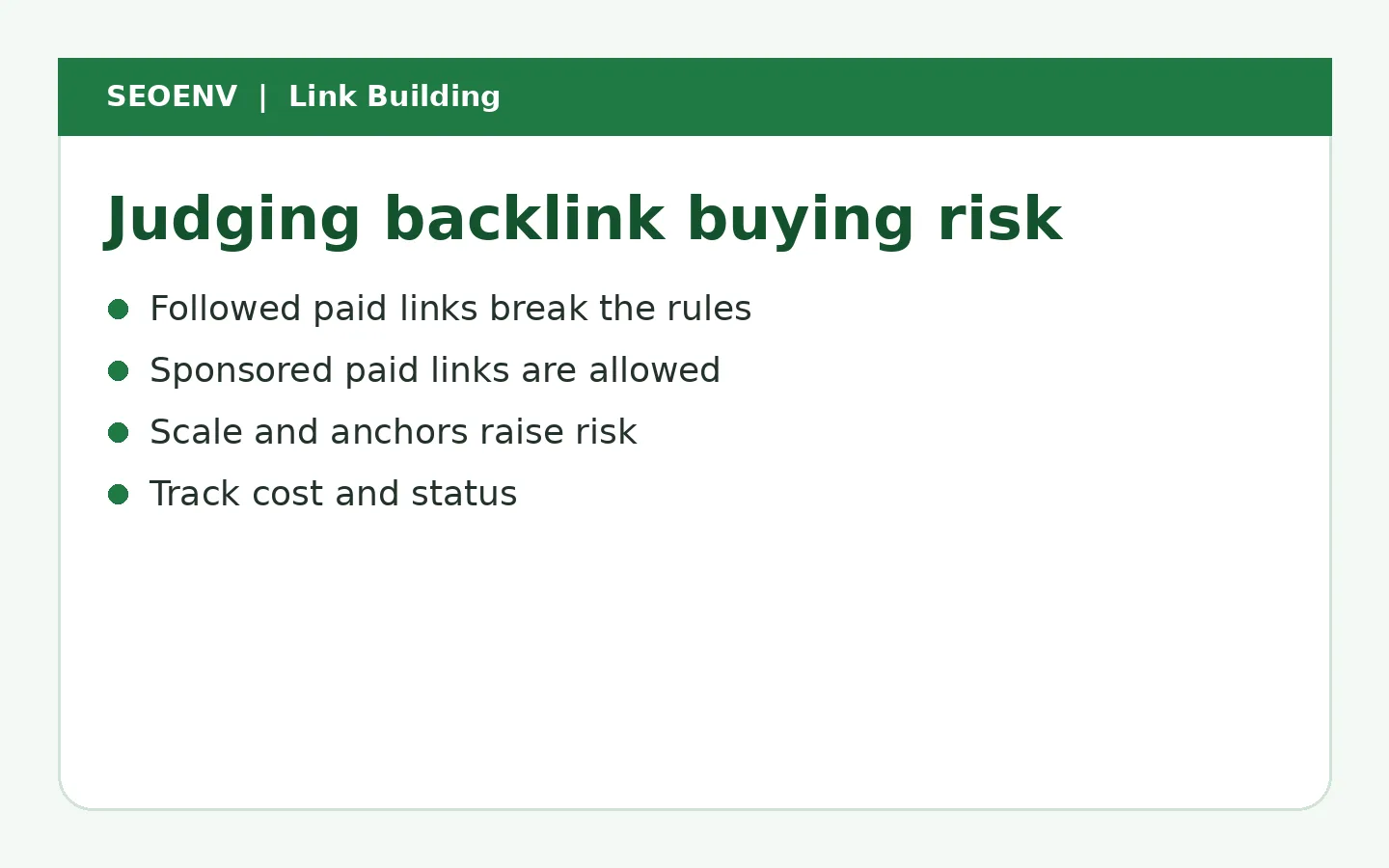
- Buying links that pass ranking credit breaks Google's spam policies.
- Paid placements marked sponsored are allowed.
- Risk rises with scale, irrelevance and exact anchors.
- Google often ignores paid links rather than penalising.
- Track every paid placement and its cost.
What the rules say
Google's spam policies include "buying or selling links for ranking purposes", including exchanging money, goods or services for links. Its qualify outbound links guide says paid links should use rel="sponsored". Google's 2021 post on link spam notes that sites failing to qualify such links may see actions.
Risk matrix
| Factor | Lower risk | Higher risk |
|---|---|---|
| Marking | Sponsored | Followed, hidden |
| Scale | Occasional | Many per month |
| Relevance | Niche match | Unrelated |
| Site | Real audience | Link-selling site |
| Anchor | Brand | Exact-match |
| Source | Publication ad programme | PBN, marketplace |
Questions before you pay
- Will the link be marked sponsored?
- Would the placement bring visitors I want?
- Does the site sell links on every topic?
- What anchor will be used?
- Can I see the site's other paid posts?
Safer alternatives
- Sponsored placements for traffic and awareness.
- Paying for content or outreach labour.
- Digital PR.
Paid links are the most likely to vanish when the vendor's site changes or the deal ends, and you only find out if you check.
Check paid links are live before you pay
Paid Collaborations tracks vendor, cost and status.
Worked example (example data)
| Offer | Marked | Relevant | Anchor | Risk |
|---|---|---|---|---|
| Niche newsletter sponsorship | Sponsored | Yes | Brand | Low |
| "DA 60 general blog" | Followed | No | Exact | High |
| Marketplace bundle of 20 | Followed | Mixed | Exact | Very high |
If you've already bought links
Stop buying followed links, record what you have and consider asking for sponsored marking. Disavow is mainly for manual actions; see how to disavow backlinks.
How to judge a paid link offer step by step
Step 1: identify what you're actually buying
Is it a sponsored article clearly labelled as such, a "guest post" on a site that charges for every post, a link inserted into an existing article, or a listing in a paid directory? Each carries different risk.
Step 2: ask how the link will be marked
Google's guidance on qualifying outbound links says paid links should carry rel="sponsored" (or nofollow). If the seller insists the link will be "dofollow" and unlabelled, you're being sold the exact thing Google's spam policies describe.
Step 3: inspect the site
Check relevance, real visitors and editorial quality. Look at recent posts: do many of them contain one commercial link to an unrelated business? That's a sign the site exists mainly to sell links.
Step 4: weigh the non-SEO value
Would the placement send relevant visitors or build brand awareness even with a sponsored label? If yes, it may be a reasonable advertising spend. If the only value is a followed link, the risk outweighs the reward.
Step 5: record the purchase
If you go ahead, record the URL, cost, date, vendor and how the link is marked. You'll need this if you ever have to clean up.
Types of paid placements compared
| Type | Typical labelling | Risk if unlabelled | Non-SEO value |
|---|---|---|---|
| Sponsored article on a real publication | Marked sponsored | Medium | Can be high |
| Paid guest post on a link-selling blog | Often unlabelled | High | Usually low |
| Link insertion into an old article | Usually unlabelled | High | Low |
| Paid directory listing | Varies | Medium | Varies |
| Event or charity sponsorship | Often a logo link | Medium | Brand and community |
| Influencer or newsletter mention | Should be disclosed | Medium | Can be high |
Example data: auditing a year of purchased links
These figures are invented example data for a mid-sized ecommerce site.
| Group | Links | Cost | Still live | Labelled sponsored | Action |
|---|---|---|---|---|---|
| Sponsored articles, real sites | 6 | 3,000 | 6 | 6 | Keep |
| Paid guest posts, general blogs | 22 | 2,200 | 15 | 0 | Ask to label or remove |
| Link insertions | 18 | 1,800 | 9 | 0 | Ask to remove; disavow if needed |
| Total | 46 | 7,000 | 30 | 6 |
Half the link insertions were already gone within a year, and 24 live links carried risk with no label. The six labelled sponsored articles were the only spend that clearly held value.
Pitfalls
- Trusting "safe" or "white hat" labels from sellers. The label doesn't change what the link is.
- Buying in bulk. Patterns are easier to detect at scale.
- Exact-match anchors. These make paid links even more obvious.
- No records. If you can't list what you bought, you can't clean it up.
- Ignoring the seller's other clients. If a site links to everyone who pays, its links carry little value.
Paid link decision checklist
- Placement type identified.
- Labelling confirmed (sponsored or nofollow).
- Site relevant with real visitors.
- Non-SEO value clear.
- Anchor natural.
- Purchase recorded with URL, cost, date and vendor.
- Link re-checked periodically.
What to do instead of buying links
Put the same budget into assets that earn links: original data, useful tools or templates, expert content and digital PR. Spend on sponsorships and advertising where the value is the audience, and accept the sponsored label. See white hat link building and how to get backlinks for approaches that don't put your site at risk.
How to explain the risk to a boss or client
Decision-makers often see competitors buying links and wonder why they shouldn't. Keep the explanation simple. Google's spam policies treat links bought to pass ranking credit as link spam. Its systems are designed to ignore such links, so the money may simply be wasted. In more serious cases, sites can receive manual actions that take time and effort to resolve. The same budget spent on content, PR or properly labelled sponsorships builds assets that keep their value. Framing it as "where will this budget still be working in two years?" usually makes the choice clear.
If a link seller contacts you
Unsolicited emails offering "high DA dofollow links" are common. Before replying, check the sites they list against the steps above. Most offers fail on relevance or on labelling. A polite decline, or no reply, is usually the right response. If you're tempted, ask the seller directly whether links will carry rel="sponsored". Their answer tells you whether you'd be buying advertising or buying risk. See also PBN backlinks, since many sellers draw on private networks that put every client linked from them at shared risk.
A quick rule of thumb
If you'd be uncomfortable showing a link purchase to a Google reviewer, a customer or a journalist, don't make it. If you'd happily show it, label it properly and keep the record.
How SEOENV handles this
SEOENV's Paid Collaborations records vendor, cost, payment status and the link, and checks the link is live before you pay. Status and dofollow or nofollow checks continue afterwards.
Judge every paid link on risk, mark it honestly and track it.
Related reading
- Paid Backlinks and Google
- Link Building Packages and Pricing: What You're Really Paying For
- PBN Backlinks: What They Are and Why They're a Bad Bet
- White Hat Link Building: Techniques That Stay Within Google's Rules
- Toxic Backlinks: How to Find Them and What to Actually Do
Sources
- Google Search Central: Spam policies (link spam)
- Google Search Central: Qualify your outbound links
- Google Search Central Blog: Link tagging and link spam
How we wrote this
The SEOENV Team wrote this guide from our day-to-day work tracking link exchanges, guest posts and paid placements, and checked the guidance against the sources listed above. Any numbers in worked examples are illustrative example data, not results from a real site or study. We review our guides when Google updates its documentation.
Frequently asked questions
Is buying backlinks illegal?
Not illegal, but buying links that pass ranking credit breaks Google's spam policies.
Can Google detect paid links?
Google uses systems and manual review to identify link spam and often nullifies it.
Are sponsored links allowed?
Yes. Paid links marked rel="sponsored" comply with Google's guidelines.
What happens if I buy backlinks?
They may be ignored, or with clear patterns, lead to a manual action.
What should I do instead?
Earn links through content, outreach and PR, and mark any paid placements sponsored.
Leave A Comment