
By SEOENV Team | Published October 23, 2026
A high-quality backlink comes from a relevant, real website that people actually read, sits inside useful content, uses a natural anchor and was given because your page helps the reader. Metrics such as Domain Rating or Domain Authority can help you shortlist sites, but they don't decide quality on their own. The checklist below lets you judge any link in a few minutes.
If you've ever been offered a "DA 70 backlink" and wondered whether it was worth it, this is for you.
Key takeaways
- Relevance to your topic and audience is the first test.
- Real organic traffic beats a high authority score.
- Links inside useful content with natural anchors are worth most.
- Paid links must be marked sponsored.
- Recheck links after they go live; quality can change.
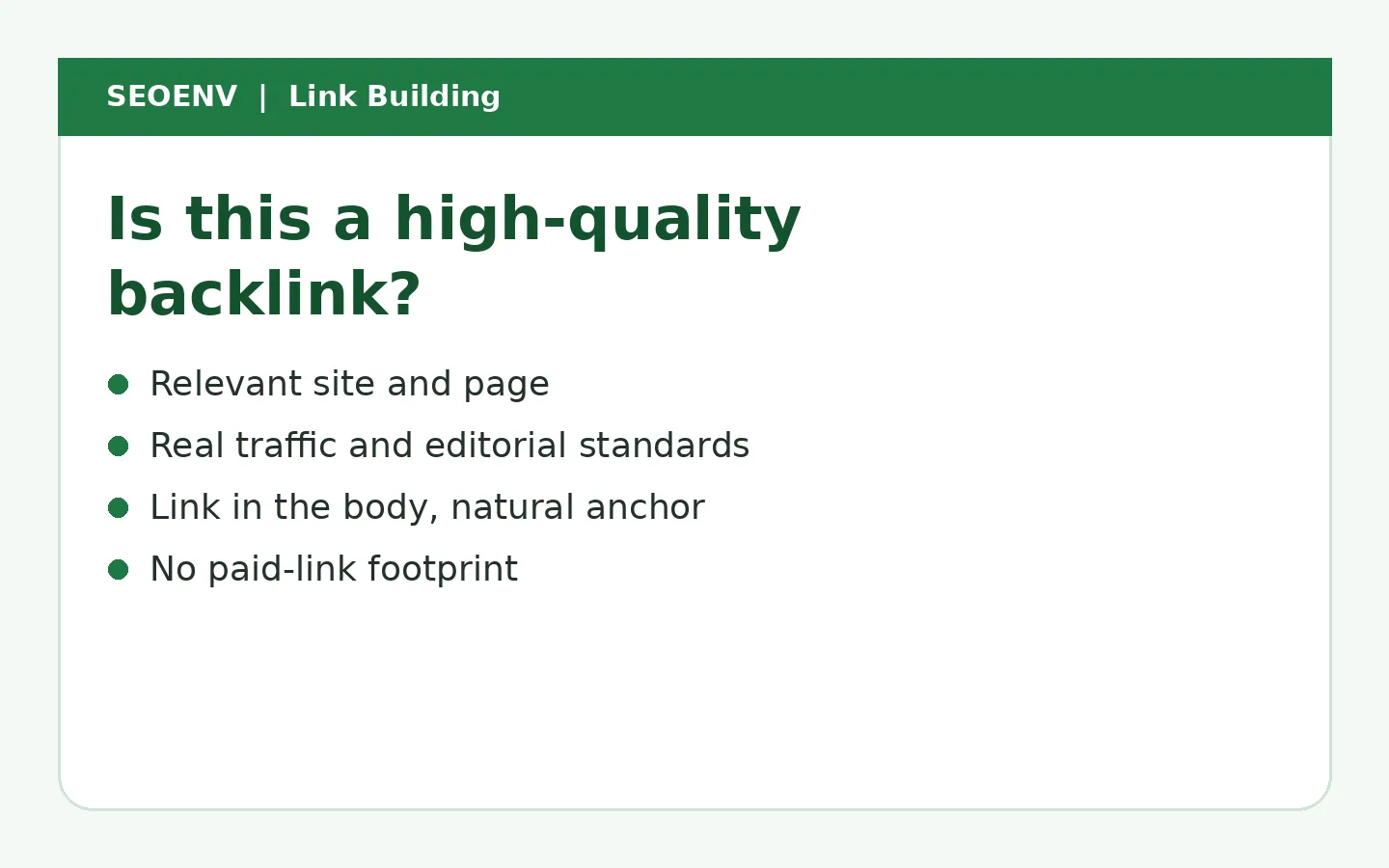
The quick checklist
| Question | Good sign | Red flag |
|---|---|---|
| Is the site relevant? | Covers your topic or audience | Writes about everything |
| Does it get real traffic? | Steady organic visitors | Traffic falling or near zero |
| Would the editor link anyway? | Link helps the reader | Link only exists because it was paid for |
| Where is the link? | In the body of an article | Footer, sidebar, author box only |
| What is the anchor? | Descriptive and natural | Exact-match commercial keyword |
| What else does the site link to? | Respected sources | Casinos, pills, loans, unrelated sites |
| Is it marked correctly? | Sponsored if paid | Followed link that was paid for |
1. Relevance comes first
The best backlinks come from sites whose readers would genuinely care about your page. A link to a link-building template from an SEO newsletter makes sense. The same link from a wedding blog does not, however strong the wedding blog is.
Check relevance at two levels: the site and the specific page. A general marketing site can be relevant if the linking article is about SEO reporting.
2. Real traffic and an audience
Use a tool such as Ahrefs, Semrush or Similarweb to look at estimated organic traffic. You're looking for:
- a steady or growing trend rather than a cliff;
- traffic coming from searches related to the site's topic;
- traffic in countries that matter to you.
Sites that sell guest posts at scale often show high authority scores with little or falling traffic. That gap is one of the most reliable warning signs.
3. Editorial standards
Read three or four recent posts. Ask yourself:
- Are they written for readers, or as thin wrappers around links?
- Do they have real authors and dates?
- Does the site publish a "write for us" page that lists prices for links?
A site with editorial standards turns down weak pitches. Ironically, that is exactly what makes its links valuable.
4. Placement inside content
A link in the main body of a relevant article, surrounded by related text, gives readers and search engines more context than a link in a footer. Our guide to contextual links explains why placement matters.
5. A natural anchor
Anchors should describe your page the way a writer naturally would. Branded, URL and descriptive anchors are normal. If every link you build uses the same money keyword, the profile starts to look engineered. See our anchor text ratio guide.
6. Correct link attributes
Google asks sites to mark paid and sponsored links with rel="sponsored" and user-generated links with rel="ugc", as described in its guide to qualifying outbound links. A nofollow or sponsored link can still be worth having for traffic and brand exposure. A followed link that was paid for is a risk under Google's spam policies.
7. The neighbourhood
Look at who else the site links to. If outbound links point to gambling, payday loans or unrelated affiliate offers, the site is probably selling links, and your link sits in bad company.
Checking all this once is easy. The hard part comes later. You vetted a site, paid or traded for the link, and three months later it's gone or has been switched to nofollow, and nobody on the team noticed.
Record quality checks next to every link
Log the site, anchor, cost and status for each backlink so you can see which ones are still live.
What about DA, DR and other authority scores?
Domain Authority (Moz) and Domain Rating (Ahrefs) are third-party estimates of how strong a site's link profile is. Google doesn't use them. They're useful for:
- sorting a long prospect list;
- spotting sites with very weak link profiles;
- comparing similar sites quickly.
They're poor at telling you whether a link will help, because they ignore relevance and can be inflated. Our domain authority guide explains what these scores measure. Treat "DA backlinks" offers with caution: a high score on its own says nothing about relevance or editorial standards.
How to check the quality of backlinks you already have
- Export your links from Google Search Console's Links report or a backlink tool.
- Group them by referring domain so one site with many links doesn't skew your view.
- Score each domain with the checklist above: relevance, traffic, placement, anchor, attributes.
- Flag the links you built separately from those you earned. Built links are where problems usually start.
- Decide next steps: keep, ask for changes, or in rare cases disavow.
Our backlink audit guide covers this process step by step.
Worked example: scoring three prospects (example data)
These prospects and scores are invented example data to show the method.
| Prospect | Relevance (0-3) | Traffic trend (0-3) | Editorial (0-3) | Placement (0-3) | Total /12 |
|---|---|---|---|---|---|
| Site A: SEO newsletter archive | 3 | 2 | 3 | 3 | 11 |
| Site B: General business blog, DR 72 | 1 | 1 | 1 | 2 | 5 |
| Site C: Niche marketing podcast notes | 3 | 1 | 2 | 2 | 8 |
Site B has the highest authority score but the lowest total. It publishes on every topic, its traffic has halved, and its "write for us" page lists a price. Site A is smaller but its readers are exactly the audience the link should reach. The team pitches A and C and skips B.
The best backlinks are usually the hardest to get
The links people call "top backlinks" tend to share three traits: they come from respected publications in your niche, they were given freely, and they send visitors. You can't buy your way to that kind of link at scale. You get there with content that deserves citing and outreach that respects editors' time.
Quality backlinks services: what to ask
If you're evaluating a provider that sells quality backlinks, ask:
- Can I see example placements from the last three months?
- Are links placed on sites with real organic traffic?
- How do you mark paid placements?
- What happens if a link is removed?
- Will I get a list of every URL, anchor and date?
If a provider won't answer these, the links are probably not what they claim. Our guide to link building services has a fuller comparison checklist.
How link quality changes over time
A link that passed every check on the day it went live can become a weaker link later. Things that commonly change:
- The page is updated and your link is removed or moved to a "resources" box at the bottom.
- The site changes owner and starts selling links on every topic.
- A CMS or plugin update adds nofollow to all outbound links.
- The page is deleted or redirected, so the link now returns a 404 or points somewhere else.
- The site loses traffic after a core update, and the link sends nobody.
None of these make a link toxic. They make it worth less than you thought. That's why quality isn't a one-off check before outreach; it's something you look at every few months for the links you've worked hardest for. Our guide on why backlinks disappear covers the most common causes and how to spot them early.
Quality red flags that should stop you
Some signs are serious enough to walk away, whatever the price or metrics:
- the site has a public price list for "dofollow guest posts";
- recent articles each contain several links to unrelated commercial sites;
- the site appears in many link-selling marketplaces under different names;
- the content is spun, machine-translated or clearly written only to hold links;
- the owner asks you not to mention the payment anywhere.
Google's spam policies describe these patterns as link schemes. A link from one of these sites is unlikely to help and can add risk.
How SEOENV handles this
In SEOENV you record each backlink with its source page, target URL, anchor, partner and cost. Checks show whether each link is Active, Lost or Broken and whether it's dofollow or nofollow. That means the quality you checked on day one stays visible after the link goes live, and you see when something changes.
Keep your quality checks from going stale
Add links you've vetted and let SEOENV check they stay live and followed.
A good backlink is one you'd be happy to show a client, a reader or a Google reviewer. If you'd hesitate to explain how you got it, it probably isn't high quality.
Build a link profile you can stand behind
Track every placement, anchor and status in one place, free for up to 20 links.
Related reading
- What Are Backlinks? How They Work and Why They Matter for SEO
- Backlink Audit Guide
- Domain Authority Explained: What It Is, How to Check It and Whether It Matters
- Anchor Text Ratio
- Toxic Backlinks: How to Find Them and What to Do
Sources
How we wrote this
The SEOENV Team wrote this guide from our day-to-day work tracking link exchanges, guest posts and paid placements, and checked the guidance against the sources listed above. Any numbers in worked examples are illustrative example data, not results from a real site or study. We review our guides when Google updates its documentation.
Frequently asked questions
What makes a backlink high quality?
Relevance to your topic, a real audience on the linking site, an editorial reason for the link, placement inside content, a natural anchor and correct attributes if it was paid for.
Are high DA backlinks always good?
No. Domain Authority is a third-party estimate that ignores relevance. A high-DA site with no real traffic or a habit of selling links can be a poor or risky link.
How can I check the quality of a backlink quickly?
Check the site's topic, its organic traffic trend, a few recent articles, where the link sits on the page and what else the page links to.
Is a nofollow link from a top site worth having?
Often yes. It may pass little ranking value, but it can send visitors and build credibility. Google treats nofollow as a hint, not a rule.
How many high-quality backlinks do I need?
It depends on your competition. Compare the number of relevant referring domains on the pages ranking for your target search.
Leave A Comment