
By SEOENV Team | Published October 23, 2026
White label link building is when an agency hires a provider to build links and resells them to clients under the agency's own brand. It lets agencies offer link building without an in-house team, but the agency remains accountable to clients for quality and risk. Vet providers carefully, check every delivered link and report from your own records with your branding.
Key takeaways
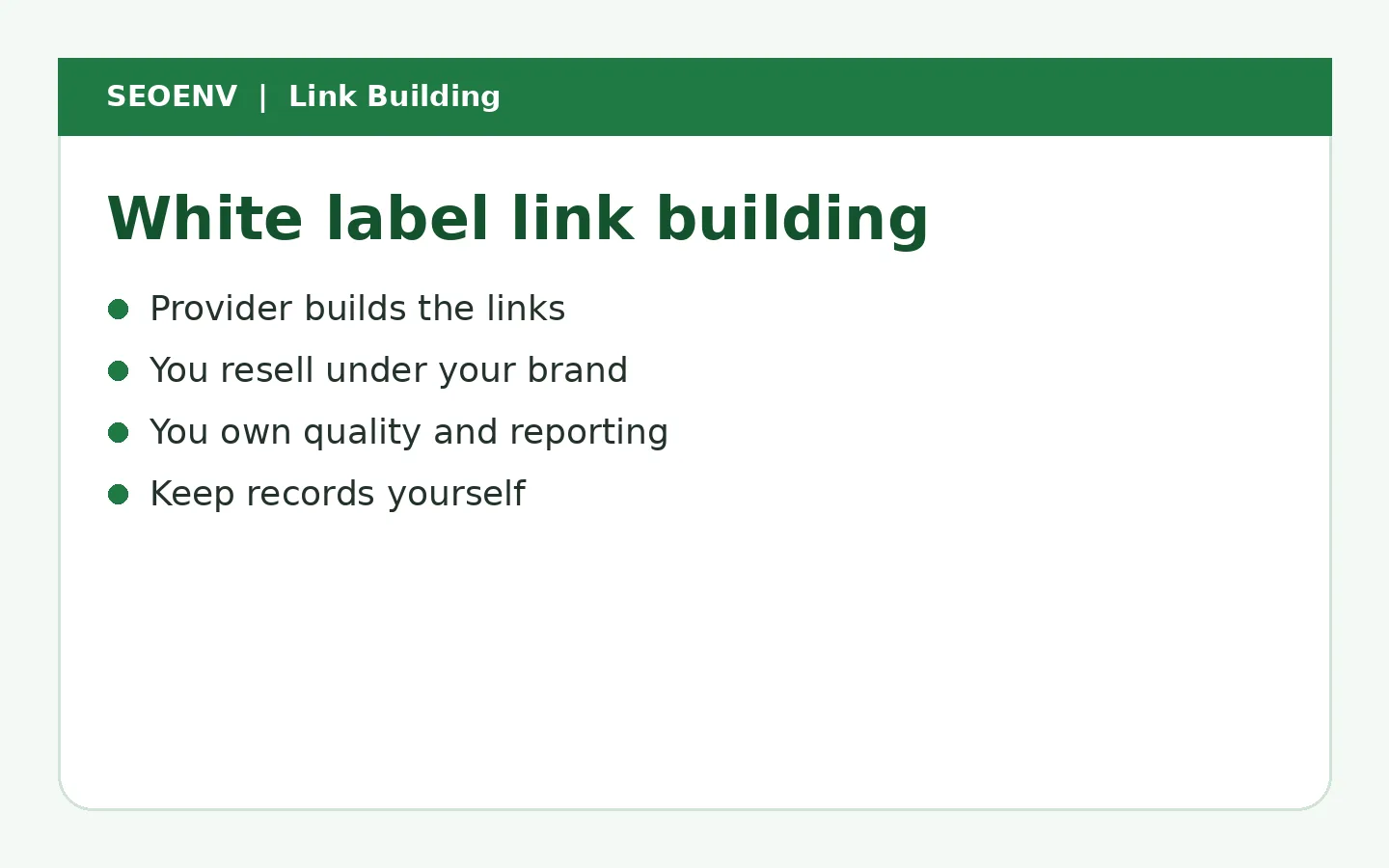
- White label providers build links that agencies resell under their brand.
- Your agency is accountable for quality.
- Check samples and methods before reselling.
- Report with your branding, from your own records.
- Keep link data under your control.
How it works
| Party | Role |
|---|---|
| Provider | Prospects, pitches, places links |
| Agency | Sells, manages, reports |
| Client | Receives links under agency brand |
Choosing a provider
- Live samples in your clients' niches.
- Clear methods; no networks. Google's spam policies cover link schemes.
- Full URL reporting.
- Replacement policy.
Google's Do you need an SEO? advises checking examples; your clients will expect you to have done so.
Quality control
Check each link before reporting it to the client: relevance, placement, attributes.
Branded reporting
Clients should see your brand, not the provider's.
When a provider's spreadsheet is the only record, you can't answer client questions quickly, and switching provider means losing history.
Worked example: monthly QA (example data)
| Delivered | Passed QA | Replaced |
|---|---|---|
| 20 | 17 | 3 |
Pricing and margin
Know your cost per live link so you can price fairly. See link building packages.
How white label link building works step by step
Step 1: agree the client brief
Before ordering anything, confirm with your client which pages need links, the audience, any restricted topics and whether paid placements are acceptable. Put it in writing.
Step 2: translate the brief for your provider
Pass on target pages, preferred site types, anchor guidance and quality rules. Don't pass on client contact details unless your agreement allows it.
Step 3: approve sites before placement
Ask your provider to send proposed sites before content is written. Check each one for relevance, traffic and editorial standards. This is the single most effective quality control step.
Step 4: review content
Read every article before it's submitted. Check accuracy, tone and that the client link fits naturally.
Step 5: verify live links
When links go live, open each page. Confirm the URL, anchor, placement and rel attribute.
Step 6: report under your brand
Send your client a report with every link listed, in your agency's branding.
Step 7: re-check monthly
Check that links stay live. Raise lost links with your provider under the replacement terms.
Choosing a white label provider in more depth
| Factor | What good looks like | Red flag |
|---|---|---|
| Site sourcing | Outreach to real sites | Fixed menu of sites with prices |
| Transparency | Shares site list before placement | Refuses to reveal sites |
| Content | Written by people who know the topic | Spun or generic |
| Paid placements | Disclosed, labelled | Hidden |
| Reporting | URL-level, white-label ready | Totals only |
| Replacements | Written policy | None |
Example data: margin and quality review
These figures are invented example data.
| Item | Amount |
|---|---|
| Provider cost per link | 150 |
| Agency price to client per link | 260 |
| Links per month | 10 |
| Gross margin per month | 1,100 |
| Hours on QA and reporting | 6 |
| Links rejected at site approval | 3 of 13 proposed |
Six hours of QA a month cuts the margin, but rejecting three weak sites protects the client relationship, which is worth far more.
White label pitfalls
- Reselling without checking. If your provider uses link networks, your client carries the risk and your reputation suffers.
- Over-promising. Don't promise clients numbers your provider can't reliably hit with quality sites.
- Hiding methods from clients. You can keep your provider private while being honest about how links are earned.
- No replacement terms. Lost links become your cost.
- Weak record-keeping. If you switch providers, you need the full history.
White label QA checklist
- Client brief agreed in writing.
- Sites approved before content is written.
- Content reviewed for accuracy and fit.
- Live links checked for URL, anchor and rel.
- Every link recorded per client.
- Branded report sent monthly.
- Monthly live-status checks.
- Replacement requests logged.
Talking to clients about white label work
Clients care about results and safety. Explain your process: how sites are chosen, how content is checked and how links are verified. You don't need to name your provider, but don't claim work is done in-house if it isn't. Being clear about methods builds trust that lasts longer than any single campaign.
Scaling white label link building responsibly
As your client list grows, the temptation is to approve sites faster. Resist it. Create a short written standard that every proposed site must meet, and make site approval a fixed step that can't be skipped. Assign one person to own QA across all clients so standards stay consistent. Review your provider's performance quarterly using live-link rates, rejection rates and replacement speed. If quality slips, raise it early or move work to another provider before clients notice.
What to include in a white label client report
Your client report should make quality visible, not just volume. Include:
| Section | Detail |
|---|---|
| Summary | Links live this month, total to date, links lost and replaced |
| Link list | Source URL, target page, anchor, rel attribute, date live |
| Site notes | One line on why each site is relevant |
| Target page progress | Rankings or clicks for the pages receiving links |
| Next month | Planned pages and themes |
Keep the format consistent month to month so clients can compare. Add a short note explaining anything unusual, such as a link removed during a site redesign, and what you're doing about it.
Pricing white label services fairly
Price based on the work you add: brief writing, site approval, content review, verification and reporting. Clients pay for confidence that links are safe and relevant. If your margin depends on skipping those steps, the price is too low. Be wary of competing with agencies that sell large volumes of cheap links. Those clients often come back after a problem, and a reputation for careful work is the stronger long-term position.
When white label isn't the right model
If a client needs deep industry relationships, such as trade press in a specialist field, an in-house specialist or a niche agency may serve them better. White label works best for repeatable, well-defined link building where quality rules can be written down and checked. For complex PR-led campaigns, consider partnering openly with a specialist rather than reselling.
Onboarding a new white label client
Start each new client with a short kickoff: confirm goals, target pages, restricted topics and approval contacts. Set up their link log on day one, so every proposed site, approval and live link is recorded from the start.
How SEOENV handles this
SEOENV organises links by client and project, checks status and type, and lets you share read-only client reports with your own branding via Report Branding.
Resell with confidence by checking quality and owning the records.
Related reading
- Outsource Link Building: When It Makes Sense and How to Manage It
- Link Building Services: How to Evaluate Them Before You Pay
- How to Choose a Link Building Agency: A 12-Point Checklist
- Link Building Workflow for Agencies
- Link Building Report Template
Sources
How we wrote this
The SEOENV Team wrote this guide from our day-to-day work tracking link exchanges, guest posts and paid placements, and checked the guidance against the sources listed above. Any numbers in worked examples are illustrative example data, not results from a real site or study. We review our guides when Google updates its documentation.
Frequently asked questions
What is white label link building?
A provider builds links that an agency resells under its own brand.
Is white label link building safe?
It depends on the provider's methods. The agency is responsible for checking quality.
How do I choose a white label provider?
Check live samples, methods, reporting and replacement terms.
Should clients know about the provider?
That's a business decision; either way, you're accountable for the links.
How should I report white label links?
From your own records with your branding.

Leave A Comment