
Link exchange risk: review your swaps before they turn into a pattern
Link exchange risk rarely comes from one swap. Also, it comes from the pattern: the same sites linking back and forth, pages that exist only to cross-link, anchors that all say the same thing. This page shows how to review that pattern on a schedule.
Where link exchange risk hides: in the total, not each swap
Nobody decides to build a link scheme. It grows one reasonable request at a time.
Link swaps are common, and many are perfectly natural. Two related sites reference each other because it helps their readers. The trouble starts when swapping becomes the main way a site gets links, or when the same small group of sites keeps trading.
In addition, picture an agency that has said yes to every relevant swap request for a year. Each one made sense on the day. Nobody has looked at the whole set since. That is where link exchange risk hides: in the totals nobody added up.
Too many with one site
Also, Repeated back-and-forth links between the same two domains across many pages.
Pages built to cross-link
Meanwhile, “Partners” or “resources” pages that exist mainly to hold swapped links.
Same anchors everywhere
Then Swapped links that all use the exact keyword you want to rank for.
What Google says about link exchange risk
Google’s spam policies list “excessive link exchanges (‘Link to me and I’ll link to you’) or partner pages exclusively for the sake of cross-linking” as an example of link spam. The key words are excessive and exclusively. At the same time, the policy does not say every reciprocal link is a problem.
So a link exchange risk review is a judgement, not a formula. You are looking for swaps that exist mainly to move rankings rather than to help readers. Of course, Google publishes no safe number, and we will not invent one. In fact, what you can do is make the pattern visible and decide with your eyes open.
A link exchange risk checklist, one question at a time
Run it quarterly, or before you agree a new batch of swaps.
- Is the partner relevant? Would a reader of their page plausibly want your page? If not, the swap is hard to defend.
- How many swaps with this one site? Count the links you gave and got with each partner. A long list with one domain deserves a closer look.
- Where does the link sit? In the body of a useful article, or on a page that only exists to list partners?
- What do the anchors say? If every swapped link uses the same exact-match keyword, vary or reconsider them.
- Is it still balanced and live? A swap where your side is live and theirs is Lost or Nofollow is a different kind of risk: you are giving without getting.
- Would you link to them anyway? The simplest test. If the answer is no, the swap is probably there for rankings alone.
Gave vs got: the record behind a link exchange risk review
A review is only as good as the list you review.
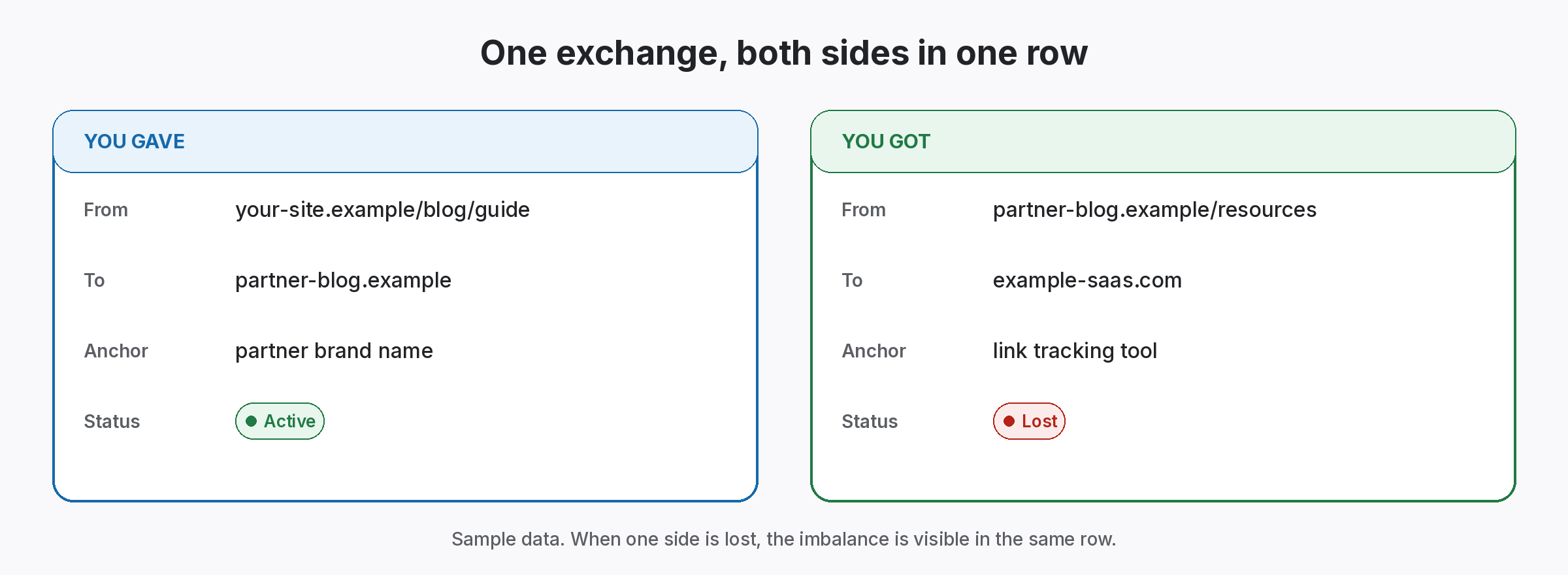
Master Link Exchange logs both sides of every direct swap, and both links get checked. So when you sit down to review, you see each partner’s count, status and type in one place instead of across inboxes.
- Both sides logged: the link you gave and the link you got.
- Both sides checked: Active, Lost, Broken or Pending, with Dofollow or Nofollow.
- Partner history: every deal with one partner, from the partner record.
Three-way swaps change the shape, not the question
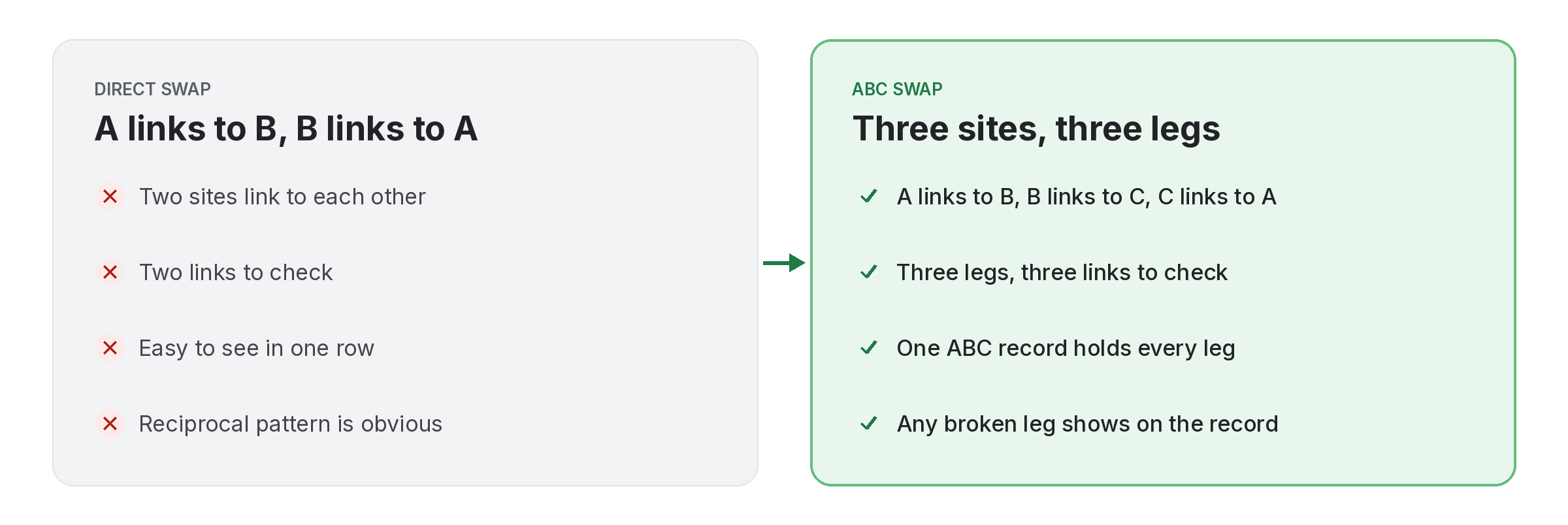
So an ABC exchange, where site A links to B, B to C and C back to A, avoids a direct reciprocal pair. It is still an exchange. The same checklist applies to each leg. SEOENV’s ABC Link Exchange logs and checks each of the three legs, so a review covers all of them.
- Review each leg for relevance, placement and anchor, just as you would a direct swap.
- Watch the third site that you may know least about. It is part of your pattern too.
The best defence is a swap you would make anyway.
Relevant, readable, and logged so you can see the whole picture.
Records that make a link exchange risk review quick
Live SEOENV features for teams that run link exchanges.
Master Link Exchange
As a result, Gave vs got for each direct swap, with both links checked.
Anchor Text Heatmap
Even so, Spot repeated exact-match anchors across a client’s links. Growth plan.
Link exchange tracking
The full workflow for running swaps across many partners.
We get asked whether link exchanges are safe all the time. The honest answer is that it depends on the pattern, and the pattern is only visible if you record every swap. That is what this review is built on.
Reducing link exchange risk without stopping swaps entirely
Most teams do not need to stop exchanging links. They need fewer, better ones. Say no to partners outside your topic, spread anchors across branded and descriptive text, and keep swapped links in real content rather than on link pages.
For more on how swaps work in practice, read our guides to reciprocal link exchange and ABC link exchange. If you are deciding which requests to accept at all, see how to triage link swap requests.
Questions about link exchange risk
Are link exchanges against Google’s rules?
Meanwhile, Google’s spam policies name excessive link exchanges and partner pages built only for cross-linking. After that, Occasional, relevant links between related sites are a normal part of the web.
How many link exchanges are too many?
Google does not publish a number, and neither do we. On the other hand, Review the pattern: relevance, how many swaps with one site, placement and anchors.
Are ABC exchanges safer than direct swaps?
They avoid a direct reciprocal pair, but they are still exchanges. Review each leg with the same checklist.
Does SEOENV score my link exchange risk?
No. SEOENV records both sides of each swap and checks every link, so you can review the pattern yourself.
What should I do with a swap that fails the review?
Talk to the partner. Instead, you might move the link into better content, change the anchor, or agree to end the swap.
See every swap in one place before you review it.
Log both sides of each exchange in SEOENV. Both links get checked.
