
By SEOENV Team | Published October 23, 2026
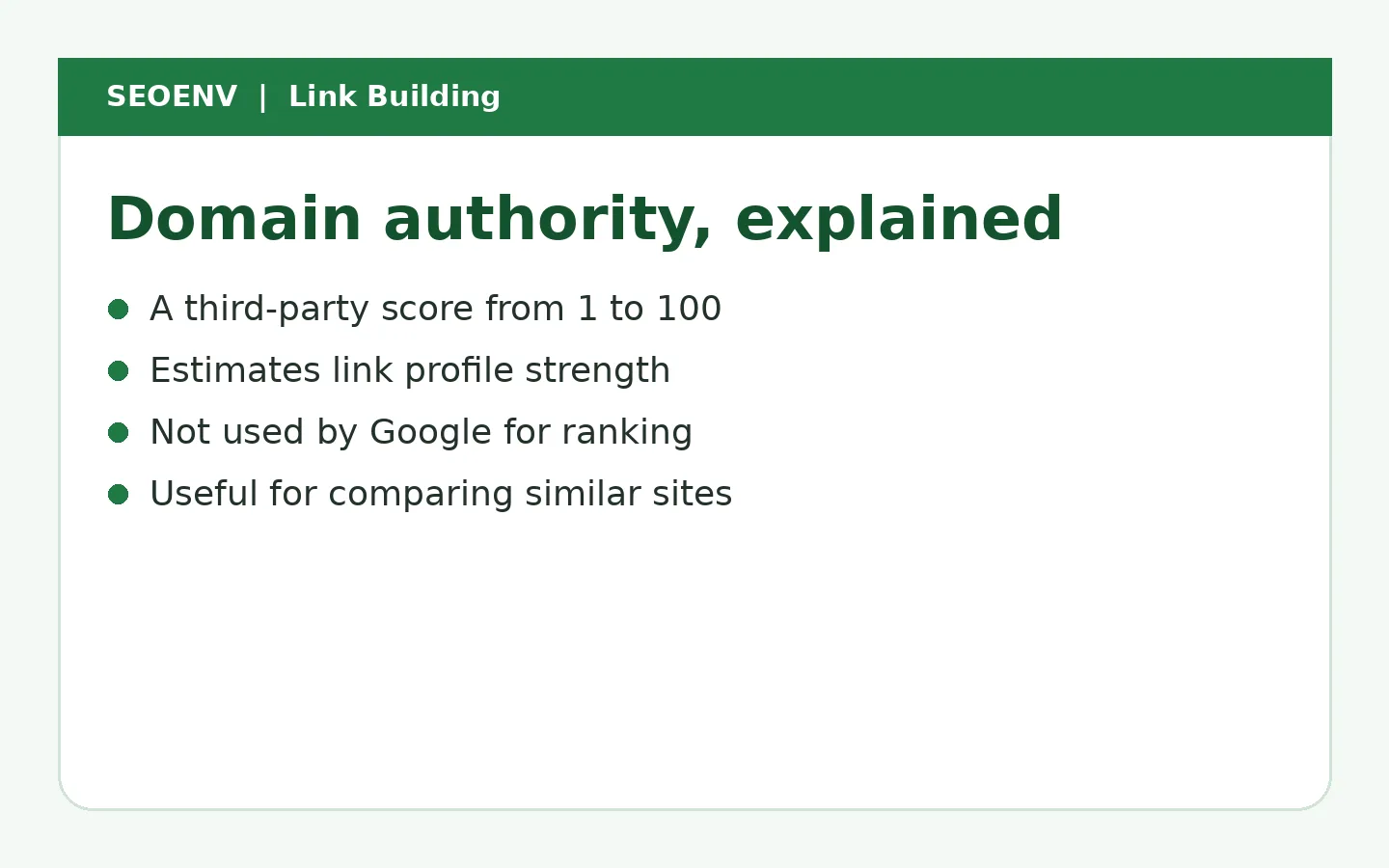
Website domain authority is a score that estimates how strong a site's backlink profile is compared with other sites. The best-known version is Moz's Domain Authority (DA), on a scale of 1 to 100; Ahrefs' Domain Rating (DR) and Semrush's Authority Score work in a similar way. These scores are useful for comparing sites, but Google doesn't use them, so a higher number doesn't directly raise your rankings.
Here's what the scores measure, how to check yours and how much attention they deserve.
Key takeaways
- Domain Authority is a Moz score from 1 to 100; Ahrefs' equivalent is Domain Rating.
- Both estimate the strength of a site's link profile.
- Google doesn't use DA or DR in its ranking systems.
- Use them to compare and shortlist sites, not to judge one link.
- Grow authority by earning relevant links, not by chasing the score.
Domain authority at a glance
| Metric | Provider | Scale | Based mainly on |
|---|---|---|---|
| Domain Authority (DA) | Moz | 1-100 | Linking root domains and link quality, via a machine-learning model |
| Domain Rating (DR) | Ahrefs | 0-100 | The number and strength of unique domains with followed links |
| Authority Score (AS) | Semrush | 0-100 | Link power plus traffic and spam signals |
| Trust Flow / Citation Flow | Majestic | 0-100 | Link trust and link volume |
What is domain authority in SEO?
Domain authority is shorthand for "how strong is this site's link profile, relative to everyone else?" Each tool crawls the web, builds its own index of links and turns that into a score. Because each index and formula is different, the same site can be DA 45, DR 52 and AS 38 at the same time.
The scales are logarithmic. Moving from 20 to 30 is much easier than moving from 70 to 80, because the sites at the top have enormous link profiles.
Does Google use domain authority?
No. DA, DR and Authority Score are made by third-party tool companies. Google has said publicly that it doesn't use a "domain authority" metric. Google does use links as one of many signals, and it does look at signals at the site level as well as the page level, which is why a strong site's new pages often rank faster. But the number in your SEO tool is an estimate made from a different index, not something Google sees.
Moz itself describes DA as a comparative metric, not a ranking factor. Its Domain Authority guide says it is best used to compare sites competing for the same searches.
What is my domain authority, and how do I check it?
Single site
- Moz: Link Explorer or the free MozBar extension shows DA for any site.
- Ahrefs: the free Website Authority Checker shows DR, and Site Explorer shows DR for paid users. Ahrefs explains the metric in its Domain Rating help article.
- Semrush: Domain Overview shows Authority Score.
Many sites at once
When you're vetting a prospect list, a domain authority bulk checker saves time. Ahrefs' Batch Analysis, Moz's Link Explorer comparison and Semrush's Bulk Analysis all accept lists of domains. Export the results and sort by both authority and organic traffic.
Your own site over time
Note your score once a month in the same tool. Scores move when the tool updates its index or model, so compare trends against competitors rather than worrying about a single drop.
What is a good domain authority?
"Good" is relative to your competitors, not a fixed number.
| Situation | What matters |
|---|---|
| New local business | Whether you're close to other local competitors, often all low scores |
| Niche blog | How you compare with the blogs ranking for your topics |
| SaaS competing nationally | Gap to the top 5 ranking domains for your main searches |
A DA of 25 can be strong in a small local niche and weak for "project management software". Look at the pages ranking for your target search and see where you sit.
Authority scores also tempt teams into chasing the wrong links. A vendor offers "DA 60+ guest posts", you pay, the links go live, and nobody checks whether those sites have real readers or whether the links are still there next quarter.
Track what you paid for, not just the score
Log each placement with its site, cost, anchor and status, and see whether it's still live.
Why domain authority can mislead you
- It ignores relevance. A DR 80 site about everything may be a worse link than a DR 30 site about your exact topic.
- It can be inflated. Link farms and expired-domain networks can build high scores with links that Google ignores.
- It ignores traffic. Some high-DA sites get almost no organic visitors.
- It's domain-wide. The specific page linking to you might be new, orphaned and buried.
- It changes with the tool. Index updates move scores without anything changing on your site.
When domain authority is useful
- Shortlisting. Sorting a list of 500 prospects by DR and traffic quickly separates sites worth a manual look.
- Competitor gaps. If every top-ranking site is DR 60+ and you're DR 15, you know links are part of the gap.
- Spotting spam. A brand-new site with DR 70 and no traffic is a warning sign.
- Tracking your own progress in one tool over time.
Worked example: comparing three prospects (example data)
These are invented example figures to show how to read the numbers together.
| Prospect | DR | Est. monthly organic traffic | Topic match | Verdict |
|---|---|---|---|---|
| Prospect A | 74 | 900 | Low, publishes on any topic | Skip |
| Prospect B | 38 | 12,000 | High, SEO and marketing | Pitch first |
| Prospect C | 55 | 4,500 | Medium, general business | Pitch with a relevant angle |
Prospect A has the highest score but very little traffic and no topic focus, a pattern typical of sites built to sell links. Prospect B is half the DR but has a real, relevant audience. Using DR alone, you'd pick the worst link.
How to increase domain authority (the right way)
You don't improve your rankings by improving the score. You improve both by earning better links:
- Publish reference content in your niche: guides, templates, data and tools.
- Earn editorial links through outreach, digital PR and guest posts on relevant sites. See how to get backlinks.
- Reclaim lost links and unlinked brand mentions.
- Build strong internal links so authority flows to the pages that need it. Our guide to link equity explains how.
- Avoid shortcuts that inflate scores but carry risk, such as PBNs and bought followed links.
What about "authority domains"?
People often use "authority domain" to mean any well-known, trusted site: major news outlets, government sites, universities and industry bodies. Links from them are valuable because they are hard to get and usually editorial, not because of the score itself. Don't buy "authority domain" packages; they rarely deliver links from genuinely authoritative sites.
Page authority vs domain authority
Moz also publishes Page Authority (PA), and Ahrefs has URL Rating (UR). These estimate the strength of a single page rather than a whole domain. For link building, page-level metrics are often more telling: a link from a strong page on a medium site can be worth more than a link from a brand-new, unlinked page on a famous one.
When you vet a prospect, look at both. If the site is strong but the page that would host your link is new, ask whether it will be linked from the site's navigation or other articles. A guest post that sits in an archive with no internal links passes far less value than its domain score suggests.
Domain authority myths to drop
- "You need DA 30 before you can rank." Low-DA sites rank every day for specific, low-competition searches, especially with focused content.
- "Links from DA 90 sites are always worth paying for." Big sites often nofollow outbound links and are frequently targeted by resellers selling placements that get removed.
- "Disavowing low-DA links raises your score." Third-party tools don't read your disavow file, and low DA doesn't mean harmful.
- "A DA drop means Google penalised you." Google doesn't use DA. Check the tool's update notes first.
Reporting authority to clients
Clients like simple numbers, so authority scores end up in reports. If you include them, add context: show the trend over six to twelve months, compare with two or three named competitors, and put the score next to metrics that matter more, such as referring domains gained, organic traffic and rankings for target pages. Our link building report template shows a format that keeps the focus on outcomes rather than a single score.
How SEOENV handles this
SEOENV doesn't calculate a domain authority score; tools like Ahrefs and Moz already do that. What it does is keep the links you build in order. For each placement you can record the site, target, anchor, partner and cost, then check whether the link is live and followed. That way, the value you thought you were getting when you checked a site's DR is still visible months later.
Pair your authority checks with link tracking
Record the sites you vet and the links you win, then keep checking them.
Use domain authority as a compass, not a scoreboard. It points you toward sites worth a closer look; your own judgement about relevance and quality decides which links are worth having.
Keep every link you earn on record
See all your backlinks by client and project, free for up to 20 links.
Related reading
- What Makes a High-Quality Backlink? A Checklist for Judging Links
- What Are Backlinks? How They Work and Why They Matter for SEO
- How Many Backlinks Do You Need to Rank? A Practical Way to Estimate
- Link Equity (Link Juice) Explained for Site Owners
- Backlink Audit Guide
Sources
- Moz: What is Domain Authority?
- Ahrefs: Domain Rating explained
- Google Search Central: How Google Search works
How we wrote this
The SEOENV Team wrote this guide from our day-to-day work tracking link exchanges, guest posts and paid placements, and checked the guidance against the sources listed above. Any numbers in worked examples are illustrative example data, not results from a real site or study. We review our guides when Google updates its documentation.
Frequently asked questions
What is domain authority in simple terms?
It's a third-party score, usually from 1 to 100, that estimates how strong a website's backlink profile is compared with other sites.
Does Google use domain authority to rank sites?
No. DA, DR and similar metrics are made by SEO tool companies. Google uses its own signals, including links, but not these scores.
How do I find my domain authority for free?
Use Moz's free MozBar or Link Explorer for DA, or Ahrefs' free Website Authority Checker for DR.
What is a good domain authority score?
It depends on your competitors. Compare your score with the sites ranking for your target searches rather than aiming for a fixed number.
Why did my domain authority drop?
Most drops come from the tool updating its index or model, or from losing links. Compare with competitors in the same tool before worrying.
Leave A Comment