
By SEOENV Team | Published October 23, 2026
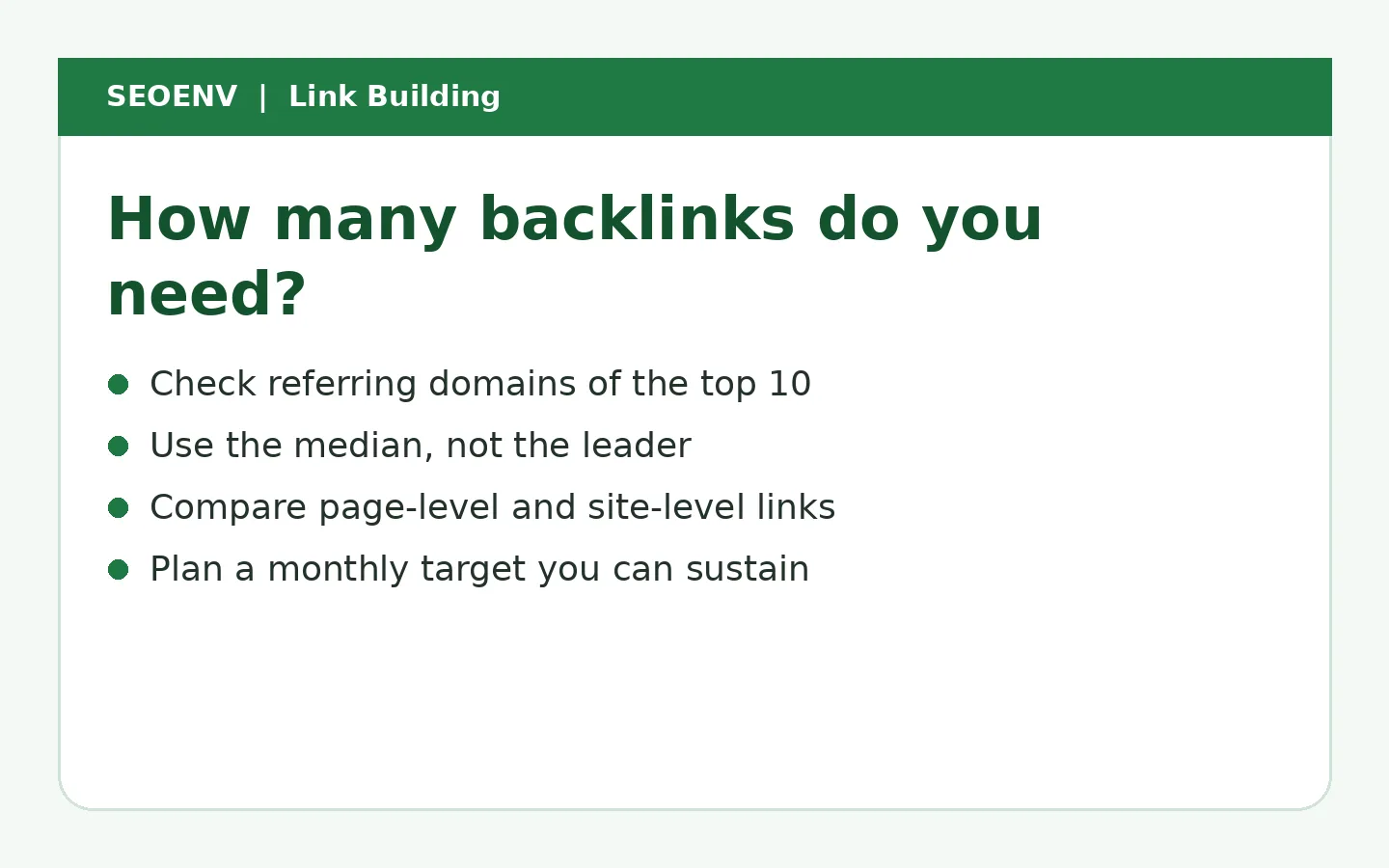
There's no fixed number of backlinks you need to rank. The practical answer is to look at the pages already ranking for your target search, count their referring domains (unique linking sites), and use the median of the top results as a rough target. For low-competition searches that might be zero to five; for competitive commercial terms it can be hundreds.
This guide shows you how to estimate the number for any keyword, how to check how many backlinks a website has, and when more links won't help.
Key takeaways
- No fixed number of backlinks guarantees a ranking.
- Estimate from the referring domains of pages already ranking.
- Look at page-level links, not just the domain.
- Relevance and quality can close a gap faster than volume.
- Content and search intent often matter more than extra links.
Why there's no single number
Google ranks pages using many signals: relevance to the query, content quality, page experience and links among them. Two pages with the same number of links can rank very differently because one answers the search better. Links also vary hugely in value. Ten relevant editorial links can outweigh a hundred directory listings.
That's why "you need 50 backlinks" advice is meaningless without context. The right question is: how many relevant referring domains do the pages that already rank have, and how far are we from them?
Backlinks vs referring domains
| Metric | What it counts | Why it matters |
|---|---|---|
| Backlinks | Every individual link | Inflated by sitewide links and repeats |
| Referring domains | Unique websites linking | Better proxy for breadth of support |
| Page-level referring domains | Unique sites linking to one URL | Best for estimating a single ranking |
Always estimate in referring domains. A site with 5,000 backlinks from 40 domains usually has much less link support than one with 800 backlinks from 300 domains.
How to estimate how many backlinks you need to rank
Step 1: pick the exact search
Choose the query and location you care about, such as "seo report template" in the US.
Step 2: list the top 10 results
Use a keyword tool's SERP overview or search manually in an incognito window. Note each ranking URL.
Step 3: record page-level referring domains
For each URL, note the referring domains to that page and the site's overall Domain Rating or Authority. Ahrefs Keywords Explorer and Semrush show these in the SERP overview.
Step 4: use the median, not the leader
Ignore outliers like Wikipedia or a giant brand. The median of positions 3 to 10 is a more realistic bar than the number one result.
Step 5: adjust for your situation
- If your site is much weaker overall than the ranking sites, aim above the median.
- If your page matches search intent better than most results, you may need fewer.
- If the top results are mostly forums and thin pages, content may win before links.
Step 6: turn the gap into a monthly plan
If the median is 30 referring domains and you have 5, the gap is 25. At a sustainable pace of five relevant links a month, that's five months of work for that page.
Worked example: estimating links for one keyword (example data)
The figures below are invented example data.
Target: "backlink tracker template". Your page has 4 referring domains.
| Position | Page-level referring domains | Site DR | Notes |
|---|---|---|---|
| 1 | 140 | 88 | Big SaaS brand, outlier |
| 2 | 62 | 71 | |
| 3 | 38 | 64 | |
| 4 | 31 | 52 | |
| 5 | 24 | 49 | |
| 6 | 22 | 58 | |
| 7 | 19 | 41 | |
| 8 | 15 | 45 | |
| 9 | 12 | 37 | |
| 10 | 9 | 33 |
Positions 3-10 have a median of about 20 referring domains. With 4 today, the page needs roughly 16 more relevant domains to compete for page one, before accounting for content quality. A plan of four links a month gives a four-month horizon, with internal links from the site's strongest pages added straight away.
Most teams can do this estimate in an afternoon. The harder part is the next four months: keeping track of which outreach landed, which guest posts went live and whether the links you got in month one are still there in month four.
Track progress toward your link target
Log each link to a target page and see how many are live, lost or nofollow.
How to check how many backlinks a website has
- Google Search Console (your own site): the Links report lists top linking sites and top linked pages. Google's Links report help page explains what it shows.
- Ahrefs Site Explorer, Semrush Backlink Analytics, Moz Link Explorer: show backlinks and referring domains for any site, with page-level breakdowns.
- Free checkers: Ahrefs and Semrush both offer limited free backlink checkers.
Expect the tools to disagree. Each crawls a different slice of the web. Use one tool consistently for comparisons.
How many backlinks should a website have?
Site-wide, there's no target either. A local bakery might do well with 20 good local links; a national publisher might have millions. Look at sites you compete with and aim to close the gap on the pages that matter commercially, rather than chasing a total.
When more backlinks won't help
- The page doesn't match intent. If searchers want a template and your page is an essay, links won't fix it.
- The content is thin. Google's helpful content guidance asks whether a page adds something beyond what's already out there.
- Technical problems. A page that isn't indexed, is canonicalised elsewhere or loads slowly needs fixing first.
- Links are irrelevant or low quality. Adding more of the same won't move you.
How fast should you build links?
There's no safe or unsafe "velocity" number from Google. What looks odd is a sudden burst of links that clearly weren't earned, such as hundreds of exact-match anchors in a week. A steady pace that matches your content publishing and outreach effort is natural. Spread links across several pages, not just your money page.
Do internal links count?
Internal links don't count as backlinks, but they pass authority and context to your target page. Linking to a new guide from your homepage or your strongest articles can sometimes do as much as several external links. Read our link equity guide for how to do this.
Long-tail keywords need fewer links
Many specific searches, such as "how to invoice link building clients", have results with few or no links. Pages that match intent precisely can rank with little link support. A content plan that mixes long-tail topics with a few competitive ones lets you win traffic while links build up.
Setting link targets that the team can hit
Once you have an estimate, turn it into numbers your team owns. A useful target has three parts: the page, the number of new relevant referring domains, and the period. "Earn 12 new referring domains to the template page by the end of Q1" is clear and measurable. "Get more backlinks" isn't.
Track progress monthly and review the estimate every quarter, because the competition moves too. If competitors gain links faster than you, the median rises and your target should follow. Our link building KPIs guide suggests which numbers to put in a monthly report.
How SEOENV handles this
In SEOENV every link you build is tied to a target URL, client and project. You can filter by target to see how many live, followed links each page has from your work, and spot when one goes missing. It doesn't estimate competitor links, which is a job for a backlink index, but it keeps your side of the gap accurate.
Keep count of the links you've built per page
Filter your links by target URL and status, and export a report any time.
The number of backlinks you need is the number that closes the gap between your page and the pages already ranking, adjusted for how well you answer the search. Measure it, plan it and track it.
Turn your link target into a tracked plan
Add your target pages and record every link toward them.
Related reading
- What Are Backlinks? How They Work and Why They Matter for SEO
- Domain Authority Explained: What It Is, How to Check It and Whether It Matters
- How to Get Backlinks: 15 Proven Ways That Work in 2026
- Link Building KPIs
- What Makes a High-Quality Backlink? A Checklist for Judging Links
Sources
- Google Search Central: How Google Search works
- Google Search Central: Search Console Links report
- Google Search Central: Creating helpful content
How we wrote this
The SEOENV Team wrote this guide from our day-to-day work tracking link exchanges, guest posts and paid placements, and checked the guidance against the sources listed above. Any numbers in worked examples are illustrative example data, not results from a real site or study. We review our guides when Google updates its documentation.
Frequently asked questions
How many backlinks do I need to rank on Google?
It depends on the keyword. Check the referring domains of pages ranking in positions 3 to 10 and use the median as a rough target.
Can I rank with no backlinks?
Yes, for low-competition, long-tail searches where the ranking pages have few links, a page that matches intent well can rank without backlinks.
How do I check how many backlinks a website has?
Use a backlink tool such as Ahrefs, Semrush or Moz. For your own site, Google Search Console's Links report shows linking sites and pages.
Is it backlinks or referring domains that matter?
Referring domains are a better measure, because many links from one site add less than links from many different sites.
How many backlinks per month is safe?
Google doesn't publish a safe rate. A steady pace of relevant, earned links is natural; sudden bursts of manipulative links are what attract problems.

Leave A Comment