
By SEOENV Team | Published October 23, 2026
A backlink example is any link on another site pointing to yours, such as a journalist citing your study, a blog listing your tool on a resources page, or your business appearing in a local directory. The value of each type depends on relevance, whether the link was given editorially and where it sits on the page. Below are 12 common types, how each one comes about and what it's typically worth.
Use this as a reference when you plan link building or explain to a client what kind of links they're getting.
Key takeaways
- Backlinks range from editorial citations to forum signatures.
- Editorial and resource links are usually worth the most.
- Paid and sponsored links must be marked as such.
- Low-effort links are easy to get and usually worth little.
- Track built links; they're the ones most likely to change.
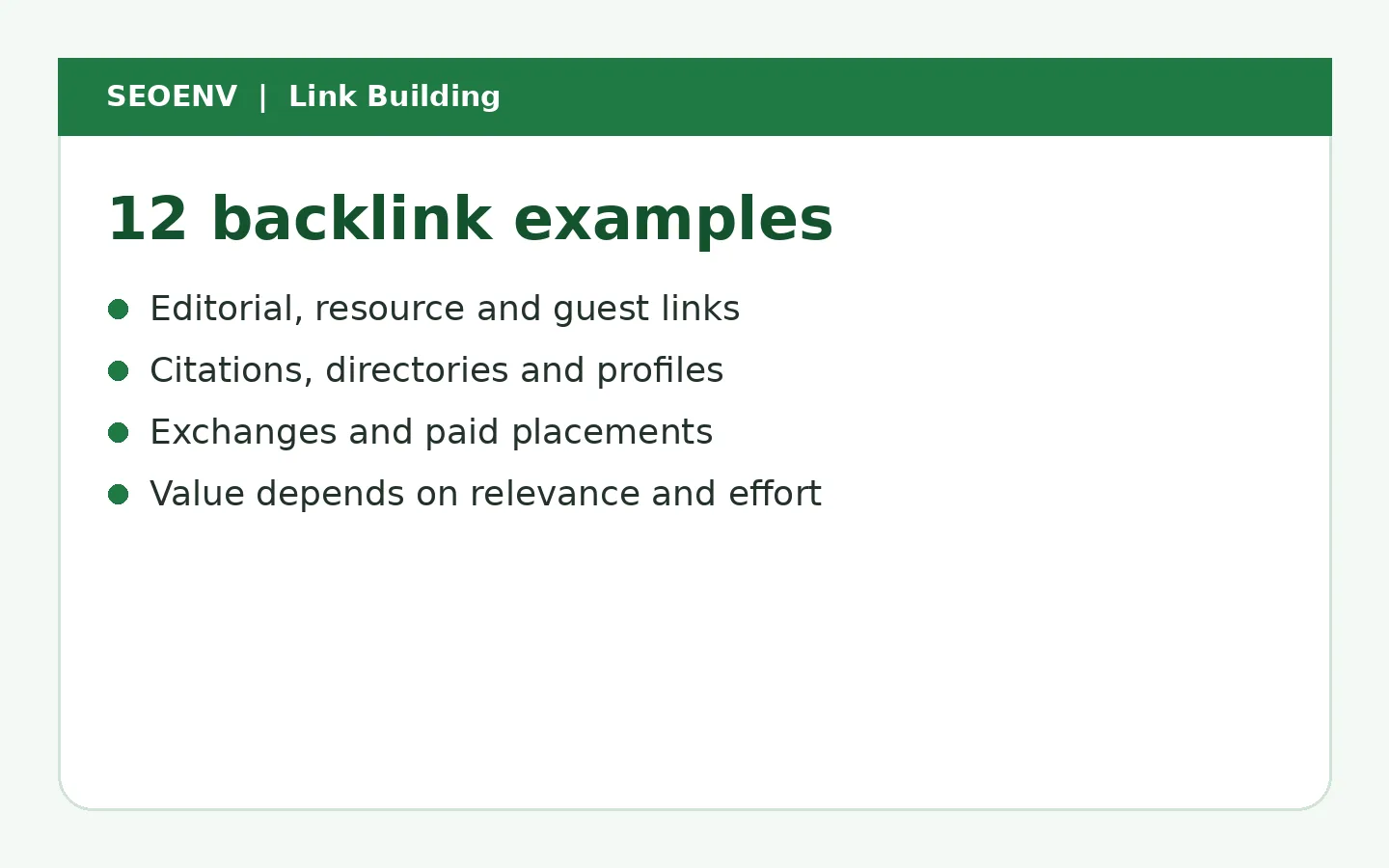
The 12 types at a glance
| # | Type | How you get it | Typical value | Effort |
|---|---|---|---|---|
| 1 | Editorial citation | Someone cites your content | High | High |
| 2 | Resource page link | You're added to a curated list | Medium-high | Medium |
| 3 | Guest post link | You write for another site | Medium | High |
| 4 | Digital PR / news link | Journalists cover your story or data | High | High |
| 5 | Unlinked mention reclaimed | You ask for a link on an existing mention | Medium-high | Low |
| 6 | Broken link replacement | You offer your page to replace a dead link | Medium | Medium |
| 7 | Podcast or interview link | Show notes link to you | Medium | Medium |
| 8 | Partner or supplier link | A business you work with links to you | Medium | Low |
| 9 | Local citation / directory | Business listing | Low-medium | Low |
| 10 | Link exchange | Two sites agree to link | Varies | Medium |
| 11 | Paid / sponsored placement | You pay; marked sponsored | Traffic, little ranking | Low |
| 12 | Profile, forum and comment link | You place it yourself | Low | Low |
1. Editorial citation
What it looks like: a writer explaining anchor text links to your guide as the source: "according to SEOENV's anchor text guide…".
Why it's valuable: the site chose to link because it helps their readers. This is the kind of link Google's systems are built to reward. Our post on editorial backlinks explains how to earn more of them.
2. Resource page link
What it looks like: a university careers page listing "useful tools for freelancers", with your template on it.
How you get it: find resource pages in your niche and suggest your page where it genuinely fits.
3. Guest post link
What it looks like: an article you wrote for an industry blog, with a link to a relevant guide on your site in the body or author bio.
Value: depends heavily on the host. A real publication with editors is valuable; a site that publishes anything for a fee is not. See the guest posting process.
4. Digital PR or news link
What it looks like: a news site covering a survey you ran, linking to the full results.
Value: often very high, because news sites are well linked and these links are editorial. Many big publishers nofollow external links, but the coverage still drives traffic and secondary links.
5. Reclaimed unlinked mention
What it looks like: a blog already mentioned your brand without a link; you asked politely and they added one.
Value: high return for little effort, because the site already likes you.
6. Broken link replacement
What it looks like: a resource page linked to a tool that shut down; you suggested your similar page as a replacement.
Value: medium. It works best when your page is a genuine replacement.
7. Podcast or interview link
What it looks like: show notes for an episode you appeared on, linking to your site.
Value: medium, plus real audience exposure.
8. Partner, supplier or customer link
What it looks like: a software integration partner listing you on their integrations page, or a supplier's "our clients" page.
Value: medium, highly relevant and easy to ask for.
Most link builders juggle several of these types at once: three guest posts in progress, two exchanges agreed, a PR pitch out and a handful of listings. The work is spread across emails and spreadsheets, and it's easy to lose track of which links actually went live.
Track every link type in one table
Guest posts, exchanges, paid placements and listings, each with its status checked.
9. Local citation or directory listing
What it looks like: your business name, address and phone number on Yelp, a chamber of commerce site or an industry directory, with a link.
Value: low to medium for rankings, useful for local SEO and for consistent business data. Our guide on directory backlinks covers which are worth it, and citation SEO explains citations in local search.
10. Link exchange
What it looks like: two related sites agree to link to each other's relevant guides, or a three-way ABC exchange.
Value: varies. Occasional, relevant exchanges happen naturally. Google's spam policies name "excessive link exchanges" as link spam.
11. Paid or sponsored placement
What it looks like: a sponsored article or newsletter mention you paid for, with the link marked rel="sponsored".
Value: traffic and visibility; it shouldn't pass ranking value if qualified correctly, as described in Google's guide to qualifying outbound links. See our post on paid backlinks.
12. Profile, forum and comment links
What it looks like: a link in your social media bio, a forum signature or a blog comment.
Value: low for rankings, usually nofollow or ugc. Genuine forum answers can send useful traffic.
Worked example: a month of link building (example data)
Here is invented example data for one month of work on a B2B blog:
| Activity | Attempts | Links live | Type | Notes |
|---|---|---|---|---|
| Guest post pitches | 20 | 3 | Guest post | 2 in body, 1 in bio |
| Unlinked mention requests | 8 | 4 | Reclaimed mention | Fastest wins |
| Broken link outreach | 30 | 2 | Replacement | |
| Partner page requests | 5 | 3 | Partner | Integration pages |
| Directory submissions | 6 | 6 | Citation | Mostly nofollow |
Eighteen links went live. The six directory listings were the easiest but add the least. The four reclaimed mentions and three partner links are the most efficient wins. Next month, the team shifts time from broken-link outreach to mentions and partners.
Link building example: a simple campaign
To make this concrete, here's how a small campaign might look for a new free template:
- Publish the template with a clear explanation and example.
- Find 50 articles that mention "link building spreadsheet" or similar.
- Email the authors where your template would genuinely help their readers.
- Pitch two guest posts on related topics that naturally reference the template.
- Share it in communities where people ask for templates, without spamming.
- Log every placement and check it weekly for the first month.
Which backlink types to prioritise
Start with the low-effort, relevant ones: partners, mentions and resource pages. Then invest in assets that earn editorial and PR links over time. Use directories and profiles for completeness, not for rankings. Keep exchanges occasional and relevant, and mark paid placements.
Backlink examples to avoid
Some link types aren't worth any effort because they carry more risk than value:
- Sitewide footer links sold across hundreds of pages of an unrelated site.
- Private blog network (PBN) links on sites built only to pass links. See our guide to PBN backlinks.
- Automated links from software that posts to forums, wikis and comment sections.
- Article directories and spun content published across many low-quality sites.
- Widget and theme links with keyword anchors hidden in code you distribute.
Each of these appears in Google's description of link schemes. They rarely help and can lead to links being ignored or a manual action.
How SEOENV handles this
SEOENV has a module for most of these link types: Master Link Exchange and ABC Link Exchange for swaps, Guest Posts with five stages from Pitched to Published, Paid Collaborations for sponsored placements and Listing Backlinks for directories and profiles. Everything also appears in one Link Tracker table, where each link is checked for live status and dofollow or nofollow.
Organise every type of backlink you build
One tracker for exchanges, guest posts, paid links and listings.
Every backlink type has a place. The skill is knowing which ones move the needle for your site and keeping track of them after they go live.
See which link types are paying off
Filter by type, client and status to see where your links come from.
Related reading
- What Are Backlinks? How They Work and Why They Matter for SEO
- What Makes a High-Quality Backlink? A Checklist for Judging Links
- Editorial Backlinks: What They Are and How to Earn Them
- Directory Backlinks: Are They Still Worth It?
- The Guest Posting Process
Sources
How we wrote this
The SEOENV Team wrote this guide from our day-to-day work tracking link exchanges, guest posts and paid placements, and checked the guidance against the sources listed above. Any numbers in worked examples are illustrative example data, not results from a real site or study. We review our guides when Google updates its documentation.
Frequently asked questions
What is an example of a backlink?
A blog post on another site that links to your guide as a source is a backlink. So is your business listing in a directory with a link to your site.
Which type of backlink is best?
Editorial links from relevant, well-read sites are usually the most valuable, because the site chose to link to you.
Are directory backlinks worth it?
A few relevant and local directories are useful, especially for local SEO. Mass directory submissions add little.
Are guest post links still valuable?
Yes, on real sites with editorial standards and a relevant audience. Large-scale guest posting with keyword anchors is treated as link spam.
Do social media links count as backlinks?
They are links, but usually nofollow, so they pass little ranking value. They can still bring visitors.

Leave A Comment