
By SEOENV Team | Published October 23, 2026
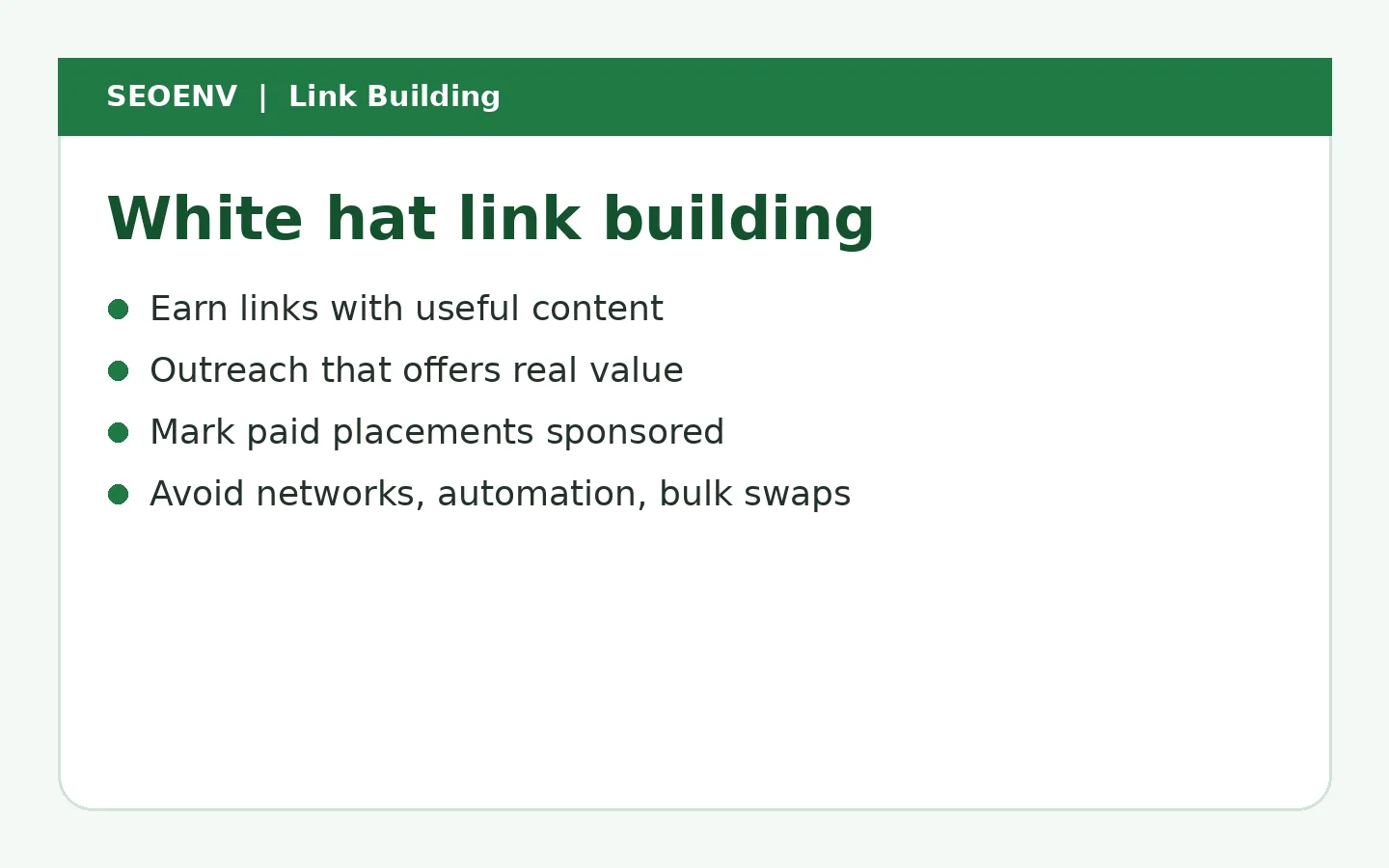
White hat link building means earning backlinks in ways that follow Google's guidelines: creating content people want to cite, reaching out to relevant sites with genuine value, contributing guest articles to real publications and building partnerships. It excludes buying followed links, link networks, automated link placement and excessive exchanges, all of which Google's spam policies describe as link spam.
Here's how to tell white hat from grey and black hat, the techniques that work and what to check before hiring a white hat link building service.
Key takeaways
- White hat link building earns links within Google's guidelines.
- It relies on content, outreach and relationships, not payment for followed links.
- Paid placements are fine when marked sponsored.
- "White hat" labels on services prove nothing; ask for examples.
- White hat links take longer but rarely disappear or need disavowing.
The quick test
Ask: would this link exist, and would I be comfortable explaining how I got it, if search engines didn't exist? If yes, it's almost certainly white hat.
White hat vs grey hat vs black hat
| Approach | Examples | Risk |
|---|---|---|
| White hat | Editorial links, outreach, guest posts on real sites, digital PR, partners, sponsored links marked correctly | Low |
| Grey hat | Paid "guest posts" with followed links, frequent link swaps, link insertions for a fee | Medium to high |
| Black hat | PBNs, automated links, hacked-site links, link farms, hidden links | High |
What Google's rules say
Google's spam policies list link schemes including:
- buying or selling links that pass ranking credit;
- excessive link exchanges ("link to me and I'll link to you");
- large-scale article marketing or guest posting with keyword-rich anchors;
- automated programs or services that create links;
- requiring a link as part of terms of service without letting the owner qualify it.
Google's qualify outbound links guide shows the white hat way to handle paid placements: mark them rel="sponsored".
White hat link building strategies
Create reference content
Original data, definitive guides, templates and tools give people a reason to link. This is the foundation of natural link building.
Outreach with relevance
Find articles that would genuinely be improved by your page and explain why in a short, personal note.
Guest posting on real publications
Write genuinely useful articles for sites with editors and audiences. Let links fit naturally.
Digital PR
Pitch stories and data to journalists. See digital PR for SEO.
Broken link and resource page outreach
Offer replacements for dead links and suggest additions to curated lists where your page fits.
Partnerships
Suppliers, customers, integration partners and associations often link to the businesses they work with.
Unlinked mentions
Ask sites that mention you to add a link.
Sponsored placements, correctly marked
Paying for exposure is fine if the link is sponsored. It won't pass ranking value, but it can drive traffic and awareness.
White hat link building is slow and conversational. Links come from dozens of individual relationships and emails, which makes it easy to lose track of what was agreed and whether the link is still where it should be.
Keep a clean record of how every link was earned
Log the source, partner, anchor and status of each link you build.
Worked example: auditing a provider's sample links (example data)
The data below is invented example data.
An agency asks a "white hat" provider for 10 recent sample placements and checks each:
| Check | Pass | Fail |
|---|---|---|
| Site has real organic traffic | 6 | 4 |
| Site's topic matches the client niche | 5 | 5 |
| Article written for readers, not just links | 6 | 4 |
| Site lists prices for "dofollow posts" | 4 | 6 |
| Paid links marked sponsored | 0 | 10 |
Four of the ten were on sites openly selling followed links, and none of the paid placements were marked sponsored. Whatever the label, that isn't white hat. The agency looks elsewhere.
White hat link building services: what to ask
- Show me live links you built in the last three months, in niches like mine.
- How do you find prospects, and how do you pitch them?
- Do you pay sites for placements? If so, how are those links marked?
- What anchors do you use?
- What do you do if a link is removed?
- Will I get a full list of URLs, anchors and dates?
An "organic link building service" or "white hat backlinks service" that can't answer these clearly is probably selling paid placements under a nicer name. Our guide to link building services has more questions.
The cost of white hat
White hat links cost time: research, writing, pitching and follow-up. Good providers charge for that labour, not for links per se. Expect fewer links than cheap packages promise, with far more of them still live a year later.
Why white hat is worth the patience
- Links are less likely to be removed.
- No need to disavow or worry about manual actions.
- Links often bring referral traffic and relationships.
- Your profile becomes an asset you can build on.
Common "white hat" myths
- "Guest posting is always white hat." Not if it's large scale with keyword anchors or paid followed links.
- "Nofollow links are useless, so paid dofollow is fine." Paid followed links break the rules regardless.
- "Link exchanges are always black hat." Occasional, relevant exchanges happen naturally; excessive ones are the problem.
Building a white hat process your team can repeat
Write the rules down. A one-page policy that says which tactics you use, which you don't, how paid placements are marked and how anchors are chosen keeps everyone consistent, especially when freelancers or new team members join. Review it whenever Google updates its spam policies.
How SEOENV handles this
SEOENV records how each link was obtained, as an exchange, guest post, paid collaboration or listing, alongside its source, target, anchor and partner. Links are checked for live status and dofollow or nofollow. That gives you an audit trail: if a client or anyone else asks how a link was built, the answer is in the record.
Build an audit trail for your link building
Every link recorded with how it was earned and whether it's live.
White hat isn't a label; it's a habit. Earn links honestly, mark paid ones and keep records you'd be happy to show.
Run white hat link building with clear records
Free for up to 20 links, with checks on every plan.
Related reading
- Link Building Strategies: A Complete Playbook for Beginners
- How to Get Backlinks: 15 Proven Ways That Work in 2026
- Editorial Backlinks: What They Are and How to Earn Them
- Buying Backlinks: How to Judge the Risk Before You Pay
- PBN Backlinks: What They Are and Why They're a Bad Bet
Sources
How we wrote this
The SEOENV Team wrote this guide from our day-to-day work tracking link exchanges, guest posts and paid placements, and checked the guidance against the sources listed above. Any numbers in worked examples are illustrative example data, not results from a real site or study. We review our guides when Google updates its documentation.
Frequently asked questions
What is white hat link building?
Earning backlinks in ways that follow Google's guidelines, such as useful content, relevant outreach, guest posts on real sites and partnerships.
Is guest posting white hat?
Guest posting on real publications for their readers is fine. Large-scale guest posting with keyword-rich anchors is treated as link spam.
Are paid links ever white hat?
Paid placements are acceptable when the link is marked rel="sponsored", so it doesn't pass ranking credit.
How long does white hat link building take?
Usually months to show results, but links tend to last and carry little risk.
How do I know if a link building service is really white hat?
Ask for recent live examples, how they find and pitch sites, whether they pay for placements and how paid links are marked.

Leave A Comment