
By SEOENV Team | Published October 23, 2026
High-quality link building means earning links from relevant sites with real editorial standards and real audiences, placed naturally in content where they help readers. Authority metrics like DA and DR are useful filters but don't prove quality; a mid-authority site in your exact niche usually beats a high-authority site that sells links on every topic. The best test is whether the link would make sense, and send visitors, even if search engines didn't exist.
This guide sets out the signals of quality, the red flags and how to judge high-quality link building services.
Key takeaways
- Quality means relevance, editorial judgement and a real audience.
- Authority scores are a starting point, not proof.
- Red flags: link-selling pages, unrelated topics, no traffic.
- A few quality links beat many weak ones.
- Check quality after the link goes live, not just before.
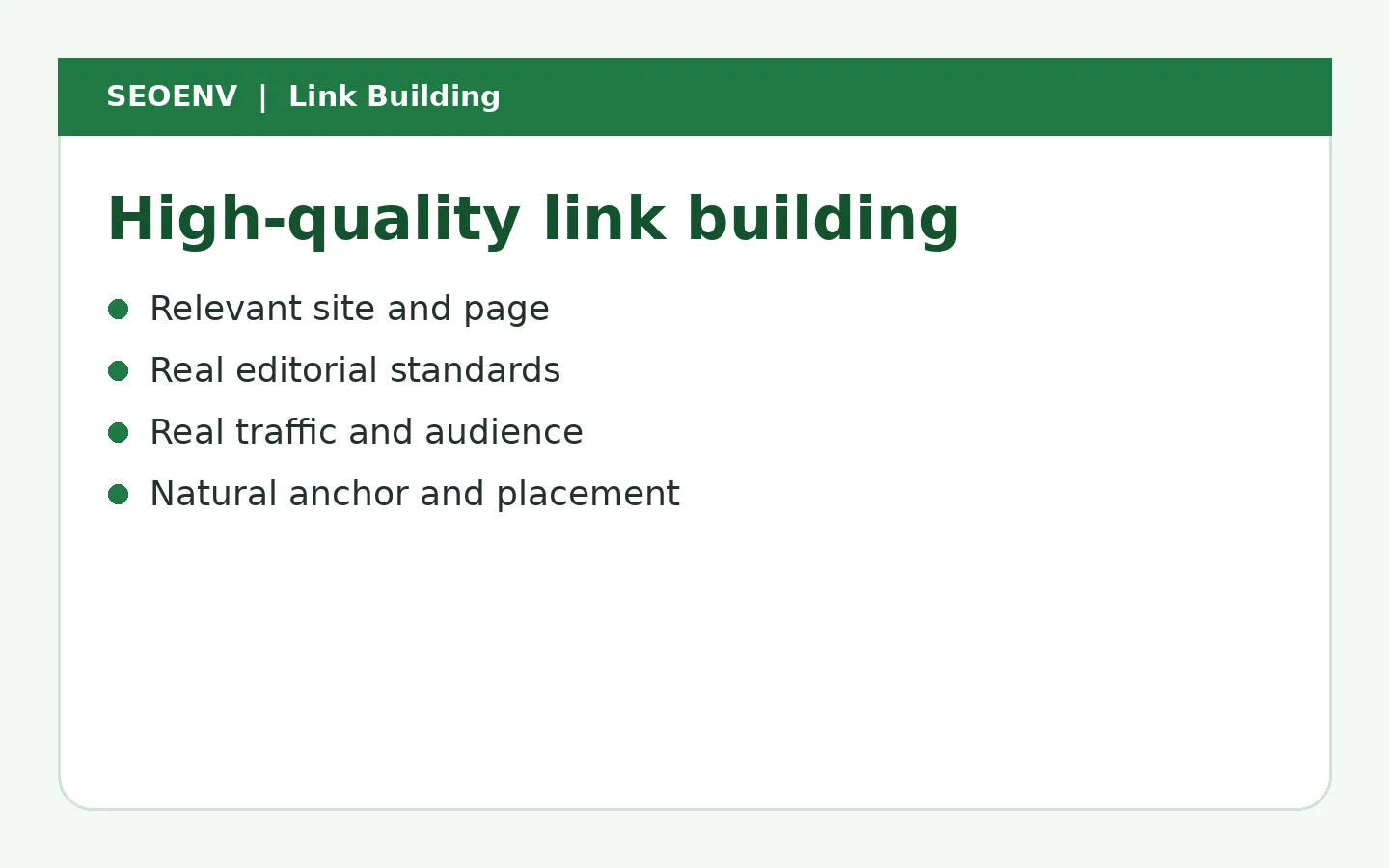
Quality signals
| Signal | High quality | Low quality |
|---|---|---|
| Relevance | Same topic or audience | Unrelated |
| Editorial standards | Edited, accurate, original | Thin, spun, anything published |
| Traffic | Real organic visitors | None or falling |
| Outbound links | Few, relevant | Many, to casinos, loans, everything |
| Placement | In body copy, in context | Footer, sidebar, author bio only |
| Anchor | Natural, descriptive | Exact-match keyword |
| Selling links | Doesn't advertise | "Write for us, $50 dofollow" |
Our high-quality backlink checklist has a scored version.
Authority metrics in context
Moz describes Domain Authority as a predictive score, not a Google metric. High-authority sites that sell links on any topic are exactly what Google's spam policies target. Use DA or DR to filter, then judge by hand. See domain authority explained.
How to build high-quality links
- Create content that deserves citation.
- Pitch sites that serve your audience.
- Contribute expertise to real publications.
- Earn press coverage with data.
- Partner with relevant businesses.
Quality checks after the link goes live
Quality isn't fixed. A site can be sold, start selling links or change the page. Check that the link is still live, still followed and still on a page you'd be happy with.
A link that passed every check in January can be gone or switched to nofollow by June, and quality campaigns are expensive enough that losing links silently hurts.
Check quality links stay live and followed
SEOENV flags Lost, Broken and nofollow changes.
Worked example: comparing two link offers (example data)
The offers are invented example data.
| Offer A | Offer B | |
|---|---|---|
| Domain rating | 72 | 38 |
| Topic | General news and lifestyle | Your exact niche |
| Organic traffic | Falling | Steady |
| Outbound links per post | 6, mixed topics | 2, relevant |
| Write-for-us page with prices | Yes | No |
| Verdict | Risky | Higher quality |
Offer B has half the authority but every other signal points to real quality.
High-quality link building services: what to ask
- Show recent live links in my niche.
- How do you qualify sites?
- Do you pay for placements, and how are they marked?
- What happens if a link is removed?
How many quality links do you need?
Fewer than you'd think. A handful of strong, relevant links often outperform dozens of weak ones. See how many backlinks do I need.
Common mistakes
- Judging by DA alone.
- Ignoring relevance for "authority".
- Accepting links in author bios only.
- Not re-checking links later.
A step-by-step process for high-quality link building
Quality comes from process, not luck. These steps take a campaign from idea to verified link.
Step 1: define what "relevant" means for you
Write down the three to five topics your audience reads about, the publications they trust and the adjacent industries that serve the same buyers. A project management tool might list remote work, team productivity, agency operations and software buying. Anything outside that map needs a strong reason to be on your list.
Step 2: build a prospect list from real pages
Search for pages that already cover your topic: recent guides, roundups, resource pages and opinion pieces. Note the author, the page URL and why your content adds something. A list of 50 well-researched prospects usually beats 500 scraped domains.
Step 3: qualify every site by hand
Open the site. Read two or three recent posts. Check whether articles have named authors, whether outbound links look editorial and whether the site shows up for its own topic in search. Use the quality signals table above as a scorecard.
Step 4: create the asset worth linking to
Most quality links point to something specific: original data, a detailed guide, a free template, a calculator or an expert opinion. Ask, "What would this editor gain by linking to us?" If the answer is "nothing", fix the asset before you pitch.
Step 5: pitch with a reason
Mention the exact page, the gap you noticed and the specific resource that fills it. Keep it under 150 words.
Step 6: verify and record
When a link goes live, check the URL, anchor text, rel attribute and the page it sits on. Record the date, the contact and any cost so you can re-check it later.
Quality scorecard you can copy
Score each prospect from 0 to 2 on every line. Pursue sites that score 10 or more out of 14.
| Criterion | 0 | 1 | 2 |
|---|---|---|---|
| Topical relevance | Unrelated | Adjacent | Same topic |
| Editorial standards | None visible | Some editing | Named authors, edited |
| Organic visibility | None | Some | Steady or growing |
| Outbound link pattern | Spammy | Mixed | Editorial, relevant |
| Placement offered | Bio/footer | Sidebar or list | In-body, in context |
| Audience fit | None | Partial | Your buyers read it |
| Link selling signs | Price list | Unclear | None |
Example data: a quarter of quality-focused outreach
The numbers below are invented example data showing what a quality-first quarter could look like for a small B2B site.
| Month | Prospects researched | Pitches sent | Replies | Links live |
|---|---|---|---|---|
| Month 1 | 60 | 40 | 9 | 3 |
| Month 2 | 55 | 45 | 11 | 4 |
| Month 3 | 50 | 42 | 12 | 5 |
| Total | 165 | 127 | 32 | 12 |
Twelve links in a quarter looks slow next to a vendor promising 50, but each of the twelve came from a relevant site, sits in body copy and was earned on merit. Those links are far less likely to be devalued or removed.
Pitfalls that quietly lower quality
- Scaling too fast. When volume targets drive the work, relevance checks are the first thing skipped.
- Reusing the same asset for every pitch. Editors notice when a pitch doesn't fit their page.
- Accepting any anchor text. Let editors choose natural wording. Pushing exact-match anchors creates a pattern.
- Forgetting to label paid placements. If money changes hands, the link should be qualified with rel="sponsored", as Google's spam policies explain.
- Not tracking removals. A quality link that disappears quietly is wasted effort.
High-quality link building checklist
- Relevance map written and shared with the team.
- Every prospect opened and read, not just scored by a tool.
- Asset reviewed: would an editor genuinely cite it?
- Pitch references the specific page and gap.
- Live link checked for URL, anchor and rel attribute.
- Link recorded with date, contact and cost.
- Re-check scheduled monthly.
How SEOENV handles this
SEOENV records each link's source, anchor, partner and cost, and checks status and dofollow or nofollow on demand on any plan and daily on paid plans. The Anchor Text Heatmap on Growth highlights over-optimised anchors, a common sign of low-quality campaigns.
Quality is relevance, editorial judgement and real audiences. Build for those and keep checking.
Related reading
- What Makes a High-Quality Backlink? A Checklist for Judging Links
- Domain Authority Explained: What It Is, How to Check It and Whether It Matters
- White Hat Link Building: Techniques That Stay Within Google's Rules
- Editorial Backlinks: What They Are and How to Earn Them
- Link Building Services: How to Evaluate Them Before You Pay
Sources
How we wrote this
The SEOENV Team wrote this guide from our day-to-day work tracking link exchanges, guest posts and paid placements, and checked the guidance against the sources listed above. Any numbers in worked examples are illustrative example data, not results from a real site or study. We review our guides when Google updates its documentation.
Frequently asked questions
What is a high-quality backlink?
A link from a relevant site with editorial standards and real traffic, placed naturally in content.
Is a high DA link always high quality?
No. DA is a third-party estimate. Relevance and editorial standards matter more.
How do I check link quality?
Check relevance, traffic, outbound links, placement and whether the site openly sells links.
Are fewer quality links better than many weak ones?
Usually yes. Relevant, editorial links carry more value and less risk.
Can a quality link become low quality later?
Yes. Sites change ownership, start selling links or remove pages. Re-check regularly.

Leave A Comment