
By SEOENV Team | Published October 23, 2026
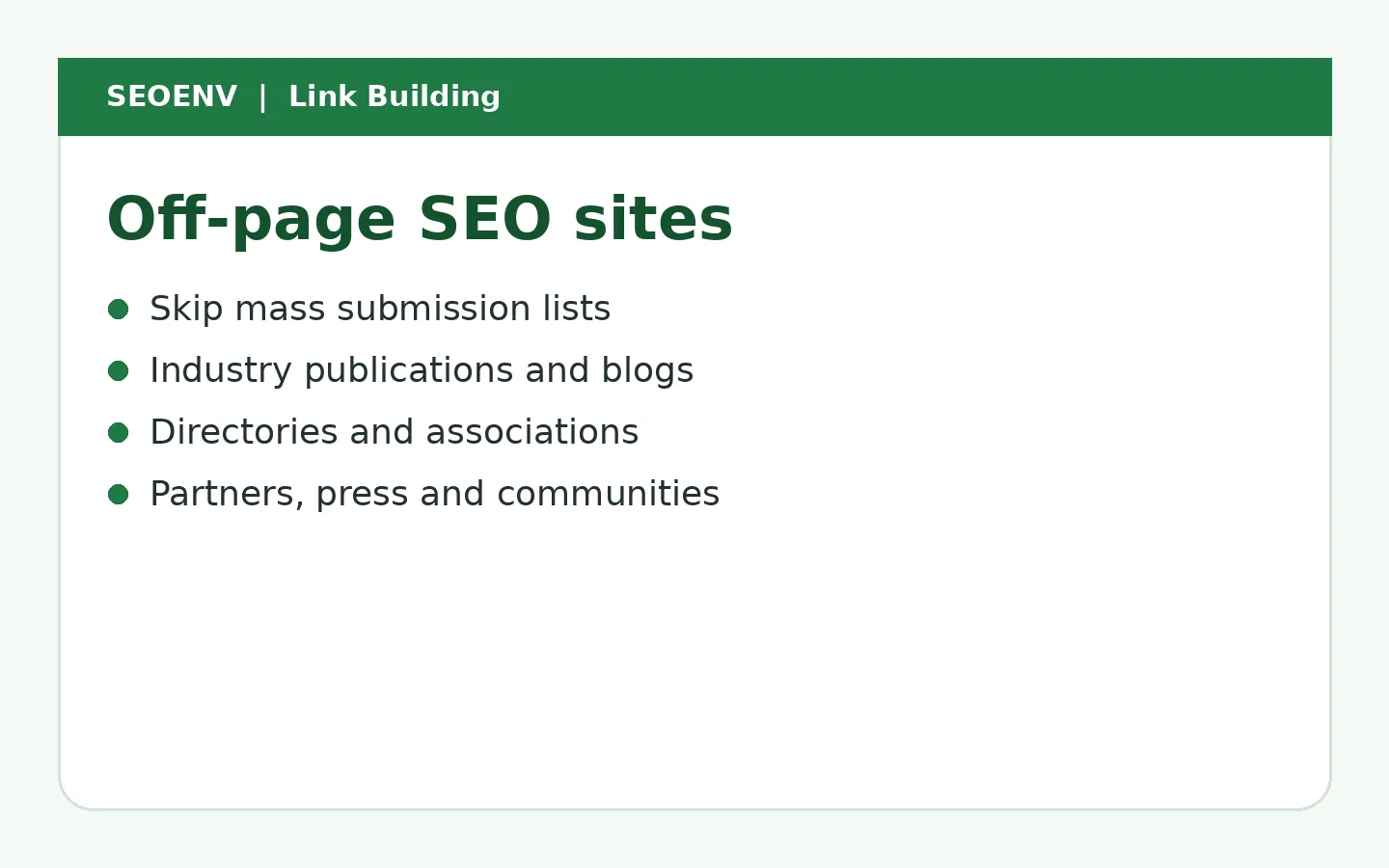
"Off-page SEO sites lists" that offer hundreds of social bookmarking, article, profile and classified sites mostly produce spam, nofollow or ignored links, and mass submission is the kind of automated link building Google's spam policies warn about. A better list is a list of site types: industry publications, niche blogs, relevant directories, associations, partners, press and communities. You then find the specific sites in each type that fit your niche.
Key takeaways
- Mass submission lists mostly produce spam or nofollow links.
- Legitimate links come from site types, not a fixed list.
- Find sites relevant to your niche for each type.
- A few relevant sources beat hundreds of submissions.
- Record where you submit so you can maintain listings.
Why mass submission lists fail
| Type on typical lists | Problem |
|---|---|
| Social bookmarking | Mostly nofollow, spam-filled |
| Article directories | Low quality, abandoned |
| Profile creation | Nofollow, no audience |
| Classified ads | Irrelevant for most |
| Web 2.0 blogs | Thin, created for links |
Google's spam policies list automated link creation and low-quality directory or bookmark links as link spam.
A better list: site types that work
| Site type | How to find | Value |
|---|---|---|
| Industry publications | "[niche] magazine", "[niche] news" | High |
| Niche blogs | "[topic] blog", competitor backlinks | Medium-high |
| Resource pages | "[topic] resources" | Medium |
| Respected directories | Trade bodies, chambers | Low-medium |
| Associations | Member listings | Medium |
| Partners and suppliers | Your relationships | Medium-high |
| Press | Journalist requests, local news | High |
| Communities | Forums and groups you use | Low (often ugc) |
| Podcasts | "[niche] podcast" | Medium |
| Review platforms | G2, Capterra, Trustpilot | Low-medium |
How to build your own list
- Export competitors' backlinks and group by site type.
- Keep only relevant, live sites with real traffic.
- Add your partners and associations.
- Search for publications and blogs in your niche.
- Score each site. See high-quality backlink checklist.
About "high DA submission sites"
High DA doesn't mean a submission there helps you. Many big platforms nofollow user links; Google's qualify outbound links guide explains the ugc and nofollow attributes.
Submission-style links are easy to create and easy to forget. Accounts pile up, listings go stale and nobody knows which login belongs to which site.
Worked example: list cleanup (example data)
| Source | Before (submission list) | After (curated) |
|---|---|---|
| Sites used | 300 | 25 |
| Followed links | 12 | 14 |
| Relevant to niche | 20 | 25 |
| Sites with real traffic | 30 | 22 |
Fewer, better sites delivered more useful links (example data).
Site types in more depth, with how to approach each
Industry associations and chambers of commerce
Membership often includes a listing with a link. The value is relevance and trust, not volume. Check that the listing page is indexable and that member pages aren't buried behind logins.
Supplier, partner and integration pages
If you use a supplier's product or integrate with a tool, ask whether they list customers or partners. These links come from relevant sites that already know you.
Niche directories
A directory serving your exact industry, with editorial review and real visitors, can be useful. A general directory that accepts anything for a fee usually isn't.
Local business listings
For local businesses, a small set of well-known listings with consistent details matters more than hundreds of submissions. Google's Business Profile help explains how local ranking works.
Q&A sites and forums
Helpful answers can earn visits and occasional mentions. Links in forum posts are usually nofollow, so treat these as visibility, not link building.
Podcasts and interviews
Guest appearances usually come with a show-notes link and reach an engaged audience.
Event and sponsorship pages
Sponsoring a relevant event may earn a listing. If you pay, the link should be qualified with rel="sponsored".
How to qualify a site before you submit
| Check | Pass | Fail |
|---|---|---|
| Real visitors | Shows up in search for its topic | No visibility |
| Editorial review | Listings are checked | Instant approval for anything |
| Relevance | Serves your industry or area | Unrelated categories |
| Outbound links | Curated | Thousands of unrelated links |
| Page indexable | Listing page can be found | Blocked or noindexed |
| Cost | Free or fair, labelled if paid | "Dofollow guaranteed" for a fee |
Example data: building a 20-site list from scratch
These numbers are invented example data for a regional accounting firm.
| Source | Candidates found | Passed checks | Submitted | Live |
|---|---|---|---|---|
| Professional associations | 6 | 4 | 4 | 4 |
| Software partner directories | 5 | 4 | 4 | 3 |
| Local listings | 12 | 6 | 6 | 6 |
| Industry directories | 15 | 3 | 3 | 2 |
| Podcasts | 8 | 3 | 3 | 2 |
| Total | 46 | 20 | 20 | 17 |
Less than half the candidates passed, and that's healthy. Seventeen relevant listings are worth more than a few hundred mass submissions.
Pitfalls
- Buying "1,000 submissions" packages. These produce low-quality links in bulk.
- Inconsistent details. Use the same business name, address and phone everywhere.
- Duplicate descriptions. Write a short, unique description for each important listing.
- Forgetting logins. Record where you submitted and how to update each listing.
- Not checking status. Listings get removed. Re-check twice a year.
Checklist for your own list
- Each site checked for visitors, relevance and editorial review.
- Business details identical across listings.
- Paid listings labelled appropriately.
- Every submission recorded with date, URL and login location.
- Live status re-checked every six months.
Why "free submission site lists" are usually out of date
Lists of hundreds of submission sites get copied between blogs for years. Many of the sites on them have closed, stopped accepting submissions, switched every link to nofollow or become spam havens. Google's spam policies mention low-quality directory and bookmark links as examples of link spam. Working from an old list wastes hours and can add links you'd later want to remove.
A better habit is to treat any list, including ours, as a starting point for research. Open each site, apply the qualification checks above and keep only the handful that fit your business.
How to keep listings up to date
Create a simple record for every listing: site, URL of your listing, date submitted, login location and last checked date. Twice a year, open each listing and confirm that the details are correct and the link still works. When your business moves, changes phone number or rebrands, update every listing in one sitting, starting with the most important ones.
A realistic expectation for listings
Listings and directory links are a foundation, not a growth strategy. They help customers find you, confirm your business details and add a small number of relevant links. Real growth in links usually comes from content worth citing, outreach and partnerships, so once your core listings are done, spend most of your off-page time there. Revisit your list only when you enter a new market, launch a new product line or join a new association. Until then, keep the list short, accurate and checked twice a year.
How SEOENV handles this
SEOENV's Site Inventory stores your curated list of sites with notes, and Listing Backlinks records each directory or profile with the account used. Every link is checked for status and type.
Skip the 500-site list. Build a short, relevant one and maintain it.
Related reading
- What Is Off-Page SEO? Definition, Factors and Examples
- Directory Backlinks: Are They Still Worth It?
- Free Backlinks: 12 Legit Ways to Get Backlinks Without Paying
- How to Get Backlinks: 15 Proven Ways That Work in 2026
- Off-Page SEO Checklist: 20 Tasks to Run Every Quarter
Sources
How we wrote this
The SEOENV Team wrote this guide from our day-to-day work tracking link exchanges, guest posts and paid placements, and checked the guidance against the sources listed above. Any numbers in worked examples are illustrative example data, not results from a real site or study. We review our guides when Google updates its documentation.
Frequently asked questions
Do off-page SEO submission sites work?
Mass submission sites mostly produce spam or nofollow links that carry little value.
What are the best off-page SEO sites?
Sites relevant to your niche: publications, blogs, associations, partners and respected directories.
Are high DA submission sites good for SEO?
Not automatically. Many nofollow user links and offer no relevance.
Is social bookmarking still useful?
Rarely. Most links are nofollow and the sites are spam-prone.
How do I build my own list?
Start from competitors' backlinks, your partners and niche publications, then qualify each site.

Leave A Comment