
By SEOENV Team | Published October 23, 2026
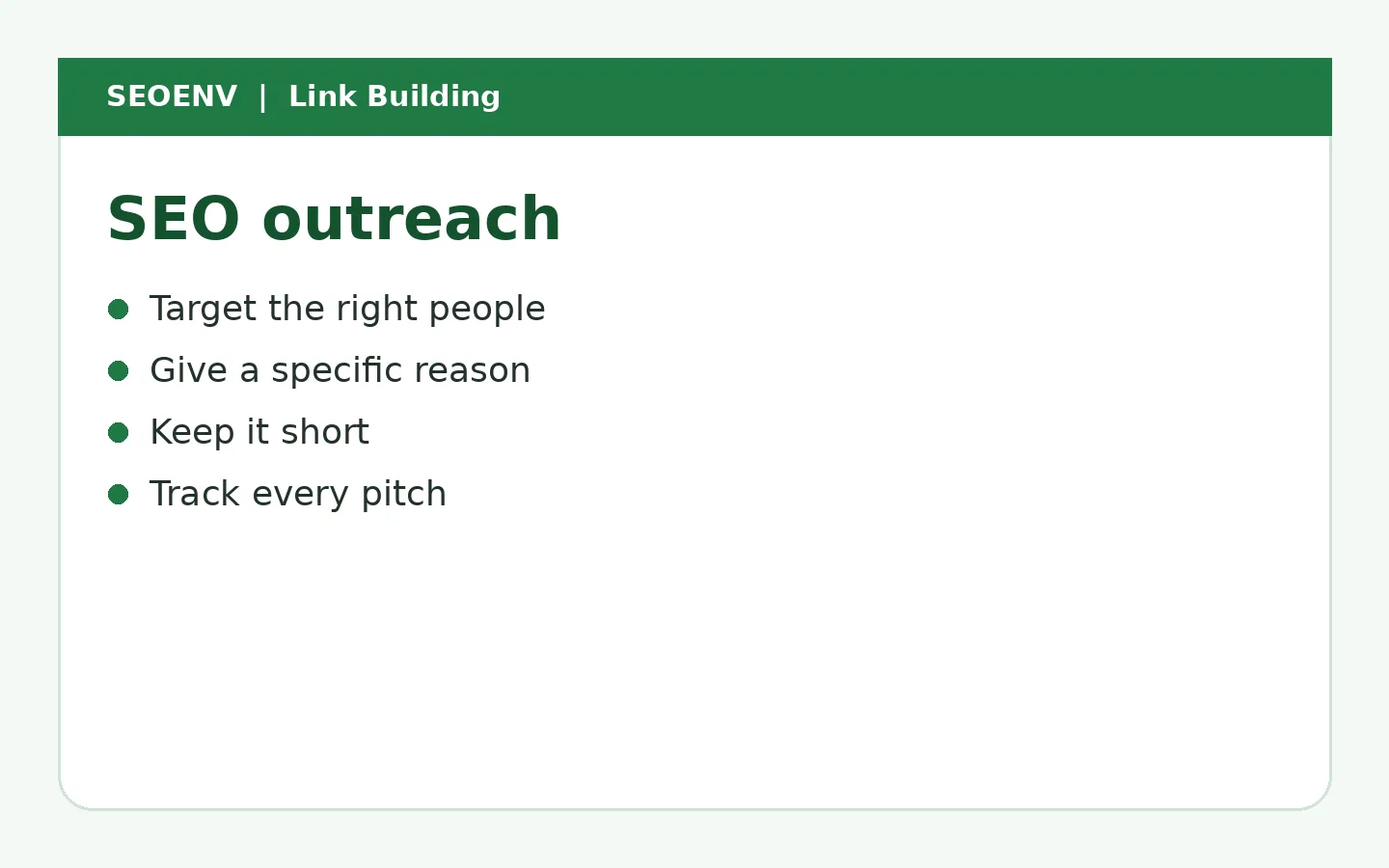
SEO outreach is contacting site owners, editors and writers to suggest your content, offer a guest post or ask for a link. Replies come from targeting: the right person, a page they've actually written and a specific reason your content helps their readers. Keep emails short, follow up once or twice and track every pitch so links don't fall through the cracks.
Key takeaways
- Outreach success depends on targeting more than templates.
- Pitch the right person with a specific reason.
- Keep emails short and useful.
- Follow up once or twice.
- Track every pitch and link.
The outreach process
| Step | What to do |
|---|---|
| 1. Target | Pages and people relevant to your content |
| 2. Research | Read what they wrote |
| 3. Pitch | Short, specific, helpful |
| 4. Follow up | Once or twice |
| 5. Deliver | Content or details promptly |
| 6. Verify | Check the link went live |
Targeting
Find writers who've covered your topic recently. Prioritise relevance over authority.
Writing the pitch
- Subject: specific to them.
- First line: their article, not you.
- Middle: what you offer and why it helps.
- End: an easy yes.
Rules to follow
Commercial email laws vary. Mailbox providers also set rules: Google's email sender guidelines cover authentication, low spam rates and easy unsubscribes, and laws such as the US CAN-SPAM Act require honest headers and subject lines. Don't offer payment for followed links, which Google's spam policies prohibit.
Outreach generates dozens of threads. The hard part is knowing which "yes" became a live link.
Worked example: improving reply rates (example data)
| Version | Sent | Replies | Links |
|---|---|---|---|
| Generic template | 200 | 8 | 3 |
| Personal, targeted | 60 | 12 | 7 |
Common mistakes
- Mass emailing.
- Asking for a link in the first line.
- No follow-up.
- No tracking.
SEO outreach step by step
Step 1: decide what you're offering
Outreach works when you offer something useful: a resource that fills a gap, a fix for a broken link, expert input for an article, data for a story or a guest contribution. Write one sentence describing the value to the recipient. If you can't, the campaign isn't ready.
Step 2: find pages, not just sites
Search for pages that cover your topic and would genuinely be improved by your resource. Useful searches include your topic plus "resources", "guide", "tools" or "statistics", and recent articles that mention competitors or outdated sources.
Step 3: find the right person
Look for the author's name on the page, then their contact details on the site or a professional profile. Editors and authors are better targets than generic contact forms. For larger publications, the section editor is often right.
Step 4: qualify before you pitch
Check that the site has real readers, relevant content and editorial standards. Skip sites with visible link price lists or posts on every topic.
Step 5: personalise the first two lines
Reference the specific page and what you noticed. One accurate, specific sentence does more than three paragraphs of flattery.
Step 6: make the ask clear and easy
Say exactly what you're suggesting and where it might fit. Include the URL. Don't attach files unless asked.
Step 7: follow up once or twice
Wait four to seven days, then send a short follow-up. Stop after two follow-ups.
Step 8: deliver and verify
If they agree, deliver quickly. When the link goes live, check the URL, anchor and rel attribute, then record it.
Outreach email structure
| Part | Purpose | Example (example data) |
|---|---|---|
| Subject | Specific and plain | "Your remote onboarding checklist" |
| Opening | Show you read the page | "Your checklist covers equipment but not first-week meetings." |
| Value | What you offer | "We published a first-week meeting plan with templates." |
| Ask | Clear, low effort | "Might it be a useful addition to the list?" |
| Close | Polite, no pressure | "Either way, thanks for the checklist." |
For full templates, see link building outreach email examples.
Example data: three campaigns compared
These campaigns and numbers are invented example data.
| Campaign | Pitches | Replies | Reply rate | Links live |
|---|---|---|---|---|
| Generic template to scraped list | 300 | 9 | 3% | 2 |
| Personalised, resource page targets | 60 | 14 | 23% | 7 |
| Broken link replacement | 40 | 11 | 28% | 6 |
The two smaller, researched campaigns produced six times as many links as the generic blast, with a fraction of the emails.
Outreach pitfalls
- Mass templates. Recipients spot them instantly.
- Fake familiarity. "Long-time reader" when you aren't damages trust.
- Offering payment for followed links. That breaks Google's spam policies.
- Too many follow-ups. Two is enough.
- Not tracking pitches. Without a log, you'll pitch the same person twice or lose track of agreed links.
- Ignoring email rules. Use a real sender name and address and honour requests not to be contacted again.
Outreach checklist
- Value statement written.
- Target pages researched individually.
- Right contact found.
- Site qualified for relevance and quality.
- First lines personalised.
- Clear, single ask.
- Follow-ups scheduled, maximum two.
- Live links verified and recorded.
How to measure outreach
Track pitches sent, replies, positive replies and live links, per campaign. Reply rate tells you whether targeting and pitches work. Live link rate tells you whether you're following through. Over time, compare campaigns to see which offers and targets work best for your niche.
How to improve reply rates over time
Review every campaign once it closes. Read the replies you got, including the rejections, and look for patterns. If editors say the resource isn't a fit, your targeting needs work. If they don't reply at all, your subject line or first sentence may not be specific enough. Test one change at a time, such as a different subject line style or a different type of target page, so you know what made the difference. Keep notes on which editors replied positively; they're the start of long-term relationships that make future outreach far easier.
Where outreach fits with other link building
Outreach is the delivery method behind most link building tactics. Resource page links, broken link replacements, guest posts, expert commentary and digital PR all depend on contacting the right person with the right offer. That means outreach skills compound: the better you get at research and personal pitches, the better every other tactic works. It also means outreach can't rescue a weak offer. If your resource isn't genuinely useful, the best email in the world won't earn a link. Spend time on the asset first, then on targeting, then on the words of the email. See how to get backlinks and manual link building for the tactics outreach supports.
Outreach timing and volume
Send pitches on weekdays during the recipient's working hours, and spread them out rather than sending hundreds at once. Sudden bursts from a new domain can hurt deliverability, and Google's email sender guidelines recommend authenticating your domain and keeping spam complaints low. A steady pace of researched pitches each week is easier to personalise and easier to follow up properly.
How SEOENV handles this
Outreach happens in your email; SEOENV records the result. Guest posts move through stages, partners are recorded and every link is checked for status and type. SEOENV doesn't send outreach emails.
Targeted, short and tracked: that's outreach that works.
Related reading
- Link Building Outreach Email Examples: 10 Templates That Get Replies
- Guest Post Outreach Email Template
- Manual Link Building: A Step-by-Step Process That Scales
- How to Get Backlinks: 15 Proven Ways That Work in 2026
- Guest Blogging for SEO: How to Do It Without Risk in 2026
Sources
How we wrote this
The SEOENV Team wrote this guide from our day-to-day work tracking link exchanges, guest posts and paid placements, and checked the guidance against the sources listed above. Any numbers in worked examples are illustrative example data, not results from a real site or study. We review our guides when Google updates its documentation.
Frequently asked questions
What is SEO outreach?
Contacting site owners and writers to suggest content, offer guest posts or request links.
What reply rate should I expect?
It varies widely. Targeted, personal pitches usually do much better than mass emails.
How many follow-ups should I send?
One or two, a few days apart.
Is blogger outreach the same as SEO outreach?
Blogger outreach is a type of SEO outreach focused on bloggers.
Can I pay for links in outreach?
Paid followed links break Google's rules. Paid placements should be marked sponsored.

Leave A Comment