
By SEOENV Team | Published October 23, 2026
The skyscraper technique is a link building method popularised by Brian Dean of Backlinko: find content in your niche that has earned many links, create something substantially better, then contact the people who linked to the original and suggest yours. It still works when "better" means genuinely more useful and the outreach is targeted, but the original version, longer content pitched to everyone, gets far fewer links today because editors have seen thousands of identical emails.
This guide explains the method, why it often fails now and how to adapt it.
Key takeaways
- The skyscraper technique: find linked content, make better, pitch linkers.
- The original version is overused and gets low reply rates.
- "Better" must mean more useful, not just longer.
- Pitch a narrow, relevant list, not everyone who linked.
- Track replies and links to see whether it's working.
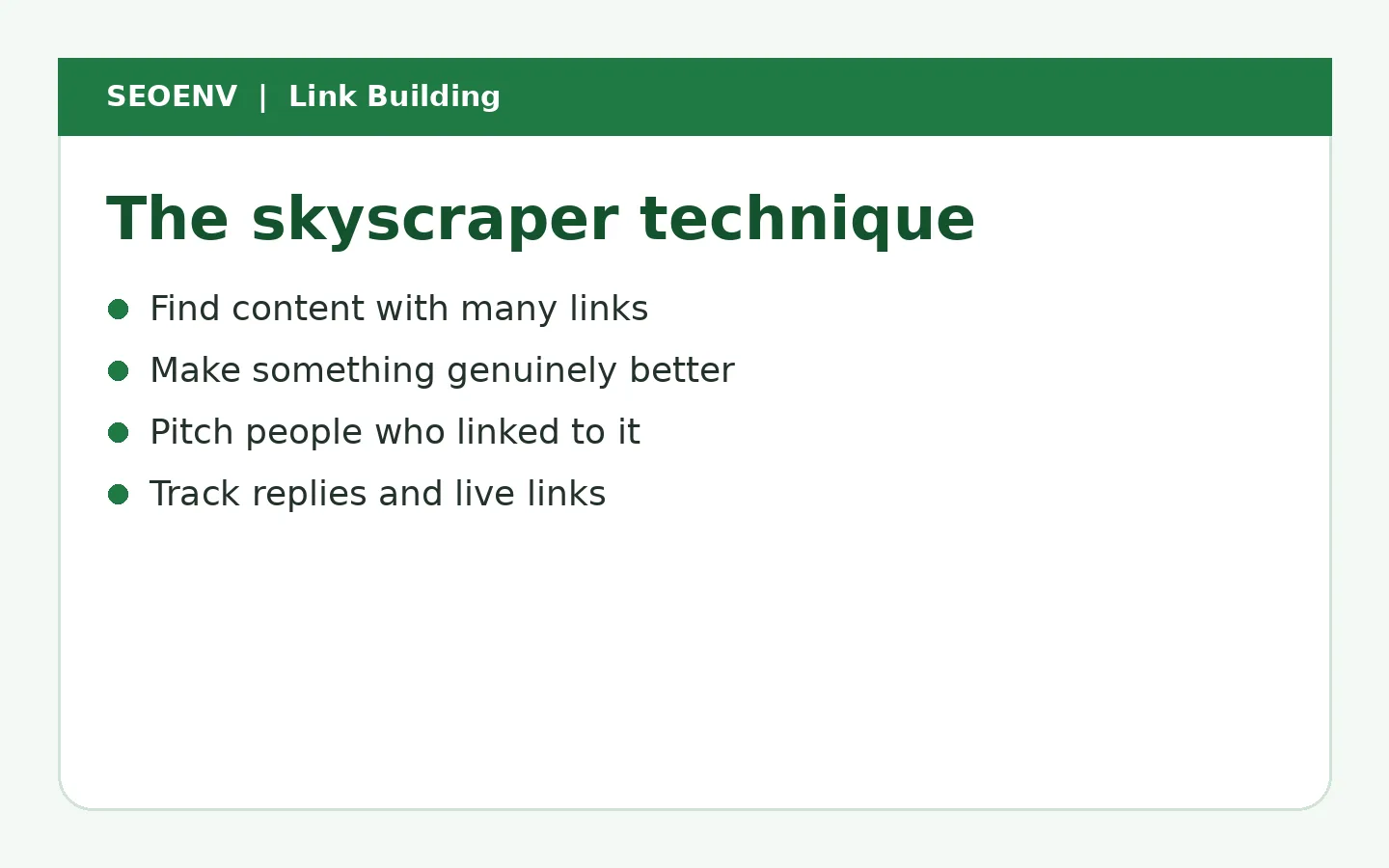
The three steps
| Step | Original version | Adapted version |
|---|---|---|
| 1. Find | Content with many links | Content with many links that's outdated or incomplete |
| 2. Improve | Make it longer, more items | Add original data, better examples, clearer answers |
| 3. Pitch | Email everyone who linked | Pitch a qualified shortlist with a personal reason |
The method is described in Backlinko's own write-up.
Why it gets fewer links now
- Editors receive many "I wrote a better version" emails.
- "Better" often just means longer, which doesn't help readers.
- Many old links are on pages nobody maintains.
- Linkers have no reason to swap a working link.
Google's helpful content guidance asks whether content provides substantial value compared with other pages in search results, which is the right bar for "better".
How to make skyscraper content genuinely better
- Add original information: data, tests, screenshots, experience.
- Update: fix outdated facts, tools and examples.
- Clarify: answer the question faster with better structure.
- Add something usable: a template, calculator or checklist.
- Cover what's missing: a section readers keep asking about.
Length is a by-product, not the goal.
How to pitch skyscraper content
- Pull the original's backlinks and filter to relevant, live, maintained pages.
- Skip pages that are years old with no updates.
- Find the author.
- Mention the specific article and what yours adds that theirs could use.
- Make it easy: suggest the sentence where the link would fit.
Skyscraper campaigns generate long prospect lists, and it's easy to lose track of who replied, who said "maybe later" and which links actually went live.
Track your skyscraper pitches and links
Record each link you win and check it stays live.
Worked example: original vs adapted (example data)
The figures are invented example data.
| Version | Pitched | Replies | Links |
|---|---|---|---|
| Original: email every linker | 400 | 18 | 5 |
| Adapted: 60 qualified, personal pitches | 60 | 14 | 8 |
The adapted version sent 85% fewer emails and won more links.
When to use the skyscraper technique
It suits topics where existing linked content is outdated or thin and you can add something original. It doesn't suit topics where the top content is already excellent.
Alternatives
Original data, tools and digital PR often earn links more reliably. See digital PR for SEO.
Common mistakes
- Treating word count as quality.
- Pitching hundreds of unqualified linkers.
- Asking people to replace links without explaining why.
- Never updating the skyscraper page after launch.
Keeping skyscraper content on top
The content you replaced was once the best. Schedule updates so yours doesn't become the next outdated target.
How SEOENV handles this
Add the links your skyscraper content earns to SEOENV under the campaign's project. SEOENV checks each one for status and dofollow or nofollow and shows which target URLs they support, so you can judge whether the campaign was worth repeating.
The skyscraper technique still works when it's about building something more useful and offering it to the right few people.
Related reading
- How to Get Backlinks: 15 Proven Ways That Work in 2026
- Manual Link Building: A Step-by-Step Process That Scales
- SEO Outreach: How to Get Replies and Earn Links
- Link Building Case Study: A Worked Example from Plan to Results
- Editorial Backlinks: What They Are and How to Earn Them
Sources
How we wrote this
The SEOENV Team wrote this guide from our day-to-day work tracking link exchanges, guest posts and paid placements, and checked the guidance against the sources listed above. Any numbers in worked examples are illustrative example data, not results from a real site or study. We review our guides when Google updates its documentation.
Frequently asked questions
What is the skyscraper technique?
Finding content with many links, creating something better and pitching the people who linked to the original.
Does the skyscraper technique still work?
Yes, when the content is genuinely more useful and outreach is targeted. Mass emails rarely work now.
Who created the skyscraper technique?
It was popularised by Brian Dean of Backlinko.
Is longer content better for skyscraper?
Not by itself. Original data, updates and clarity matter more than length.
How many people should I pitch?
A qualified shortlist of relevant, maintained pages usually works better than emailing every linker.

Leave A Comment