
By SEOENV Team | Published October 23, 2026
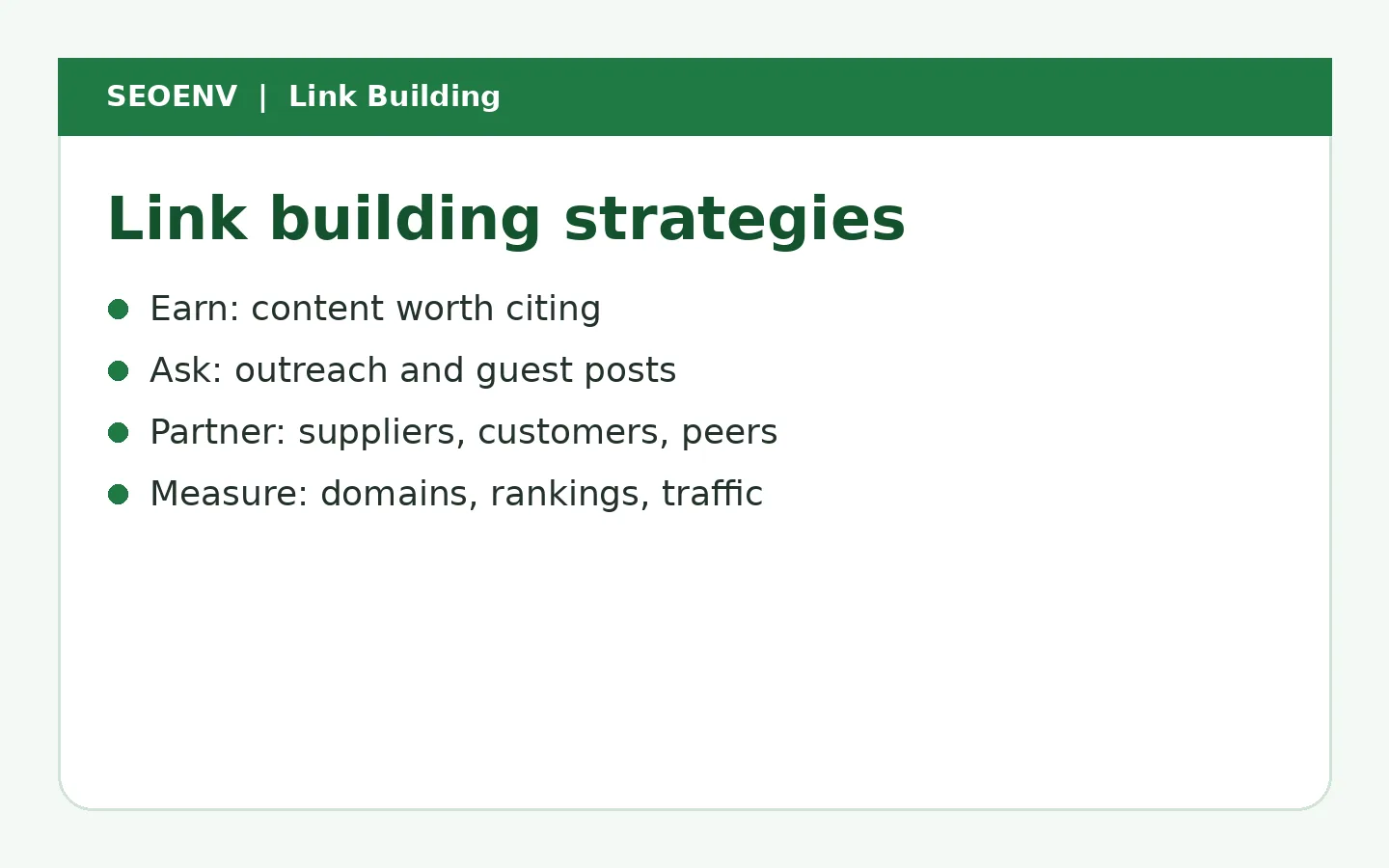
Link building is the work of getting other relevant websites to link to yours, and a good link building strategy combines content worth citing with a repeatable way of getting it in front of the right people. For beginners, the most dependable strategies are reference content, targeted outreach, guest posting on real sites and partnerships, measured by new referring domains to the pages you want to rank.
This playbook explains what link building does, the main strategies, how to choose between them and a simple 90-day plan to start.
Key takeaways
- Link building is getting other relevant sites to link to yours.
- Strategies fall into earning, asking, creating and partnering.
- Pick strategies that match your resources and niche.
- Plan in 90-day cycles with clear page targets.
- Measure referring domains and rankings, not raw link counts.
What is link building in SEO?
Links help search engines find your pages and are one of the signals they use to judge how useful and trusted a page is. Link building is the deliberate effort to earn more of those links. Done well, it also brings referral traffic and builds relationships in your industry.
Done badly, buying followed links, running link networks or spamming forums, it breaks Google's spam policies and can lead to links being ignored or manual actions.
Link building benefits
- Rankings: competitive searches are often won by pages with stronger, relevant link support.
- Discovery: links help new pages get crawled and indexed sooner.
- Referral traffic: visitors from relevant sites are often well qualified.
- Credibility: being cited by respected sites builds trust with buyers.
- Relationships: outreach builds a network of editors, partners and peers.
The four families of strategies
| Family | Examples | Best for |
|---|---|---|
| Earn | Original data, tools, definitive guides, digital PR | Sites willing to invest in content |
| Ask | Outreach, resource pages, broken links, unlinked mentions | Everyone, especially early on |
| Create | Guest posts, podcasts, contributions, expert quotes | People with expertise to share |
| Partner | Suppliers, customers, integrations, associations, careful exchanges | B2B and local businesses |
Our list of 15 ways to get backlinks covers individual methods in each family.
How to choose your strategy
Answer four questions:
- What do you have? Data, expertise, a product others use, partners, a budget for content?
- Who links in your niche? Look at your competitors' backlinks. Are they mostly from news, blogs, directories or partners?
- What can you sustain? Two guest posts a month for a year beats twenty in one month.
- Which pages need links? Strategies should serve specific target pages.
The best SEO link building strategy for you is the one you can do consistently, in a way that fits your niche.
Step 1: pick target pages
List three to five pages that matter commercially and are close to ranking (positions 5-20). Estimate how many referring domains they need using the method in how many backlinks do I need.
Step 2: make sure each page deserves links
Improve thin pages before outreach. Add examples, data, visuals and clear answers. Google's SEO starter guide emphasises content that's useful to people.
Step 3: build a prospect list
Find sites that link to similar pages, cover your topic or serve your audience. Score them for relevance, traffic and editorial standards using our high-quality backlink checklist.
Step 4: run outreach
Personalise every pitch, explain why your page helps their readers and keep it short. Follow up once or twice. See our outreach email template.
Step 5: record and check every link
Note each link's source, target, anchor and date, then check it's live and followed. Links you've built are the ones most likely to change.
Most beginners get steps one to four right and skip step five. Three months in, they have dozens of links in an outreach spreadsheet, half the statuses are out of date and they can't tell a client what's actually live.
A 90-day starter plan (example data)
The plan below is an example; the targets are illustrative, not benchmarks.
| Weeks | Focus | Example target |
|---|---|---|
| 1-2 | Audit, target pages, unlinked mentions, partner asks | 5-10 links from quick wins |
| 3-6 | Publish one linkable asset (template or data) | Asset live and promoted |
| 5-10 | Outreach to 100 relevant prospects; 3 guest posts | 8-15 links |
| 9-12 | Competitor gap and broken link outreach | 5-10 links |
| 12 | Review: what worked, what didn't | Plan next 90 days |
How to measure link building
| Metric | Why |
|---|---|
| New referring domains to target pages | Breadth of support where it matters |
| Rankings for target keywords | The outcome you're after |
| Organic traffic to target pages | Business impact |
| Referral traffic from links | Direct value |
| Lost links | Keeps the profile healthy |
Our link building KPIs guide goes deeper.
Learn link building: common beginner mistakes
- Pitching the homepage instead of a specific, useful page.
- Sending templated pitches with no personal detail.
- Using exact-match anchors for every link. See anchor text in SEO.
- Judging sites on DA alone.
- Giving up after one month.
Is link building still worth it?
Yes, in most competitive niches. What's changed is that shortcuts carry more risk and less reward, while genuinely earned links keep their value. Treat link building as a mix of content, PR and relationships rather than a numbers game.
In-house or outsourced?
Small teams often start in-house to learn what works, then outsource parts of the work (prospecting, outreach) once they have a process. Whichever you choose, keep the records yourself. If a provider leaves, your link history shouldn't leave with them. Our guide to outsourcing link building covers how to choose and manage a provider.
How SEOENV handles this
SEOENV is where the "record and check" step lives. Guest posts, exchanges, ABC swaps, paid placements and listings each have a module, and every link appears in one Link Tracker with its status and dofollow or nofollow type. Organise links by client and project, then share read-only reports with clients.
Give your link building strategy a system
Track every link from pitch to live, by client and project.
Pick a strategy you can sustain, aim it at specific pages and keep a record of every link. That's most of what separates link building that works from link building that fizzles out.
Start your first 90-day plan with SEOENV
Free for up to 20 links, with checks on every plan.
Related reading
- How to Get Backlinks: 15 Proven Ways That Work in 2026
- What Are Backlinks? How They Work and Why They Matter for SEO
- White Hat Link Building: Techniques That Stay Within Google's Rules
- Link Building KPIs
- How to Manage Backlinks
Sources
How we wrote this
The SEOENV Team wrote this guide from our day-to-day work tracking link exchanges, guest posts and paid placements, and checked the guidance against the sources listed above. Any numbers in worked examples are illustrative example data, not results from a real site or study. We review our guides when Google updates its documentation.
Frequently asked questions
What is the best link building strategy for beginners?
Start with quick wins (unlinked mentions, partners), then create one useful asset and do targeted outreach to relevant sites.
How long does link building take to work?
Often a few months for less competitive pages. Competitive searches need a sustained effort.
Is link building against Google's rules?
No. Earning links is fine. Buying followed links, link networks and excessive exchanges break Google's spam policies.
How many links should a beginner build?
Set targets per page based on the referring domains of ranking competitors, not a fixed monthly number.
Do I need tools to start link building?
A backlink tool helps with research, but you can start with Google searches, Search Console and a simple tracker.

Leave A Comment