
By SEOENV Team | Published October 23, 2026
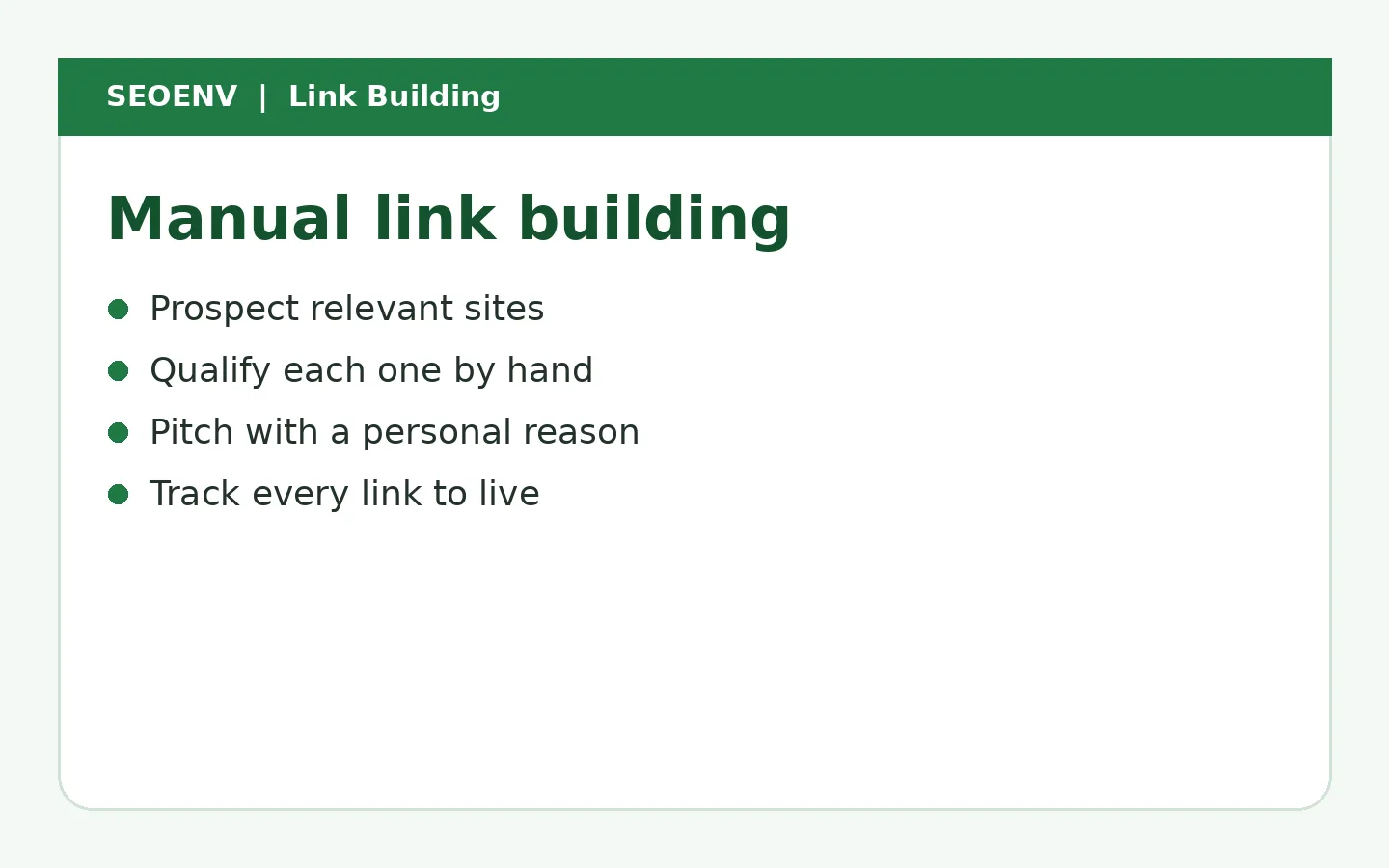
Manual link building means a person, not software, finds each prospect, checks it's relevant, writes a personal pitch and secures the link. It's slower than automated methods but produces links from real sites with real audiences, and it avoids the automated link creation that Google's spam policies prohibit. The way to make manual link building scale is a repeatable process: prospect, qualify, pitch, follow up and track.
Here's that process step by step, with the time each stage takes.
Key takeaways
- Manual link building means a person finds, pitches and secures each link.
- It's slower than automation but far safer and more relevant.
- A repeatable process makes it scale: prospect, qualify, pitch, follow up, track.
- Templates help, but every pitch needs a personal reason.
- Tracking is what stops manual work from being wasted.
Manual vs automated link building
| Manual | Automated | |
|---|---|---|
| Who places links | People, with site owners' agreement | Software, often without |
| Typical sources | Real publications, partners | Profiles, comments, link farms |
| Relevance | High | Low |
| Risk | Low | High |
| Speed | Slower | Fast |
Google's spam policies list "using automated programs or services to create links to your site" as link spam.
The manual link building process
1. Choose target pages
Pick the pages that need links and define the topics prospects should cover.
2. Prospect
Find sites via Google searches, competitor backlinks, resource pages and communities. Aim for a list larger than you need, since many won't qualify.
3. Qualify by hand
Visit each site. Check relevance, real traffic, editorial quality, whether it sells links openly and whether a link would genuinely help its readers. Use our high-quality backlink checklist.
4. Find the right contact
The editor or author, not a generic inbox if you can avoid it.
5. Pitch personally
Mention a specific article, explain what you offer and why it helps their readers. Keep it short. See outreach email examples.
6. Follow up
One or two polite follow-ups, a few days apart.
7. Deliver
Write the guest post, send the resource details or provide the data.
8. Verify and record
Check the link is live, points to the right URL and has the agreed attributes. If any payment was involved, Google's qualify outbound links guidance says the link should be sponsored.
Steps one to seven get the attention, but step eight decides whether the work pays off. Manual campaigns run across dozens of conversations, and without a record links go unverified, attributes change and removals go unnoticed.
Worked example: time per link (example data)
The figures are invented example data for a manual campaign.
| Stage | Volume | Time (example) |
|---|---|---|
| Prospects found | 200 | 4 hours |
| Qualified | 70 | 5 hours |
| Pitched | 70 | 6 hours |
| Positive replies | 14 | – |
| Content written and delivered | 10 | 15 hours |
| Links live | 9 | 1 hour checking |
About 31 hours for 9 live links, roughly 3.4 hours per link. That's the real cost of manual link building and why providers charge what they do.
How to make manual link building scale
- Build prospect lists by topic, reusable across clients.
- Keep a library of pitch templates with spaces for personal detail.
- Split roles: prospecting, outreach, writing, verification.
- Track every stage so nothing stalls.
Manual link building services
A manual link building service should show you live examples, explain its prospecting and give you a full list of links. Ask how many hours go into each link.
Common mistakes
- Skipping qualification to save time.
- Sending generic templates.
- Not checking links after they go live.
- Keeping records in personal inboxes.
When manual is not enough
Manual outreach works best with an asset worth linking to. If reply rates are poor, improve the page before sending more pitches.
How SEOENV handles this
SEOENV supports the manual process from pitch to live. Guest posts move through five stages: Pitched, Accepted, Writing, Submitted and Published. Exchanges, paid collaborations and listings have their own modules. Every resulting link is checked for status and dofollow or nofollow.
Run manual link building with a clear pipeline
Stages for each pitch and checks for each link.
Manual link building is craft work. Make the process repeatable and the tracking automatic, and it scales further than you'd expect.
Related reading
- How to Get Backlinks: 15 Proven Ways That Work in 2026
- White Hat Link Building: Techniques That Stay Within Google's Rules
- SEO Outreach: How to Get Replies and Earn Links
- Link Building Outreach Email Examples: 8 Templates That Get Replies
- Link Building Workflow for Agencies
Sources
How we wrote this
The SEOENV Team wrote this guide from our day-to-day work tracking link exchanges, guest posts and paid placements, and checked the guidance against the sources listed above. Any numbers in worked examples are illustrative example data, not results from a real site or study. We review our guides when Google updates its documentation.
Frequently asked questions
What is manual link building?
Building links by hand: a person finds, qualifies and pitches each site and secures the link with the owner's agreement.
Is manual link building better than automated?
Yes. It produces relevant links from real sites, while automated link creation is treated as link spam.
How long does it take to build a link manually?
It varies, but several hours per live link, including prospecting, pitching and content, is common.
Can manual link building scale?
Yes, with a repeatable process, split roles and good tracking.
What should a manual link building service report?
The full list of links with source, target, anchor, date and status.

Leave A Comment