
By SEOENV Team | Published October 23, 2026
Wikipedia backlinks are nofollow, so they pass little direct ranking value, but they can bring steady traffic and lead other writers to cite you. .edu backlinks don't get a special boost just because of the domain extension; a link from a relevant university page is valuable for the same reasons any relevant, editorial link is. Both are worth earning legitimately and not worth buying, spamming or gaming.
Here's how each works, legitimate ways to earn them and the tactics to avoid.
Key takeaways
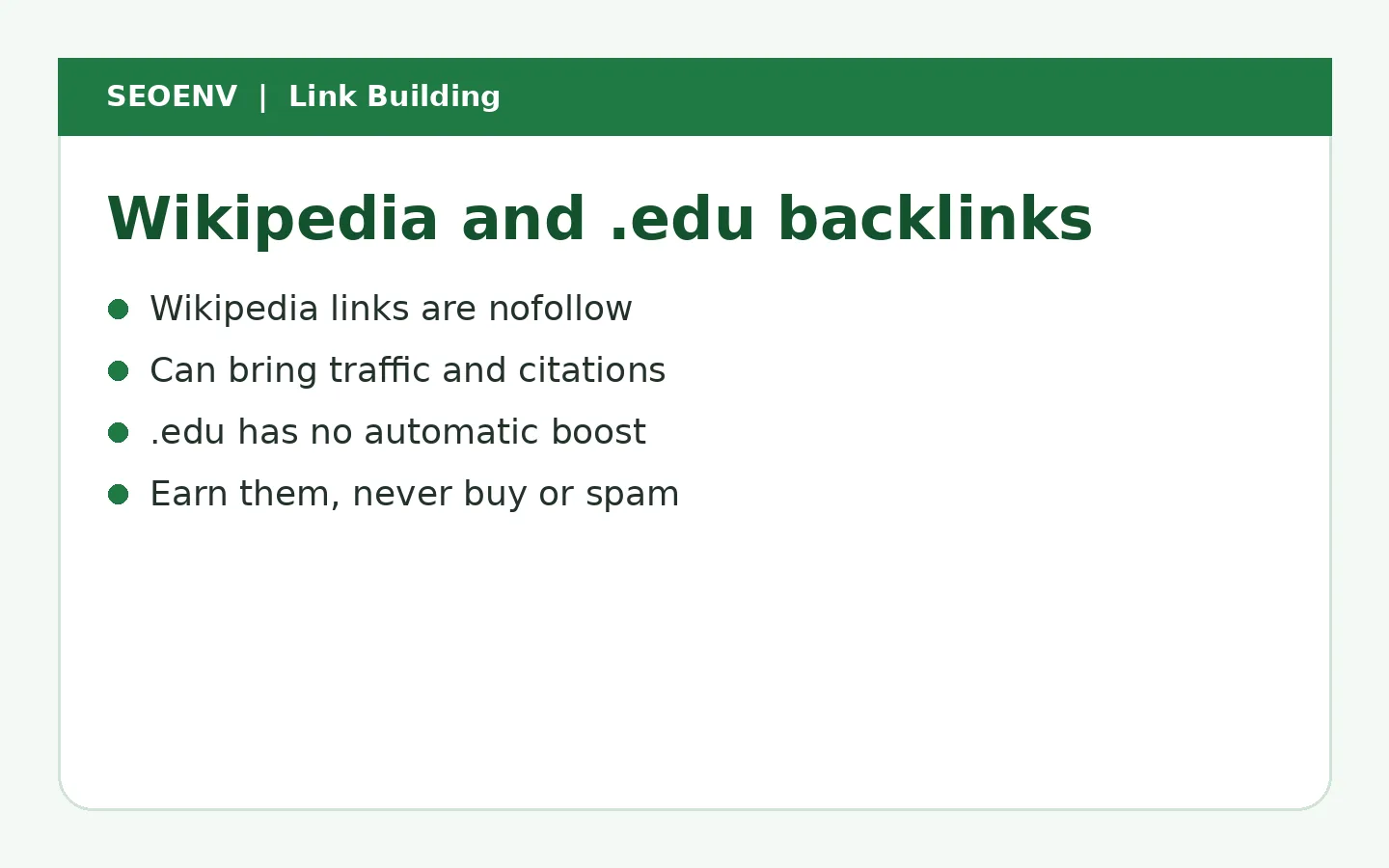
- Wikipedia external links are nofollow.
- Wikipedia links can still bring traffic and get copied by other writers.
- .edu and .gov domains have no special ranking boost by extension alone.
- Earn .edu links with real resources, scholarships rules permitting, and partnerships.
- Avoid buying or spamming either.
Wikipedia vs .edu links
| Wikipedia | .edu | |
|---|---|---|
| Link attribute | nofollow | Varies, often followed |
| Special ranking boost? | No | Not by extension alone |
| Main value | Traffic, credibility, secondary citations | Relevance, credibility |
| Can you add your own? | Discouraged (conflict of interest) | Only if the page owner agrees |
| Common spam | Self-promotional edits | Bought student/forum pages, scholarship spam |
Wikipedia backlinks
Wikipedia marks external links nofollow. Google's qualify outbound links guide treats nofollow as a hint, so some value may pass, but don't count on it.
Why they still matter:
- Wikipedia pages get large amounts of traffic.
- Journalists and writers use Wikipedia's references to find sources, then link to them directly.
How Wikipedia links happen legitimately
Editors cite reliable sources. Original research, data and authoritative guides get cited. Wikipedia's conflict of interest guideline strongly discourages editing articles about yourself or your company, and its external links guideline restricts promotional links. Adding your own links usually gets them removed.
.edu backlinks
Google has said domain extensions like .edu don't get special treatment. The value comes from relevance and editorial standards.
Legitimate ways to earn .edu links
- Resources useful to students or researchers: guides, data and tools.
- Research partnerships with academics.
- Guest lectures and career talks, which may get event or speaker pages.
- Alumni features.
- Job and internship listings on career pages.
- Local community programmes.
What to avoid
- Buying links on hacked or abandoned university pages.
- Spamming student blogs and forums.
- "Scholarship link building" created only for links, which universities increasingly ignore.
People pursue these links through a lot of different channels, and they're easy to lose: university pages get reorganised every term, and Wikipedia citations get edited.
Worked example: earning links from academic sources (example data)
The scenario is invented example data.
| Activity | Outcome (example) |
|---|---|
| Published an open dataset on local air quality | 3 university research pages linked |
| Guest lecture at a local college | 1 event page link |
| Internship listing | 1 careers page link |
| Dataset cited in a Wikipedia article by an independent editor | 1 nofollow link + 4 later news citations |
None of these were bought. Each came from producing something academics or editors found useful.
Gov backlinks
The same logic applies to .gov links: no automatic boost, rare and earned through genuine public resources or partnerships.
Common mistakes
- Editing Wikipedia to add your own links.
- Paying for .edu links.
- Assuming any .edu link is high quality.
- Ignoring relevance.
How SEOENV handles this
SEOENV tracks any links you've earned or arranged, including academic and partner pages, and checks status and dofollow or nofollow. If a university reorganises its site and your link breaks, you'll see it and can ask for an update.
Wikipedia and .edu links are by-products of producing something genuinely useful. Chase usefulness and the links follow.
Related reading
- Editorial Backlinks: What They Are and How to Earn Them
- Dofollow vs Nofollow Links: Do Nofollow Links Help SEO?
- What Makes a High-Quality Backlink? A Checklist for Judging Links
- How to Get Backlinks: 15 Proven Ways That Work in 2026
- Buying Backlinks: How to Judge the Risk Before You Pay
Sources
- Wikipedia: External links guideline
- Wikipedia: Conflict of interest guideline
- Google Search Central: Qualify your outbound links
How we wrote this
The SEOENV Team wrote this guide from our day-to-day work tracking link exchanges, guest posts and paid placements, and checked the guidance against the sources listed above. Any numbers in worked examples are illustrative example data, not results from a real site or study. We review our guides when Google updates its documentation.
Frequently asked questions
Are Wikipedia backlinks dofollow?
No. Wikipedia marks external links nofollow.
Are Wikipedia links good for SEO?
They pass little direct value but can bring traffic and lead writers to cite you directly.
Do .edu backlinks rank higher?
No special boost comes from the extension. Relevance and editorial standards matter.
How do I get .edu backlinks?
Create resources useful to students and researchers, partner with academics, give talks or list internships.
Can I add my site to Wikipedia?
Wikipedia discourages editing for your own interests. Let independent editors cite you.

Leave A Comment