
This link building glossary explains the terms that come up when you build and track links, in one or two plain sentences each. Where a term has its own page or guide, the definition links to it, so you can go deeper when you need to.
Link building glossary: the terms, in plain English
Glossary terms with their own page
Each page gives the definition and shows how to check or track it.
Dofollow link
A normal link with no nofollow, sponsored or ugc value, and how to check one.
Guest post
How the process runs from pitch to published, and how to track each one once live.
Link profile
What a link profile includes, and how to review the part you control.
Link scheme
The examples Google lists in its spam policies, and how good records help you avoid one.
Referring domain
How it differs from a backlink, and how to count them from your own records.
Root domain
How it differs from a subdomain and a URL, and why link tools group links by it.
Link building glossary: link types and attributes
Also, how a link is marked, and what that means.
- Dofollow link: a link with no nofollow, sponsored or ugc value. In fact, there is no dofollow attribute; see the full definition.
- Nofollow: a rel value that hints you don’t want to endorse the linked page. For example, Google treats it as a hint.
- Sponsored: a rel value for adverts, sponsorships and other paid placements.
- UGC: a rel value for links in user-generated content such as comments.
- Contextual link: a link inside the body of an article, rather than in a sidebar, footer or bio. See contextual links.
- Editorial link: a link an editor chose to include because it helps readers, rather than one placed as part of a deal.
Anchor text terms
Then the clickable words, sorted by type.
- Anchor text: the visible, clickable text of a link. For example, Google recommends descriptive anchor text.
- Branded anchor: an anchor that uses the brand name, for example “Acme”.
- Exact match anchor: an anchor identical to the target keyword.
- Partial match anchor: an anchor that contains the keyword plus other words.
- Generic anchor: an anchor like “click here” or “read more”, which tells readers little.
- Anchor mix: the share of each anchor type across a page or site, which this link building glossary groups as above. See anchor text ratio.
Link exchange terms in the glossary
Swaps, legs and balance.
- Link exchange: two sites agreeing to link to each other. Google’s spam policies name excessive exchanges as link spam.
- Reciprocal link: a direct two-way link between two sites, often agreed by email.
- ABC exchange: a three-way swap: A links to B, and C links back to A. See the ABC guide.
- Leg: one link within an exchange, so an ABC swap has at least two.
- Swap balance: whether both sides still have live, followed links. Try the fairness checker.
Link tracking and status terms
In fact, what the words in a link report mean.
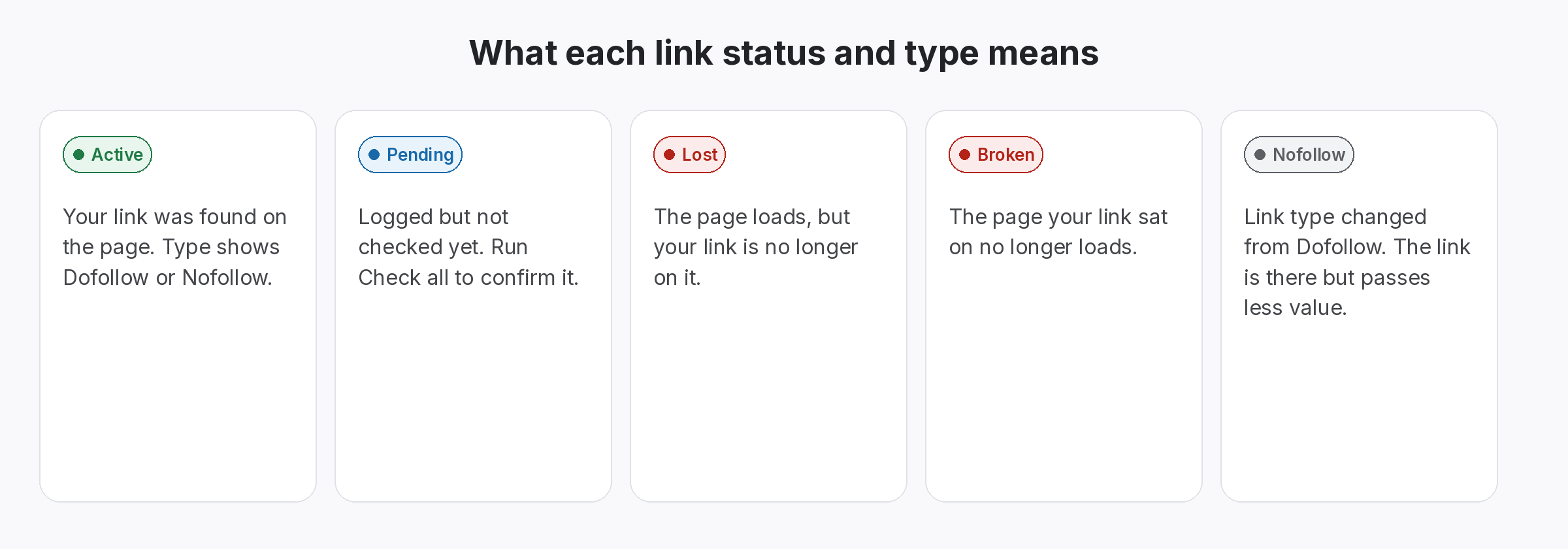
- Active: the link is on the page and the page loads.
- Lost: the page loads, but the link is gone.
- Broken: the page with your link no longer loads.
- Pending: the link is logged but not yet found on the page, usually because the post isn’t live yet.
- Link rot: links disappearing over time as sites change. See link rot prevention.
- Link reclamation: getting back a link that was removed or broken. See the workflow.
- Live link rate: links live today divided by links built. See live link rate.
Shared words make for shorter client calls.
Send a client this page before the first report.
Of course, In our experience, much of the confusion in link reports comes from people using the same word for different things. We wrote this link building glossary so clients, editors and builders start from the same definitions.
How to use this link building glossary
After that, use this link building glossary as a reference, not a course. When a client asks what “nofollow” or “ABC swap” means, send the relevant line. Also, when your team writes reports, use the status terms the same way every time, so “lost” always means the same thing.
For longer explanations, however, the guides linked above go further, because a glossary line can only say so much. For the basics of links themselves, start with what backlinks are and nofollow vs dofollow.
Questions about the link building glossary
Even so, Is there a rel=”dofollow” attribute?
No. A link is followed unless it carries nofollow, sponsored or ugc, or the page has a robots nofollow.
Finally, what is the difference between Lost and Broken?
Lost means the page loads but your link is gone. Also, broken means the page itself no longer loads.
So what is an ABC exchange?
In short, a three-way swap where A links to B, and a third site C links back to A.
Will you add more terms?
Yes. In fact, we add terms as they come up in our guides.
Meanwhile, Can I share this glossary with clients?
Yes. So that’s one of the reasons we wrote it.
Track your links with the same words your reports use.
Instead, SEOENV marks every link Active, Lost, Broken or Pending, and Dofollow or Nofollow.
